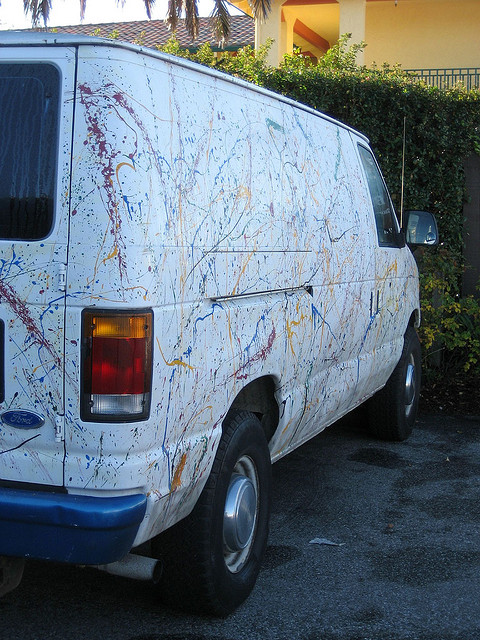
A. These are good times for portable opera. The genre associated with massed choruses, long evenings, and multi-ton sets can also yield a 50-minute show thrown together with a few musicians, some cables, and scenery that will fit in a van.
B. I caught a trio of splatter operas.
C. [Pop-up opera festival] Prototype is the teenage hacker of the opera world, and in its first public action, it’s left a message blinking on Big Opera’s screen: CAN YOU DO THIS?
Can you guess? Give up?
Well, they're statements that are part of a NY Magazine article that, I suppose, is meant to convince me that the "pop-up" opera festival Prototype is a good thing.
Apparently, Prototype should, according to the article's author, quickly evolve into a New York institution.
Armed with a jaunty slogan—“Opera/Theater/Now!”—the producers managed to pull off 29 performances of five premieres in three venues this past week. Audiences materialized too.
Don't get me wrong. That is a truly serious feat ... pulling off five premieres in three different venues. I mean: that's huge. Good for them!
This is nothing against Prototype or its productions. But, I'm just not quite convinced by this NY Magazine article that I need to go and see a small "splatter opera" produced - or "thrown together" - out of the back of a van by a "teenage hacker".
Call me crazy, but that's like saying, "Here, try these oysters! They're super slimy, uber salty and are kind of rubbery and grotesque if you chew them. In fact, it's better if you swallow them whole ... and, do it quickly."
Yeah - not so much on the oysters. And, I still need convincing on Prototype, too.
As you'll remember, I unearthed - and, subsequently discussed - a spectacular little gem from PEOPLE Magazine last week. It was an article from the mid '80s entitled Marilyn Horne: 'The Greatest Singer in the World' Turns a Feisty 50 with a Met Premiere and a Controversial New Book.
Perhaps I'm a little clairvoyant? Maybe it's just a coincidence ... but, Ms. Horne is back in the news this morning. It's local NYC news - but, it's news all the same.
(A side note: As a guy who loves nicknames, I have to try so very hard not to refer to her as Jax. It's so difficult...)
New York's WQXR radio station has announced that Operavore - their Opera-centric blog - will launch a new 30-minute radio show devoted entirely to the world of ... yes, opera.
Airing every Saturday at 12:30pm ET on 105.9 FM and on WQXR.org, the new show extends Operavore’s online offerings, which include the blog, and their stellar all-opera webstream.
Hosted by WQXR’s Naomi Lewin, Operavore aims to keep its finger on the pulse of the opera scene. Whether it be news bulletins from the around the globe, previews of new recordings or interviews with the players and personalities on the scene ... the Operavore radio show will provide it all. Including ...
[Pause for Herald Trumpets...]
Marilyn Horne.
The legendary mezzo-soprano will give an insider’s take on stories and productions, as well as conduct interviews with a cast of folks from outside the operatic world. Initial guests will include playwright Terrence McNally (Master Class and Golden Age); US Supreme Court Justice Ruth Bader Ginsburg; and beloved star of TV and stage, Tyne Daly, who recently performed the role of Maria Callas in McNally’s Master Class.
Weekly commentary will be provided by Our Lady of Operatic Snarky-ness, La Cieca of Parterre.com ... La C. is, of course, the alter ego of opera critic James Jorden. Operavore blogger Fred Plotkin will also provide commentary and insight.
The radio show will launch as a limited-run series and is set to augment WQXR’s weekly broadcasts of live and recorded full-length operas from the world’s most prominent stages.
And, PS...
Dear Operavore,
I am so pleased that you'll be on the radio and cannot wait to hear the new show.
Please know that should you ever find yourself in need of another contributor, I not only have a nice radio voice - I mean: I am an opera singer, after all - but, I also have previous radio experience.
Well, this was bound to happen sooner or later. To be honest, I'm surprised it took this long...
The Opéra de Montréal is set to stage Die Fledermaus (La Chauvre-Souris en francais) on Jan. 26. But, the singer the company calls "the prince of Quebec tenors," Marc Hervieux, is refusing to sing during rehearsals this week.
Hervieux says he is on a "vocal cord strike," because he is upset with the posters the company is using for its advertising campaign. You see, for this season the company features models instead of performers on its posters. In fact, upon his refusal to sing, Hervieux said, "Call this guy on the poster to sing."
"If you don't know a lot about opera, you see this poster of this beautiful girl or this beautiful guy," says Hervieux. "When you buy your ticket, suddenly, where is this beautiful guy?"
McGill University management professor Karl Moore stated the obvious: the ad campaign is aimed at attracting a younger audience to the opera. "It is a bit of a shell game, in that you convince people to get in the door, but once there, the people on stage don't look like these great models," Moore said. "But given the challenges [the company faces,] I think it makes sense."
I've not had a lot of time to read recently. And, by "read" we all know that I mean surfing my favorite blogs and social media outlets.
But a few days ago, I did find one thing of note. A People Magazine article from January of 1984: Marilyn Horne: 'The Greatest Singer in the World' Turns a Feisty 50 with a Met Premiere and a Controversial New Book.
You could have pushed me over with a feather ... no joke. I'm not sure which was more shocking: the fact that an opera singer was in People Magazine, or because of some of the content.
Get this: it turns out that this wasn't the first time Marilyn Horne appeared in People Magazine - she appeared 10 years earlier, also.
Well, I was certainly intrigued. Intrigued enough, in fact, that I have to share some of the 1984 article with you:
Marilyn Horne
By Michael Ryan 'The Greatest Singer in the World' Turns a Feisty 50 with a Met Premiere and a Controversial New Book
The pearl gray Cadillac courses through that flat section of East Texas that divides the culture capital of Austin from the capitalist culture of Houston. The fog is thick enough to julienne with a Cuisinart. The driver is approximating the speed limit closely enough to make a roadside state trooper yawn in boredom. In the front seat Nicola Zaccaria, silver-haired, courtly, in a double-breasted blazer and brass buttons, is drumming his fingers nervously. In the rear Marilyn Horne, black-haired, heavyset, in a long black dress with a Blackglama mink-to-die-for folded neatly at her feet, is unperturbed. At about this time she should be in Houston, 100 miles away, lighting the official city Christmas tree and preparing to give a concert at the Houston opera house. Instead, with the airports closed, she and Zaccaria, the former La Scala basso who is her companion, have hired a car. The concert is just 48 hours away and here is Jackie—as her friends call her—calmly trying to persuade the driver to find an air-conditioner setting somewhere between icebox and steam bath. Although Zaccaria grows increasingly tense as the minutes crawl by, the diva is philosophical. "In this business," she explains, "you get to the point where you can field almost any emergency that's thrown your way—onstage or off."
Fogged in, late, tired and too hot. Such is the life of "the greatest singer in the world," as Italy's respected Rossini Foundation called her in a citation two years ago. People who don't go to the opera know her through television shows such as The Odd Couple, The Tonight Show and last month's Marilyn Horne's Great American Song-book on PBS. Her new autobiography has generated comment — and controversy — in the music world for its candid appraisals of well-known musicians. And with this week's premiere of Rinaldo, three days after she turns 50, Marilyn Horne will do what no other singer has done: bring the work of George Frederick Handel to New York's Metropolitan Opera House.
I know ... you're plotzing, aren't you? So was I.
I mean: I had no idea that Ms. Horne and Nicola Zaccaria were "companions". But wait, there's more:
In some ways the private life of the diva has had as many tragic convolutions as a Rossini opera. The man in her life today is the Greek-born Zaccaria, 60, for whom she fell "head over heels" while they were appearing together in a production of Mignon in Dallas 10 years ago. Zaccaria, famous for recordings with Maria Callas in the '50s and '60s, is now retired. He accompanies Horne on most of her trips; he is never far from her side, photographing her, taping her, worrying about details—and, although his English is really quite passable, talking to her mainly in Italian. "I learned fluent Italian from him," Horne says, smiling. "Now I even dream in Italian." In her book Horne admits that her 18-year-old daughter, Angela, dislikes Zaccaria. Despite that, and despite a melodramatic confrontation three years ago in which Zaccaria's estranged wife trailed Horne to a Venice street corner and implored — unsuccessfully — that the diva give her back her husband, the relationship has endured.
Now, if this article was published in 1984 ... and Horne met Zaccaria 10 years earlier ... that would have been around the same time that Ms Horne and her husband, conductor Henry Lewis split - although they were not legally divorced until 1979. Hmmm... interesting.
Well, they may have split up, but ...
... the figure of another man broods over Horne's life: her ex-husband, the conductor Henry Lewis. When Horne gave her American Song-book concert at Lincoln Center, Zaccaria was in Greece. It was Lewis, 51, and their daughter, Angela, who waited backstage with champagne to toast the diva. They speak of each other with a plangent affection. "She's a very, very important person in my life," he says. "There's a niche for her within my heart." Horne echoes him: "There's a deep friendship and a very deep love that will always be there." Lewis now lives in California, while Horne has apartments in New York and Venice. They still speak frequently; both are intensely devoted to [their daughter] Angela...
We obviously now know that Henry Lewis died in 1996 after battling lung-cancer. If you haven't already, please read my short profile of Henry Lewis.
As for Marilyn, her success is the more remarkable because she has achieved it as a mezzo-soprano. Most mezzo parts are either "trouser roles" — many of which were originally written for castrati — or roles in which the mezzo is an adjunct to a soprano. "To be a mezzo is to be an Avis in a Hertz world," Horne says with a chuckle. But Horne has tried harder, and succeeded, achieving greatness with a voice whose richness and technical perfection are matchless.
As Neocles in Rossini's Siege of Corinth
The good-humored Horne has many close friends in opera: Joan Sutherland, Montserrat Caballé, Leontyne Price and Luciano Pavarotti among them. But, as she makes bluntly clear in her book, she has had run-ins with other legends of the opera. She flays the Berlin Philharmonic's Herbert von Karajan for allowing his booming orchestra to drown her out. "It was a tremendous disillusionment to work with him," she says. "I should have just walked out."
The Boston Opera's Sarah Caldwell fares no better: Horne denounces her as chronically unprepared and reports that Caldwell once arrived at a rehearsal and opened her score with a resounding crack of its spine — a sure sign, says Horne, that Caldwell had never read it. Beverly Sills is thoroughly pounded in the book as well. Horne's dislike of America's other beloved native-born diva began years ago at La Scala, when, Horne claims, she heard from her dresser that Sills and her press agent were removing photographs of Horne from a press packet. "Sometimes you've got to pull out those prima-donna guns, and I did it," Horne says. In the armor-plated costume of her role in The Siege of Corinth, Horne barged into Sills's dressing room, confronted the singer and her press agent, and told the [agent]: "If the New York Times runs a picture and I'm not in it, I'll find you and smack you right in the face, you son of a bitch!"
A more recent photo of Ms. Horne.
I think that last story has to be one of my all-time-favorite opera related stories. Imagine little - but, stout - Marilyn Horne barging in a threatening an agent... marvelous.
Such conduct is unusual for a woman who is normally one of the most cheerful of performers. Her patience is remarkable, given her schedule: a concert or an opera about every three days, 50 weeks a year, in cities across the globe. "Singing is like being a baseball pitcher," she explains. "You can pitch every three or four days, but you've got to rest your arm. I have to take care of this little piece of gristle in my throat. I can sing one or two songs in between, but I can only do a recital or an opera every three or four days."...
... She has brought Stephen Foster to La Scala and Rossini to Tulsa. At her concerts across the world audiences explode with applause, and bravas ring down from the cheap seats to the orchestra. And when that approbation comes, an observer need only see the diva, like Jeanie in the song, radiant in gladness with a day-dawn smile, to know that the blood feuds and the bittersweet love affairs have receded into darkness, and Marilyn Horne, for just that instant, is the happiest woman on earth.
So, now I'm off to purchase Marilyn Horne: The Song Continues, which is the updated (2004) version of her original autobiography from 1984, Marilyn Horne: My Life. Given what's in this article ... I can't wait.