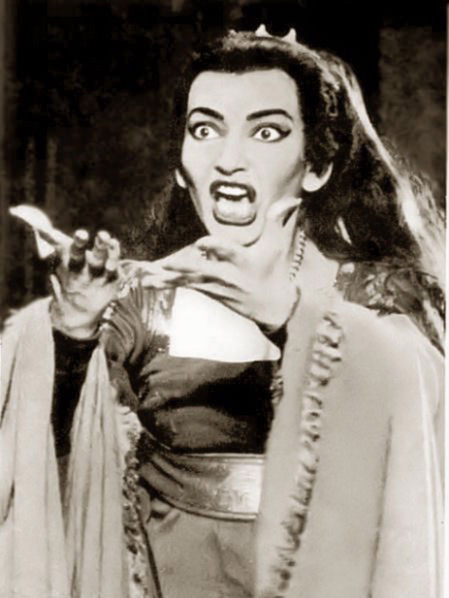
In honor of her 94th birthday, I have to revisit this clip of La Divina — because it’s phenomenal.
So, do you ever think about what someone like Maria Callas did on stage when the wheels started coming off the musical bus? I know I do. Well, if you're a YouTube-geek, like I am (and you know you are), you may have already seen this clip. If so, it's worth another look - for sure. If you've not seen it ... trust me, you'll find much pleasure in this week's Another Favorite Clip.
In this vintage-1958 Callas clip, we see La Divina hauling out another "Casta Diva" from Bellini's Norma. Only this time, when the chorus comes in part way through the first half, they begin singing a little late and while some try to catch up, others dig their feet in. What we're left with is a diva, center stage, flanked by a chorus that is singing out of sync.
La Divina is having NONE of that. As she joins the choir (approx the 1:57 mark), she holds up her hand in order to tell them to cease .... perfection. It doesn't just stop there, though. Shortly thereafter, she cues the choir to come in at the proper spot by tilting her head back slightly. Yes. She. Does.
Just when you think she's done ...
As soon as everyone gets back in sync with each other, she gives a look to stage left - I'm assuming the look is toward the offending party - and gives whomever she's looking at a *serious* up/down.
You think I'm joking? Have a look ... and, enjoy! I know I did.
Remember 10 years ago when Facebook was barely a thing and Twitter wasn't a thing at all. We relied on the "CNN Alert Widget" to get our breaking news, right? If something major happened, it would pop up in the lower part of your computer screen with the alert.
Now, I say "something major" because anymore, a panda at the National Zoo could pass gas and we'd get a breaking news alert. But, I digress...
10 years ago, today, I was sitting at my computer and a "CNN Alert" popped up on the screen:
Famed Tenor Luciano Pavarotti dead at 71.
I literally gasped and said, "Oh my god!"
Now, I can confidently say that I can count on one hand the number of people whom I know who had the same reaction. But, you see, to us in the opera world, Pavarotti was the biggest star in our stratosphere - both figuratively and literally.
I was in high school when Pavarotti teamed up with Jose Carreras and Placido Domingo for the Three Tenors Concert. I remember watching it on PBS with my grandmother - awestruck at the sound. I had heard opera before but, this was accessible, fun and exciting. This was "rock star" opera: I mean, stadiums packed with throngs of cheering fans is pretty much "rock star" status.
As I moved into my own operatic study and career, he was always the sound that we singers listened to. His technique was impeccable - although, many of us were divided on his use of "shadow vowels". Like at the end of "Nessun Dorma" when, instead of singing "All'alba vincerò! Vincerò! Vincerò!", Pavarotti would sing "All'alba vincerò! Vinahcerò! Vin-aah-cerò!". Here... see for yourself. I always dismissed it as one of those funky things we singers adopt from time to time. But, I found out years later in my own study that there was a reason for it.
After years of listening, watching and listening somemore... the voice - the personality - the smile ... all of it gone? Taken by cancer? At a time of his life when other singers have started to teach and pass on their vast knowledge to the next generation? I was in denial and disbelief.
Famed tenor Luciano Pavarotti, who died on Thursday at the age of 71, was one of opera's most adaptable and ebullient performers, appearing on stage with singers as varied as Dame Joan Sutherland, U2's Bono and Liza Minnelli.
Much as the star power of Rudolf Nureyev and Mikhail Baryshnikov revived widespread interest in classical ballet in the 1970s and 1980s, Pavarotti's beaming charisma and bravura style captured the attention of the late-20th-century audience for opera.
Widely considered the greatest tenor of his time, Pavarotti began his life modestly in Modena, the son of Fernando, a baker and amateur singer, and Adele, who worked at the local tobacco factory.
"I dreamed to become a singer when I was four and I hear my father singing in the church with a beautiful tenor voice," he told CNN in a 1991 interview. "And I say to myself, well, let's try to do something."
The young Pavarotti -- who played soccer with his town's junior team -- joined the church choir with his father and traveled with him to Wales, where the singing group won first prize at the Llangollen International singing competition.
Although the experience left Pavarotti enthralled with singing, he graduated from the local teaching institute in 1955 and taught elementary school for two years, then worked as an insurance salesman. He continued his vocal studies, however, working first with with Arrigo Pola and then with Ettore Campogalliani.
Then, in 1961, Pavarotti won the prestigious Concorso Internazionale and made his operatic debut at the Reggio Emilia Theater as Rodolfo in Giacomo Puccini's "La Boheme."
His fame spread throughout Italy and then throughout the European continent as he made his international debut in Giuseppe Verdi's "La Traviata" in Belgrade.
When Dame Joan Sutherland brought him on-stage with her during a performance of Gaetano Donizetti's "Lucia di Lammermoor" with the Greater Miami Opera in 1965, Pavarotti began his American career.
He debuted at New York's Metropolitan Opera House three years later, and eventually marked 379 performances there, including his final opera, Puccini's "Tosca" in 2004, in which he performed as the painter Mario Cavaradossi.
In between Pavarotti sold millions of records and raised millions of dollars for charity through benefit concerts, often sharing the stage with pop stars as well as other opera singers.
Of his recordings, 1990's "The Essential Pavarotti" was the first classical album to reach No. 1 on Britain's pop charts, where it remained for five weeks. 1994's "The Three Tenors in Concert," with Placido Domingo and Jose Carreras, remains the best selling classical album of all time.
Pavarotti joined with Domingo and Carreras in 1990, and although critics complained that Pavarotti's vocal skills were waning, the trio performed together for 14 years.
Among his charities were a 1995 "Concert for Bosnia" that raised $8.5 million and other concerts that raised $3.3 million for refugees from Afghanistan and $1 million for refugees from Kosovo.
In artistic terms, Pavarotti brought to the stage a voice neatly suited to the traditional bel canto, or "beautiful singing" style, essential to 17th-century Italian opera. As much about intensity as pitch, bel canto focuses the voice, concentrating the sound with both outstanding warmth and agility.
So demanding is this work even of the best singers that Pavarotti in concert recital could be seen rising to the balls of his feet during the most challenging passages.
A long, white handkerchief always hung from one hand as he sang, his eyebrows arched high in the effort, forming an expression seemingly of surprise at his own success.
From his small beginnings, Pavarotti rose to great heights, performing in front of 500,000 people in New York's Central Park -- a concert seen by millions on television -- and before another 300,000 at Paris' Eiffel Tower.
When cancer finally stopped Pavarotti from singing, it was only the second interruption of his career.
"I think I just stopped for one year when from a kid I become a man and the voice is changing," he said in 1991.
"I was an alto and became a tenor and that is the only time I think I remember to have stopped singing. Otherwise I have sung all my life."
Although truly known by the masses for the Three Tenors concerts, it is his operatic work that will always remain in the forefront of my mind. Here is Another Favorite Clip of one of the most famous voices of our time.
Continue to rest peacefully, Maestro. And, thank you.
With Halloween upon us, I thought I would share Another Favorite Clip of a spooky, yet spectacular, organ piece that is most decidedly one of my favorites - the Toccata from Léon Boëllmann's Suite Gothique.
Turn up the volume and enjoy. Happy Halloween!
Alright, Ladies and Gents ... it's been a long time since I brought you Another Favorite Clip. 6 months, to be exact. When I was alerted to this clip though, I instantly knew this would be the one to bring the feature back.
I mean, who doesn't love a good Operatic Flash Mob (done right, of course).
Last week, 100 plus people came to a cocktail party here in NYC for the Vital Voices Mentorship Program. Little did they know that they were in for a surprise serenade. Ten singers from Canada, USA and Puerto Rico - under the guise of being New York City socialites - absolutely thrilled the unsuspecting crowd with a little Verdi.
And for such a wonderful cause, too. Vital Voices - which was in the news recently when Hillary Clinton spoke at their Global Partnership 2013 Global Leadership Awards - states that its mission is to identify, invest in and bring visibility to extraordinary women around the world by unleashing their leadership potential to transform lives and accelerate peace and prosperity in their communities.
I encourage you to check out Vital Voices as they are most certainly a force for good.
BUT... not until you see this first. Directed by baritone Jonathan Estabrooks, this is sure to add a little enjoyment to your Monday!
So, I don't know about you ... I seriously needed some inspiration to get me through the end of this Friday.
Here it is ... Another Favorite Clip: Have you ever seen a troupe of Japanese Taiko Drummers who are in the 6th grade? Well, get ready. It's something...
It's been a while since I've share Another Favorite Clip with you, friends. So, when I came across this gem on Twitter this morning I simply had to share.
In 2009 - during the twilight of her singing career - mezzo-soprano Frederica Von Stade sat down with Emmy-winning interviewer Ernie Manouse for a candid conversation about her career - from it's beginning to the challenge of continuing to perform at an elite level after more than three decades on the stage.
Yesterday, Apple released it's latest iPhone 4S TV ad featuring director Martin Scorsese. Mr. Scorsese’s ad is the fourth in a series of shorts which feature Siri being used by the celebrities in ways that match the celebrities public personas. The previous ads feature Zooey Deschanel, Samuel L. Jackson and John Malkovich.
You've have seen the iPhone ad with John Malkovich chatting-it-up with Siri, right?
Released in May, the ads, titled "Life" and "Joke", begin with Malkovich sitting in his comfy chair and listening to Puccini's Madama Butterfly. He begins challenging Siri with a variety of tasks, such as checking the weather and his calendar. Malkovich also asks his iPhone for a joke - at which point Siri replies: "Two iPhones walk into a bar ... I forget the rest."
[Inserting pause for laughter here]
But, who is the soprano singing Butterfly's aria "Un bel di" for these John Malkovich iPhone ads? In all of the press coverage I've seen surrounding the ads - and there was plenty - no one asked the question.
So, here I am ... asking the question. Who is that soprano? Any guesses?
Yours Truly has the scoop. But first, watch the ads...
I only had to get through the opening "Un bel di vedremo..." to tell you that it's a soprano voice which I am very accustomed to hearing. The recording from which it comes is actually a unique recording that exists in a world all on it's own.
As many of us opera-geeks know, Puccini's Madama Butterfly is not an opera that was shaped into a perfect final revision. Instead, it's one that exists in several versions, none of which are definitive.
After its disastrous 1904 premiere in Milan, Puccini hastily revised the Madama Butterfly score, heavily cutting Act 1, dividing Act 2 into two parts and providing the tenor with a brief aria in the final scene. The result, in Brescia less than four months later, was triumphant to say the least, but the process of revision was not over.
For the first Paris production, in 1906, many more edits were made. In fact, it is this 1906 version of the score that is normally performed nowadays. BUT Chiclets, there is evidence that even as late as 1920, Puccini was making yet further adjustments, including the restoration of some of the previous cuts.
In the early and mid 1990s, there were several revivals of Puccini's original version. But alas, controversy still erupted due to a climate of political correctness. You see, in the original 1904 version, Pinkerton is pretty disrespectful of the Japanese — though less so than in the first draft of the libretto. And additionally, Cio-Cio San (Butterfly) was a more developed and three-dimensional character ... much less of a victim than we see in the later versions.
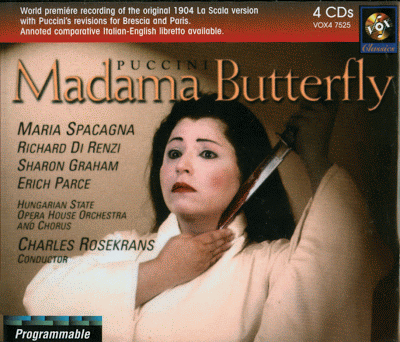
There is but one single recording of Madama Butterfly - ONLY ONE - that includes every version of Puccini's masterpiece. And it is from that one-recording that Apple chose to pull it's "Un bel di". The soprano singing Cio-Cio San on that recording - and on Apple's iPhone TV ad featuring John Malkovich - is ... Maria Spacagna.
Full disclosure: Maria Spacagna has been my voice teacher and mentor for many years ... no wonder I am accustomed to that voice, right?
Maria Spacagna truly forged her career singing the role of Cio-Cio San ... even becoming the first American-born singer to perform the role at La Scala, Milan ... thanks to a certain Maestro Lorin Maazel. This trailblazing moment was so monumental that it garnered Ms. Spacagna a place in La Scala's Encyclopedia of the Opera.
Under the baton of conductors such as Julius Rudel, James Levine, Edoardo Müller, Riccardo Chailly, Nello Santi, Placido Domingo and Marco Armiliato, Maria Spacagna has sung in nearly every major opera house in the world ... La Fenice in Venice, Arena di Verona, Festival Pucciniana in Torre del Lago, Deutsche Oper Berlin, New York City Opera, Dallas Opera, San Francisco Opera, Opera Theater of Montreal, and Canadian Opera in Toronto - just to name a few.
After establishing a reputation as a remarkably skilled soprano and consummate actress, it was time for Maria Spacagna to make her debut at the Metropolitan Opera. That debut came in the title role in Verdi’s Luisa Miller. Her tenor that night was some guy named Luciano Pavarotti [wink wink].
Soon thereafter, Ms. Spacagna was tapped by another tenor. This time, at Placido Domingo's request, Ms. Spacagna was invited to sing at a White House State Dinner at which President Bill Clinton and First Lady Hillary Rodham Clinton honored the Prime Minister of Italy.
A native of Rhode Island, Ms. Spacagna has been honored with the Rhode Island Pell Award for Excellence in the Arts, was the first recipient of the Distinguished Artist Award presented by the Rhode Island Civic Chorale and Orchestra and is a member of the Rhode Island Heritage Hall of Fame. She also recently received an award from the Italian Consulate General in Boston for Outstanding Achievement in Art, Culture and Entertainment.
Before her stellar operatic career, Maria Spacagna did what many singers don't these days ... she cultivated her voice and educated herself. After receiving Bachelor of Music and Master of Music in Voice degrees from the New England Conservatory of Music - where she was a student of Gladys Childs Miller - Ms. Spacagna furthered her studies as a member of the Juilliard Opera program in New York.
Inevitably, the combination of her education and her experience as an accomplished performer would make Ms. Spacagna an often-sought-after voice teacher. Ms. Spacagna maintains private voice studios in New York City, Boston and Providence, RI. She was also a member of the Boston University voice faculty, recently vacating her post to begin a new chapter this fall as Associate Professor of Voice at Carnegie Mellon's School of Music.
Above and beyond all of that, Maria Spacagna's voice is now the stunning soprano which sets the scene for John Malkovich and Siri - being forever woven into the fabric of our popular culture. And, she's in great company as she joins Maria Callas ... another soprano who lent herself to an Apple ad campaign.
This is a wonderful performance of Verdi's Requiem conducted by Claudio Abbado featuring a 36 year old Marilyn Horne, Renata Scotto, Luciano Pavarotti and Nicolai Ghiaurov. Brilliant singing for sure. Can we discuss for a moment the use of the open vowels? Get it, girl.
When you're done with Jackie, pop down and hear Renata Scotto sing one helluvah "Libera me". Trust me: you wont be disappointed.
So, Chickpeas ... do you ever think about what someone like Maria Callas did on stage when the wheels started coming off the musical bus? I know I do. Well, if you're a YouTube-geek, like I am (and you know you are), you may have already seen this clip. If so, it's worth another look - for sure. If you've not seen it ... trust me, you'll find much pleasure in this week's Another Favorite Clip.
In this vintage-1958 Callas clip, we see La Divina hauling out another "Casta Diva" from Bellini's Norma. Only this time, when the chorus comes in part way through the first half, they begin singing a little late and while some try to catch up, others dig their feet in. What we're left with is a diva, center stage, flanked by a chorus that is singing out of sync.
La Divina is having NONE of that. As she joins the choir (approx the 3:00 mark), she holds up her hand in order to tell them to cease .... perfection. It doesn't just stop there, though. Shortly thereafter, she cues the choir to come in at the proper spot by tilting her head back slightly. Yes. She. Does.
Just when you think she's done ...
As soon as everyone gets back in sync with each other, she gives a look to stage left - I'm assuming the look is toward the offending party - and gives whomever she's looking at a *serious* up/down.
You think I'm joking? Have a look ... and, enjoy! I know I did.
It's been a crazy week for Yours Truly and although I have had much to say, I haven't had the time to put it in writing. Alas, that is the way the cookie crumbles from time to time.
To end this week, I needed something that made me smile ... something to make this Friday an even *happier* Friday. So, here it is: Ms. Marilyn Horne singing Rosina at the Festival di Macerata in 1980. Please note, not only is her ornamentation mind-bending but, also note the length of the applause at the end of her aria... see how she acknowledges it?
This weekend being Easter weekend, I thought I would bring you a little story of redemption courtesy of Puccini's Suor Angelica.
The opera opens with scenes showing typical aspects of life in the convent — all the sisters sing hymns, the Monitor scolds two lay-sisters, everyone gathers for recreation in the courtyard. The sisters rejoice because, as the Mistress of Novices explains, this is the first of three evenings that occur each year when the setting sun strikes the fountain to turn its water golden. This event causes the sisters to remember a sister who has died, Bianca Rosa. Sister Genevieve suggests they pour some of the golden water onto her tomb.
The nuns then discuss their desires — while the Monitor believes that any desire at all is wrong, Sister Genevieve confesses that she wishes to see lambs again because she used to be a shepherdess when she was a girl, and Sister Dolcina wishes for something good to eat. Sister Angelica claims to have no desires, but as soon as she says so, the nuns begin gossiping — Sister Angelica has lied, because her true desire is to hear from her wealthy, noble family, whom she has not heard from in seven years. The rumors have it that she was sent to the convent in punishment.
The conversation is interrupted by the Infirmary Sister, who begs Sister Angelica to make a herbal remedy — Sister Angelica's specialty. Two tourières then arrive, bringing supplies to the convent, as well as news that a grand coach is waiting outside the convent. Sister Angelica immediately becomes nervous and upset, thinking rightly that someone in her family has come to visit her. The Abbess chastises Sister Angelica for her inappropriate excitement and then goes on to announce the visitor, the Princess, Sister Angelica's aunt.
The Princess explains that Angelica's sister is to be married and that Angelica must sign a document renouncing her claim to her inheritance. Angelica replies that she has repented for her sin, but there is one thing she cannot offer in sacrifice to the Virgin — she cannot forget the memory of her illegitimate son who was taken from her seven years ago. The Princess refuses to speak, but finally informs Sister Angelica that her son died of fever two years ago. Sister Angelica, devastated, signs the document and collapses in tears. The Princess leaves.
In the clip that follows, Sister Angelica (sung here by soprano Barbara Frittoli) laments the death of her son in one of the most gut wrenching arias in all of opera: "Senza Mamma" (Without Mamma).
Sister Angelica is seized by a heavenly vision — she believes she hears her son calling for her to meet him in paradise. She makes herself a poison and drinks it, but realizes that in committing suicide, she has committed a mortal sin and has damned herself to eternal separation from her son. She begs the Virgin Mary for mercy and, as she dies, she sees a miracle: her son appears to embrace her. [Source]
Break out the Kleenex ... here now, is the finale of Puccini's Suor Angelica.
Ernst von Schuch, who had previously conducted the premieres of Strauss's Feuersnot, Salome and Elektra conducted the performance. By many accounts, that evening's Rosenkavalier was said to have been the pinnacle of soprano Margarethe Siems career. It is of note that Ms. Siems, who sang this first Marschallin, was also Strauss’ first Chrysothemis in Elektra.
Anyhoo-anyhow ... after a stellar opening, which was praised by critics and the public alike, Rosenkavalier went on to become one of Strauss' most popular works during his lifetime and remains a part of the standard rep of many opera houses today.
In order to mark today's occasion, I thought I would bring you Another Favorite Clip. Well, ok ... considering that I couldn't land on one fave, I am bringing you two. One features stars of recent times past - Dame Kiri Te Kanawa as the Marschallin, Tatiana Troyanos as Octavian and Judith Blegen as Sophie- singing the Final Trio at the Met in 1982. And the other features two current stars - Joyce DiDonato as Octavian and Diana Damrau as Sophie - singing the "Presentation of the Rose" for the 2007 Richard Tucker Gala.
Now, a word about Octavian. For those not acquainted with this type of thing (no judgment, I promise), Octavian is a young man and thus, is played by a mezzo soprano. It's not meant to confuse you, I promise. Indeed, a "pants role" is any male character that is sung by a female singer. Most often the character is an adolescent or a very young man, sung by a mezzo soprano, contralto and on occasion, a male countertenor.
I hope you enjoy these clips - they are simply fantastic!
[Photo above is a painting by Robert Sterl - 1912]
This will not come as a shock to many of you. I have a love for big voices that borders on the extreme. Don't get me wrong, I like a smaller voice that can move with laser beam precision, too. However, it is pretty safe to say that like my taste in cars, if given the choice I'd most likely chose a voice that was built for comfort over a voice that was built for speed. Yes, there are a few exceptions ... but, we'll get into that another time.
If it were up to me to name a Patron Saint of Big Voices, it would definitely be Bulgarian soprano Ghena Dimitrova (may she rest in peace). Let's be perfectly honest with one another ... the voice was gigantic!
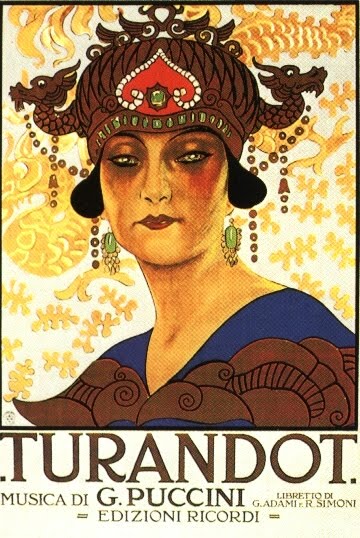
ANYWAY, a colleague of mine mentioned in her Facebook status today that she spent the morning discussing Puccini's last opera Turandot ... thus infecting those around her with her love for Puccini. Well, she certainly got my mind fixed on it.
Over to YouTube I went and re-discovered this utterly fantastic clip of Ms. Ghena singing Princess Turandot's tour-de-force "In questa reggia" at Arena di Verona (Oh yea, Nicola Martinucci is singing Calaf somewhere in there).
You've undoubtedly seen it here before. But, it certainly deserves another viewing - I, for one, just can't get enough. So here it is, this week's installment of Another Favorite Clip. For those who would like a translation of the aria, make sure to check out the Aria Database.
Last Saturday, the Opera Company of Philadelphia kicked off National Opera Week on a huge scale. Partnering with Macy's and the John S. & James L. Knight Foundation, the Opera Company of Philadelphia Chorus combined with other area choirs to produce one of the Knight Foundation's "Random Acts of Culture".
That's right, Chiclets. 650 singers from the area, accompanied by the famed Wanamaker Organ - the world's largest pipe organ - surprised shoppers at the Center City Philadelphia Macy's with a spontaneous rendition of the Hallelujah Chorus from Handel's Messiah.
This is true amazingness. So, without further word from Yours Truly, I give you the next installment of Another Favorite Clip. Enjoy!
[On a side note: Lest you think I don't know my Handel from my Verdi, I must tell you that the opening music on the clip is not from Handel's Messiah but is actually from Verdi's Aida.]
Everyone loves a good Mad Scene, no? Come on ... you know you love it when a singer runs around the stage having a melt down like Sally Field in the funeral scene of Steel Magnolias.
Keeping in that motif, this installment of Another Favorite Clip is dedicated to the art of the Mad Scene - AH! Quel furore!
I was zipping around YouTube today and ran across a wonderful clip. In it, soprano Anna Tomowa-Sintow [R.] and tenor Luciano Pavarotti sing "Teco io sto" from Verdi's Un Ballo in Maschera at Grand Théâtre de Genève. Their conductor is Riccardo Chailly.
Although Pavarotti seems to be struggling a bit physically - the voice is as glorious as ever. Tomowa-Sintow, although not known for her ability to consistently produce a stunning pianissimo sound, is a dream in this duet... she certainly gives an amazing example of what it means when a singer "rides the breath". Especially around the 6:00 mark when, during one of Verdi's more treacherous phrases, she just hooks into her breath support and rides it all the way to the end.
Speaking of the end - when you get to it, you'll notice something that has always made me laugh about Pavarotti.
Sometimes when you're singing a duet and you get to the climax (for lack of a better term), it's not always easy to hear when the other person is getting ready to cut off. So, traditionally there is usually a sign that one singer gives to the other as a subtle hint that it's time to cut off. Dearest Pavy Paverson would generally grab his leading ladies to communicate his need to end. Unfortunately, in this instance, it looks like he's getting ready to shake poor Anna. Wait for it...
Enjoy "Teco io sto" from Verdi's Un ballo in maschera!
In honor of the passing of Cesare Siepi, I thought I would make this fab clip the latest installment of Another Favorite Clip.
Now Friends, I have to tell you that this is one of my favorite arias to sing... period. Fully stop. There's nothing like a good Verdi to wrap your voice around.
Without further pontification from Yours Truly - enjoy Ella giammai m'amo from Verdi's Don Carlo.