Thursday, December 31, 2009

The potential of 2010

We spend January 1 walking through our lives, room by room, drawing up a list of work to be done, cracks to be patched. Maybe this year, to balance the list, we ought to walk through the rooms of our lives... not looking for flaws, but for potential. ~Ellen Goodman
Here's to a new year and another chance for us to get it right.

Cheers to you all! Happy New Year from A Liberal's Libretto!

Wednesday, December 30, 2009

Questioning the wrong Maestro

In an article titled Leave James Levine aloooooone (yes, I counted the 'o's), Paul Wells discusses the current backlash against an ailing James Levine.

Discussing a Jeremy Eichler Boston Globe article as "a cranky year-ender", Wells points out that Eichler's theme is that Levine’s “larger artistic vision” is lacking. In addition it seems that Eichler wrote a similarly lamenting piece a while back, when 28-year-old Gustavo Dudamel started in Los Angeles and 42-year-old Alan Gilbert in New York. Anthony Tommasini joined the chorus in the New York Times saying there was “an artistic quandary” in Levine’s leadership.

I think Mr. Wells hits the nail on the head in this article, which is linked in it's entirety below. Towards it's end, Wells creates a very interesting hypothesis:
I think the real problem, which isn’t really a problem, is that two cute young guys have arrived in Los Angeles and New York to announce their visions, while Levine has been implementing a coherent and ambitious vision for eight years, and the local critic is a bit bored with it all. And to make matters worse, the new conductor in Los Angeles looks like this:


while the old conductor in Boston looks like this:

In the opinion of Yours Truly, comparing Levine and Dudamel is certainly like comparing a Cadillac and a Porsche. One is built for comfort and one is built for speed. One is built for long, level rides while the other is built for boisterously dashing about.

Let me be clear; I am not in any way denouncing Dudamel's genius. His conducting and manner with an orchestra is certainly beyond compare. But, let's not forget that Levine made his debut conducting at the MET some 10 years before Dudamel was even born. Levine, too, was 28 years old.

This debut led Speight Jenkins to write in the Dallas Texas Times Herald:
The most exciting dividends came from Levine, who conducted the Dallas Symphony this season. His baton technique is clear; his rhythms radiate flexibility; and he brought to Tosca a dramatic tautness frequently missing in the Met's pit. Brass often came to the fore to emphasize Scarpia's cruelty; many of the score's instrumental details received a new focus. Levine should have a great career ahead of him; the Cincinnati-born maestro at only 28 had obviously won the respect of the choosy and temperamental Met orchestra.
I ask you friends, why are we even questioning Levine when we should clearly be questioning the rising young-uns like Dudamel?

To me, the question is not whether or not Levine's "artistic vision" is lacking or whether or not there is “an artistic quandary” in Levine’s leadership.

Indeed, the question should be: does Dudamel have what it takes? Does Dudamel have the kind of potential for achievement and maturation that Levine has proven to possess over the last 38 plus years?

It remains to be seen.


Links:

Leave James Levine aloooooone by Paul Wells of MACLEANS.

Jeremy Eichler's Boston Globe "a cranky year-ender".

Anthony Tommasini piece including the “an artistic quandary” in Levine’s leadership is here.

The Speight Jenkins, Dallas Texas Times Herald quote comes courtesy of the MET Opera Archives.

Tuesday, December 29, 2009

Dolora Zajick knows big voices ... and isn't afraid to train them.

Those of you who follow me on Twitter were privy to this little anecdote from & about Yours Truly. Upon leaving the Christmas Eve Service at St. John's in Brooklyn, I tweeted:


We bigger voices tend to hear this quite often. And, if not this specifically, we hear that we are singing too loudly, that we are ruining our voices, or that we are unrefined.

A few years ago, I was singing with a small opera company which shall remain nameless to protect the innocent. While in rehearsals, the cast members were given the opportunity to audition for the larger company in town. I'd like to point out that I use the word "audition" rather loosely considering the person for whom we sang had absolutely no baring on who they hired as janitors, much less on casting decisions.

But, we showed up and sang anyway.

I sang two arias and felt that they both went very well. At the end of my second aria, the auditioner said to me, "I'm not sure who you're studying voice with, but you either need to change teachers or reassess the way you sing. If you keep singing like that, you wont be singing past your 30th birthday."

Let the record show that this year marks the 4th anniversary of my 30th birthday ... and I'm still singing.

I think we would all be shocked at how many larger voices are either dismissed or crammed into a smaller box. Most of the time the reason is because people don't know what to do with a larger voice because larger voices take longer to develop and are more difficult to refine and cultivate.

Mezzo soprano Dolora Zajick knows this first hand. In a recent article written by Brian Manternach for Classical Singer Magazine, Ms. Zajick says:
“I was lucky in that I had a teacher that understood what my voice was from the very beginning,” Zajick says. “I was in pretty good technical shape when I arrived to New York. But it wasn’t refined yet. There were a lot of people at the school that did not understand me and there were a handful that did. I ran into a lot of flack for the size of my voice,” she continues, “but because of that handful of people that understood, I stuck to my guns. I was told a thousand times that I was ruining my voice, but my voice teacher said I wasn’t, so I believed her.”
Ms. Zajick has taken that experience and built on it - not only creating an international operatic career, but also forming The Institute For Young Dramatic Voices, which began 3 years ago. The Institute's website says in part:
There is a severe shortage of large, dramatic voices in the opera world today, especially for the great roles of the Verdi, Strauss and Wagner repertoire. A dramatic voice is one large enough to be heard over these composers’ heavy orchestration. Lighter, lyric voices are often pushed into these dramatic voice parts to fill this void - often shortening their careers as a result. The Institute for Young Dramatic Voices aims to remedy this situation by finding, nurturing and inspiring the next generation of Wagner, Strauss and Verdi singers, so that these unique talents may reach the world’s great opera stages.
As General Director, in addition to being a member of the voice faculty, Ms. Zajick has assembled quite a list of faculty members including Kathleen Kelly, Joel Revzen, and Peak Performance Coach - Dr. Jon Skidmore, Psy.D.

The Institute for Young Dramatic Voices, which takes place during the summer in Orem, Utah, has four program levels: Discovery Level - Ages 15-20, Introductory Level - Ages 15-22, Intermediate Level - Ages 23-29 and Advanced Level Ages - 27-34. If you don't fit into these age groups, there are several possibilities available to audit the program. Auditors are allowed to observe classes and lessons each day, including the daily warm-up with Ms. Zajick.

Again from the Classical Singer article:
Zajick acknowledges that while the Institute is certainly not for every singer wishing to pursue an operatic career, she is thankful for the good fortune in her own life of having teachers who understood how to guide her voice as it developed. “But,” she says, “I saw a lot of colleagues that weren’t that lucky. When I was older, I could tell the difference—but when I was these kids’ age, there’s no way I would have been able to tell the difference. So, I’m here to guide them. That’s the purpose. And I firmly believe that if you give me 10 years—and that’s seven years more from this point—I can increase the number of Wagnerian and Verdi singers. I know that’s a little bravado, but I think I can do it—if I live long enough!” she laughs.
We wish the Institute all the best and can't wait to hear some of it's alums in the near future.


Links:

For more information on The Institute For Young Dramatic Voices, please check out their website.

For more on the Institute's faculty, including bios and links, visit their faculty page.

To read Brian Manternach's article in Classical Singer Magazine: Handled with Care: Dolora Zajick and The Institute for Young Dramatic Voices, click here.

[Photo - Dolora Zajick by John-Francis Bourke]

Monday, December 28, 2009

Top Classical Artists of 2009

I trust this finds all of you recovering nicely after the Christmas Holiday...

Now, moving right along - it's time for a New Year: 2010. Can you believe it, 2010?

Before we cross over into the next decade though, we have to continue to take a look back at the year that has almost passed.

I know many of you are wondering: who will Billboard deem as the Top Classical Artists of 2009?

Alright, fine - let's just call a spade a spade - did any of you even truly know that this list existed, much less was published?

Exactly. I thought not.

Well, here it is - Billboard's Top Classical Artists of 2009:
25. Sharon Isbin
24. Anne-Sophie Mutter
23. Renée Fleming
22. Lang Lang
21. Escala
20. Neal E. Boyd
19. Academy of Saint Martin in the Fields
18. Mack Wilberg
17. Andre Rieu
16. The Cistercian Monks of Stift Heiligenkreuz
15. Josh Groban
14. Placido Domingo
13. Joshua Bell
12. The Baby Einstein Music Box Orchestra
11. Orchestra at Temple Square
10. Mormon Tabernacle Choir
09. David Garrett
08. Paul Potts
07. Luciano Pavarotti
06. The Priests
05. Sarah Brightman
04. Sting
03. Yo-Yo Ma
02. Andrea Bocelli
And now, Billboard's #1 Classical Artist of 2009:
01. IL DIVO
I'm sure it's an honor to make the list - yaddah, yaddah. My hope is that Placido Domingo, Josh Groban and Renée Fleming don't mind that they came in behind the likes of The Baby Einstein Music Box Orchestra and Sarah Brightman.

Really? The Baby Einstein Music Box Orchestra is considered a Classical Artist by Billboard? Come on folks... seriously?

And... Sarah Brightman? She's still producing "music"? More importantly - who in the hell is buying the drivel? Yick.

Congrats to Il Divo - keep crankin' out the hits, boys.

[Photo - Il Divo courtesy of Sony BMG Entertainment.]

Thursday, December 24, 2009

Have Yourself a Merry Little Christmas!

We here at A Liberal's Libretto would like to wish you and yours a very Merry Christmas.

May all your wishes come true, your dreams be fulfilled and may Peace come to all.

Tuesday, December 22, 2009

Tosca, Zeffirelli and Weenies- oh MY!

Last night, I had the ... uhm ... pleasure of watching the MET's controversial new Tosca, which was directed by Luc Bondy. I had DVR'd it because I knew that I would have to get up the courage to watch it, very much in the same way that someone summons the courage to battle.

You see, Tosca is one of those shows that has a special place in my heart. Not only do I love the show, but when I sang Scarpia, it was the last production in which I had the opportunity to work with Francesco Pace. My Tosca, Kathleen Halm, was beyond compare dramatically and vocally, and the production - although very small scale - was really quite a joy.

Watching my reactions as I viewed the MET's Tosca, you would have thought I was watching my favorite team lose the Superbowl - complete with the talking out loud to the television. I'm not going to lie to you, Friends. I don't have a favorite team and I don't watch football. But, how-in-the-hell else was I to get my point across?

I digress.

The choices that Bondy made in his direction, although fresh and new, were not ideal in the minds of purists as his directives had little to do with the music and libretto. Some may like the production and his choices - that is perfectly fine - but for me, not so much.

Now, enter a NY Times article from yesterday - The Metropolitan Opera Weighs the Return of Zeffirelli’s Tosca.

It seems that in order to make space for Wagner’s “Ring” cycle next season, the MET has been kicking around the idea of bringing back the Zeffirelli version of Tosca because it takes up less space backstage.

The article says in part:
The scheduling involves backstage space for the Met’s new production of Wagner’s “Ring” cycle that is being created by Robert Lepage, the Canadian director. The “Ring” set, because of its complexity, must remain fixed on one of the Met’s two lateral stage wagons — rolling platforms that are stored in the wings — for long periods. The Bondy Tosca set uses both lateral wagons, while the Zeffirelli production uses only one lateral wagon and the stage’s rear wagon.

When asked why, then, the Met did not schedule an opera with a more compatible set, Mr. Gelb said it made sense to bring back
Tosca because of the investment in rehearsal time. He acknowledged that the plan had been to retire the Zeffirelli Tosca but added that he had publicly stated that it would not be destroyed.
Operatic staples like Tosca are important sources of income for many opera houses - the MET is no different. As the NY Times points out, the opera sold out this fall, and Mr. Gelb said that advance sales for the remaining performances this season were "strong".

I say, whatever the reason, bring back the Zeffirelli version. Please?!

This whole Bondy Tosca fracas flared up (again) this last week as many PBS stations aired the telecast of the Bondy Tosca, hence my DVR'd copy. Reviewing it in The San Francisco Chronicle, Joshua Kosman came to the defense of Mr. Bondy’s direction, but did say there were “some directorial bad decisions.”

According to the NY Times, Mr. Kosman went on to say:
“But so what?” he continued. “None of these are extensive or integral to the production. When they are corrected, what’s left will be a bare-knuckled exploration of political and sexual power, unimpeded by fussiness or luxury.” He called New Yorkers angered by the production “a big bunch of weenies.”
Well, if wanting to see a production that is actually based on the music, libretto and composer's directives written in the score makes me a weenie - then, call me a Ball Park Frank and pass the mustard.

Seriously though... the more this hooplah around Tosca continues, the better it is for all involved. Gelb, Bondy, Zeffirelli, the MET - all of them. You can't buy this kind of publicity.

[Photos - Both from ACT I of Tosca. Top: Luc Bondy's by Andrea Mohin for The New York Times. Bottom: Franco Zeffirelli's by Ruby Washington for The New York Times.]

Check yourself before you wreck yourself...

Sharon Daniels, the head of Boston University's Opera Institute, is one of the most prominent voice instructors and stage directors in Boston. In addition to running one of the most prestigious opera programs in the country, her stagings of operas such as The Marriage of Figaro have received great reviews.

Well, as it has been said, it's lonely at the top and once you're up there, people start taking notice - of everything.

Being reviewed by the faculty as part of contract renewal protocol, it appears that Ms. Daniels' biography has been embellished a tad bit. It wasn't just that it was her bio, but it was her online bio available for the world to see on the Boston University's website.

Ms Daniels' bio stated that she performed in starring roles with several "A" houses in Europe and San Francisco however, a Boston Globe review found that four institutions have either no record of her or cast her in minor parts. In one case, in which she is listed as principal soprano, she was actually the fifth of six flower maidens in a 1974 production of Wagner’s Parsifal.

Both Boston University officials and Daniels herself conceded yesterday that they were made aware of the discrepancies in her official biography as far back as January, but the university was not quick to correct them. After the Boston Globe raised questions on Wednesday, the biography was immediately changed. But, according to the Globe, it was not completely corrected.

Tracy Jan of the Boston Globe writes in part:
Confronted with the embellishments, Daniels explained in an interview yesterday that a BU staff member had condensed her curriculum vitae for the online biography and that she and BU officials did not become aware of any errors until a colleague on a faculty review committee raised concerns about the biography when her contract was up for renewal last school year. She said she was led to believe that the director of BU’s School of Music would correct it.

“When my bio was condensed from my vitae, there were just some things that got smushed together and became misleading, Daniels said. “I honestly don’t go online and read my bio all the time. I did not ever intentionally puff up my work."

Administrative staff typically extract professors’ online bios from their CVs and ask the individuals to validate what is ultimately posted on the website, Meissner said. Faculty are supposed to review and update their bios every year, but Daniels’s had not been changed for about four years, he said.

“There is some negligence here,’’ Meissner said. “Some faculty are rather sloppy about reviewing their bios online. It’s really the university bragging about who their faculty are.’’

Daniels, a former elementary school teacher, runs a voice studio where she has produced award winning singers; she counts BU’s provost, David Campbell, among her pupils.
Ladies and Gents... check those resumes, bios and CVs. You never know who is going to fact check those little gems.

For more on Bio-gate including more specifics on further embellishments, check out the Boston Globe website.

Monday, December 21, 2009

Happy Birthday to Erwin Schrott.

Bass Baritone Erwin Schrott (a.k.a. Mr. Anna Netrebko) turns 37 years old today... or 34, depending on whom you believe.

So, who is this Erwin Schrott?

I came across him 4 years ago when I was studying for a Dulcamara in L'Elisir D'Amore. I found his Dulcamara with the Macerata Opera Festival to be fun in a very quirky kind of way. It was nice to see a young and blithe Dulcamara instead of the usual older, buffo type.

Since that 2002 whimsical L'Elisir he has transformed his image from goofy baritone to ... well ... read for yourself:
With his onstage charisma and matinee-idol looks, it’s no surprise that the European press has dubbed Erwin Schrott “the Brando of opera.” Since winning Plácido Domingo’s Operalia competition in 1998, the Uruguayan bass baritone has established himself as one of the premier interpreters of Mozart’s operas in roles ranging from Figaro to the Count, Don Alfonso to Don Giovanni.
The transformation has worked rather well for him.
In particular, his compelling portrayals of Don Giovanni and Leporello in Don Giovanni and in the title role of Le nozze di Figaro, together with his dark, chocolaty, sensuous bass-baritone voice, have created a frenzy amongst critics and audience alike. He has now appeared at the world's most prestigious opera houses including the Teatro alla Scala, Milan; Metropolitan Opera; Vienna State Opera; Royal Opera, Covent Garden; Opéra National de Paris; Washington Opera; Teatro Colón, Buenos Aires; Théâtre Royale de la Monnaie, Brussels; Teatro Comunale, Florence; Los Angeles and many others.
Happy Birthday, Mr. Schrott. Whether you're 34 or 37 - doesn't truly matter - we wish you continued success.

[Quotes provided by the Met Opera website and by Mr. Schrott's online biography. Photos - Top: Mr. and Mrs. Schrott at the CulturArte de Puerto Rico festival. Bottom: for DECCA by Uli Weber.]

Friday, December 18, 2009

DVR Alert! La Diva Renee, Martha Stewart & Snoop Dogg - on the same show.

Now... THIS, I gotta see.
Satisfy your sweet tooth with an hour full of can't-miss Christmas cookie recipes! Bake brownies topped with festive green sprinkles with rapper Snoop Dogg, learn a creative icing technique for decorating snow globe cookies from in-house stylist Dani Fiori, and prepare scrumptious spritz sugar cookies with soprano Renee Fleming.
For more information go to The Martha Stewart Show website.

Monday, December 14, 2009

Two dames ... one night only

Some breaking news from BroadwayWorld.com:
Tony Award winner Kristin Chenoweth will join mezzo-soprano Marilyn Horne for the upcoming DAMES AT "C" concert at Carnegie Hall. The concert series will take place January 22nd at 7:30pm. DAMES AT "C" is part of the Marilyn Horne Foundation's THE SONG CONTINUES... series taking place at Carnegie Hall January 19th through January 22nd.

The full cast for the concert will include Keri Alkema, Elaine Alvarez, Amanda Majeski, Jennifer Zetlan, Michael Baitzer, Warren Jones, Tamara Sanikidze, and David Shimoni.
I have no doubt that these two ladies will be a hoot together on stage. I can't wait!

Tickets for DAMES AT "C" range in price from $37 to $45 and can be purchased through the Carnegie Hall website.


Links:

For more information on THE SONG CONTINUES... visit the Marilyn Horne Foundation website.

For more information on Kristen Chenoweth, visit her website.

For more Broadway news, visit BroadwayWorld.com.

Obama meets Kennedy Center Honorees

Some months back, we reported here that Ms. Grace Bumbry was to be among those being recognized at this year's Kennedy Center Honors.

Ms. Bumbry is part of that generation of singers that helped break down barriers placed against African Americans. As you probably read in my previous post, she was cast by Wieland Wagner (Richard Wagner's grandson) as Venus at the Bayreuth Festival in 1961, at age 24 - the first black singer to appear there. Conservative Germans were appalled, and the ensuing media attention shot her to international fame. She was subsequently invited by Jacqueline Kennedy to sing at the White House. She returned to Washington DC in 1981 to sing at the Inauguration of Ronald Reagan.

Ms. Bumbry has returned to the White House once again. This time, she was honored by the president, who himself has broken a few barriers in his day.

On December 10, 2009, President Obama met with and celebrated this year’s Kennedy Center Honorees - Dave Brubeck, Mel Brooks, Grace Bumbry, Robert DeNiro, and Bruce Springsteen. Below is some footage from the event courtesy of WhiteHouse.gov. Enjoy!

And, don't miss The Kennedy Center Honors, which airs at 9:00 PM on Tuesday, Dec. 29th on CBS.

Saturday, December 12, 2009

10 Most Fascinating People of 2009

It's time for another end of the year list!

This week, Barbara Walters announced her 10 Most Fascinating People of 2009. Her list included director, actor and producer Tyler Perry, pop icon Lady Gaga and performer Adam Lambert. Her MOST fascinating person of 2009? Why, the FLOTUS of course - Michelle Obama.

Every year since 1993, with the exception of 2000 and 2001, Barbara Walters' selects her 10 Most Fascinating People of the year. She usually leaks the bottom 9 and holds the announcement of the top spot until her televised program. So, who are some of the people who have held this top spot of Most Fascinating Person?
2008 - President Elect Barack Obama
2007 - Author J.K. Rowling
2006 - Incoming House Speaker Nancy Pelosi
2005 - Duchess of Cornwall, Camilla Parker Bowles
2004 - GW Bush advisor Karl Rove
2003 - General Tommy Franks
2002 - FLOTUS Laura Bush
Interesting question: What happened to 2000 & 2001? There weren't too many fascinating folks, I guess.

For the entire list of the 10 Most Fascinating People of 2009, check out the ABC website for a slideshow.

[Photo - First Lady Michelle Obama is Barbara Walters' Most Fascinating Person of 2009. Official White House Photo by Samantha Appleton.]

Thursday, December 10, 2009

Another Favorite Clip

Today's Another Favorite Clip comes to us from the Theatre Aficionado at Large, Kevin Daly.
Courtesy of Langley Studios:

Every one down on Broadway liked Christmas a lot.

But the Stritch who lived just north of Broadway, on Mount Carlyle, did not!

This Bats Langley Studios parody is meant in the spirit of playful caricature of the great Elaine Stritch. Miss Stritch is an inspiration. Merry Christmas, and we hope you enjoy.

Thank you to Nick Clark-Spear for lending his vocals and lyrical talents, Dr. Seuss for creating such a perfect foundation for the parody, and Ms. Stritch, Ms. Chenoweth, Ms. Cook and Mr. Grey for providing the inspiration for this venture.
Anyone who has stuck around here long enough has seen that I think Stritchy is pretty great. And while I think this is traveling the road leading to Meanville, I love a good parody.

Just for the record, I'm with Mr. Daly - I don't agree with their assessment of At Liberty at all, but I couldn't help but laugh...

And now, brought to you without commercial interruption, our featured presentation: How the Stritch Stole Christmas

Wednesday, December 9, 2009

One moment in time ... La Boheme

On this date in 1993, the MET gave it's 1,000th performance of La Bohème. The cast, conducted by Carlo Rizzi, boasted a little known soprano at the time, Angela Gheorghiu who had just given her debut 5 days earlier, as Mimi. Also singing was MET old-timer Carol Neblett as Musetta. Ms. Neblett, gave her final performance at the MET 12 days later.

Being that I love a good conspiracy theory... I ask you: Coincidence? One soprano in and another one out?

Hmmm... you be the judge.

Some of you might remember the name Carol Neblett from some controversy she sparked over 30 years ago during a production at NY City Opera. It was in their production of Monteverdi's The Coronation of Poppea that she distinguished herself by being the first singer on a New York opera stage to appear in total nudity.

1000 performances earlier, the MET's premiere of La Bohème was actually at the Hazard's Pavilion in Los Angeles on November 9, 1900. This cast, conducted by Luigi Mancinelli, featured Dame Nellie Melba as Mimi. Oddly enough, after singing Mimi, Dame Melba returned to the stage to sing the Mad Scene from Donizetti's Lucia di Lammermoor. La Bohème received fifteen performances during the 1900 season, eight of them concluding with her performance of the Mad Scene.

Now, THAT'S one hell of an encore!

Dame Nellie Melba was born Helen Porter Mitchell in Australia. She became one of the most famous singers of the late Victorian Era and the early 20th century due to the purity of her lyrical voice and the brilliance of her technique. Melba was the first Australian to achieve international recognition as a classical musician. She was also one of the first stage performers (along with Dame May Whitty) to be made a Dame of the Order of the British Empire.

From Dame Nellie Melba to Angela Gheorghiu - my, how times have changed.

[Photos - Top: Angela Gheorghiu by Sasha Gusov. Bottom: Dame Nellie Melba as Mimi.]

Once again, curves are banned

As reported here numerous times, the look of opera is changing. No where is that more evident than at the MET - and this time, I'm not talking about itty-bitty singers.

This time, the problem is with the casting of the extras. The NY Post has reported - Curves banned from Attila:
Miuccia Prada is a tough audience. The designer was here yesterday designing costumes for the Metropolitan Opera's upcoming production of Attila, Paper magazine reports, and she met with some of the women who were cast months ago as extras. But Prada didn't like their curvy figures. "I cannot clothe them! I need models!" she reportedly groaned. Paper claims the Met is now on the hunt for models. A rep for the opera company told us that casting "is at the discretion of the creative team. Due to a change in concept, the Met is in the process of recasting" some of the extras.

Monday, December 7, 2009

You're running out of time...

With only four days until the start of Hanukkah and 17 shopping days left until Christmas, don't forget: If you still have people to cross off your gift list and aren't sure what to get them - check out our Holiday Gift Ideas. We've got items to listen to, to watch and to read.

We hope you enjoy our picks and if you have any of your own picks that you'd like to share - let us know.

A Maestro on the mend ... speaks

When Detroit Symphony Orchestra music director Leonard Slatkin suffered a heart attack on November 1, many of us were taken aback and immediately started sending positive energy his way.

During the time since that day, his post-surgery recovery has been carefully guarded by the conductor, his management and the DSO. Maestro Slaktin has not spoken publicly about his ordeal since trading e-mails with the Detroit Free Press from his hospital bed two days after the attack.

Well now, the cat's outta the bag. On his website, Maestro Slatkin details for us the events surrounding the attack and how he has been progressing since.

In part, Maestro Slatkin writes:
During my week of rehearsals and concerts in Rotterdam, I had started to feel a bit out of breath, especially walking over to the hall. Being somewhat overweight, this was not out of the ordinary, but once in a while, I actually had to stop. This should have told me something.

There were four concerts all together. During the first three, I got a bit winded and dizzy but got through the programs easily enough. At the first performance I felt I might actually fall forward off the podium and attributed this to simply not getting my balance. There were even moments when I knew I was losing concentration, but again, I ignored the signs, and attributed it to jet lag.

The final performance was on Sunday, at 2:30 in the afternoon. I had brought my luggage to the hall, as my flight to Prague for the next set of concerts was set to leave at 8:30 pm. It is about an hour's drive from Rotterdam to Schipol airport in Amsterdam. Again, I got quite out of breath walking to the hall but this time the feeling did not dissipate, at least for a while.

When I got to my dressing room, I was already huffing and puffing. The first piece on the concert was the
3rd Piano Concerto of Beethoven, not a particularly physical work for the conductor. As it progressed, I started to feel much better. However, during intermission, I started to experience the out of breath symptoms that had occurred an hour earlier. Someone actually asked me if I was okay and I said yes.

Then things started to change.
To get the rest of the story, check out Maestro Leonard Slatkin's website.

We continue to wish the Maestro well as he continues to gain strength. We are very much looking forward to his conducting Angela Gheorghiu in the MET Opera's La Traviata... that is, if she goes ahead with the contract.

[Photo - Leonard Slatkin. By Donald Dietz courtesy of the Detroit Symphony Orchestra]

Wednesday, December 2, 2009

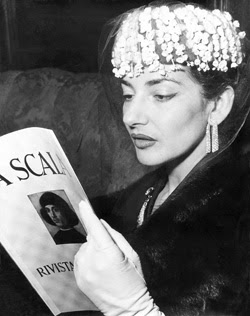
Happy Birthday, La Divina!

On December 2, 1923, Sophia Cecelia Kalos was born here in Manhattan. Later christened Sofia Cecilia Anna Maria Kalogeropoulos, Maria Callas was the 3rd child of Greek immigrants George and Evangelia Kalogeropoulos.

Since Maria's older brother had died from meningitis, Evangelia (or Litza) was convinced that her third child would be a boy; she was so disappointed by the birth of another daughter that she refused to even look at Maria for four days. Around age three, Maria's musical talents began to manifest themselves, and after Evangelia discovered that her youngest daughter also had a voice, she began pressuring Maria to sing. Callas would later recall, "I was made to sing when I was only five, and I hated it."

After a non-existent childhood, Maria's mother moved her and her sister Jackie back to their home in Greece. Callas began studying voice and before long was studying with spanish coloratura Elvira de Hidalgo at the Athens Conservatoire. De Hidalgo would later recall Callas as "a phenomenon... She would listen to all my students, sopranos, mezzos, tenors... She could do it all." Callas herself said that she would go to "the conservatoire at 10 in the morning and leave with the last pupil ... devouring music" for 10 hours a day. When asked by her teacher why she did this, her answer was that even "with the least talented pupil, he can teach you something that you, the most talented, might not be able to do."

On April 2, 1939, a 16 year old Maria Callas undertook the part of Santuzza in a student production of Mascagni's Cavalleria Rusticana at the Olympia Theater, and in the fall of the same year she officially enrolled at the Athens Conservatoire. After several appearances as a student, Callas began appearing in secondary roles at the Greek National Opera. De Hidalgo was instrumental in securing roles for her, allowing Callas to earn a small salary, which would help her and her family get through the war.

Callas made her professional debut in February 1942 in the small role of Beatrice in Franz von Suppé's Boccaccio. Later, Callas made her leading role debut in August 1942 as Tosca, going on to sing the role of Marta in Eugen d'Albert's Tiefland.

Back in the United States by 1945, she auditioned for Edward Johnson, general manager of the Metropolitan Opera in December. Callas maintained that the Met offered her Madama Butterfly and Fidelio, to be performed in Philadelphia and sung in English, both of which she declined. She felt she was too fat for Butterfly and did not like the idea of opera in English. Although no written evidence of this offer exists in the Met's records, in a 1958 interview with The New York Post, Johnson corroborated Callas's story: "We offered her a contract, but she didn't like it—because of the contract, not because of the roles. She was right in turning it down—it was frankly a beginner's contract."

Refusing the Met in the beginning proved no effect on her career. She quickly became one of the most recognized and famous women in the world and was also responsible for bringing many of the long forgotten Bel Canto operas back to the stage. Of course, with fame comes scandal and controversy: The dramatic weight loss, a "rivalry" with Renata Tebaldi, her difficult temper, her firing from the Met by Rudolf Bing, a relationship with Greek shipping tycoon Aristotle Onassis which ended when Onassis left Maria for Jackie Kennedy and her subsequent vocal decline.

Because of this vocal decline, her singing career was essentially over by the time she was 40. In a magazine article printed shortly after her death, Callas is quoted as saying:
I never lost my voice, but I lost strength in my diaphragm. ... Because of those organic complaints, I lost my courage and boldness. My vocal cords were and still are in excellent condition, but my 'sound boxes' have not been working well even though I have been to all the doctors. The result was that I overstrained my voice, and that caused it to wobble. (Gente, October 1, 1977)
Callas spent her last years living largely in isolation in Paris and died on September 16, 1977, of a heart attack. A funeral was held at St. Stephen's Greek Orthodox Cathedral on rue Georges-Bizet, Paris, on September 20, 1977, and her ashes were interred at the Père Lachaise Cemetery. After being stolen and later recovered, they were scattered over the Aegean Sea, off the coast of Greece, according to her wish.

As with many people of her stature, Maria Callas' genius was overshadowed by the controversy that followed her and the scandals that distracted her. No matter, though: Her artistic achievements were so great that Leonard Bernstein called her "The Bible of opera". In 2006, Opera News wrote of her, "Nearly thirty years after her death, she's still the definition of the diva as artist—and still one of classical music's best-selling vocalists."

Happy Birthday to Maria Callas who would have been 86 years old today.

Tuesday, December 1, 2009

Cuts announced at Washington National Opera

Anne Midgette writes:
Following weeks of rumors about serious financial difficulty, the Washington National Opera on Monday announced cutbacks, not only to staff, but also to programming for next season. The 2010-11 season will present only five operas, down from six this season and seven in 2008-09.

The company is also eliminating eight staff positions and shuffling at least one. Mark Weinstein, brought in as executive director in 2008, "will be focusing exclusively on fundraising and broad-range financial strategic planning," according to a statement by the opera's president, Kenneth R. Feinberg. Weinstein will retain his title through the end of this season, Feinberg explained in a subsequent telephone conversation.
See the full story at The Washington Post.
Related Posts Plugin for WordPress, Blogger...