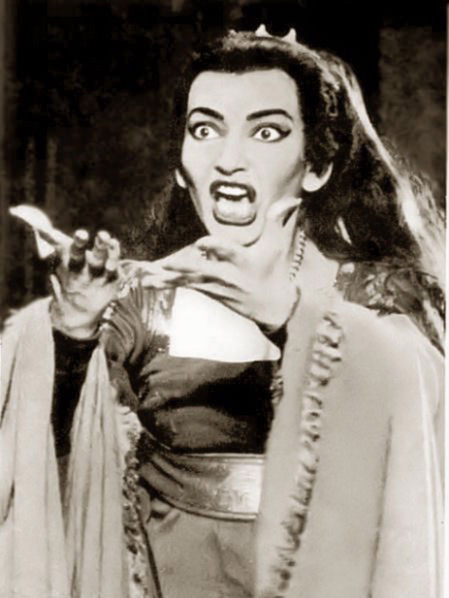
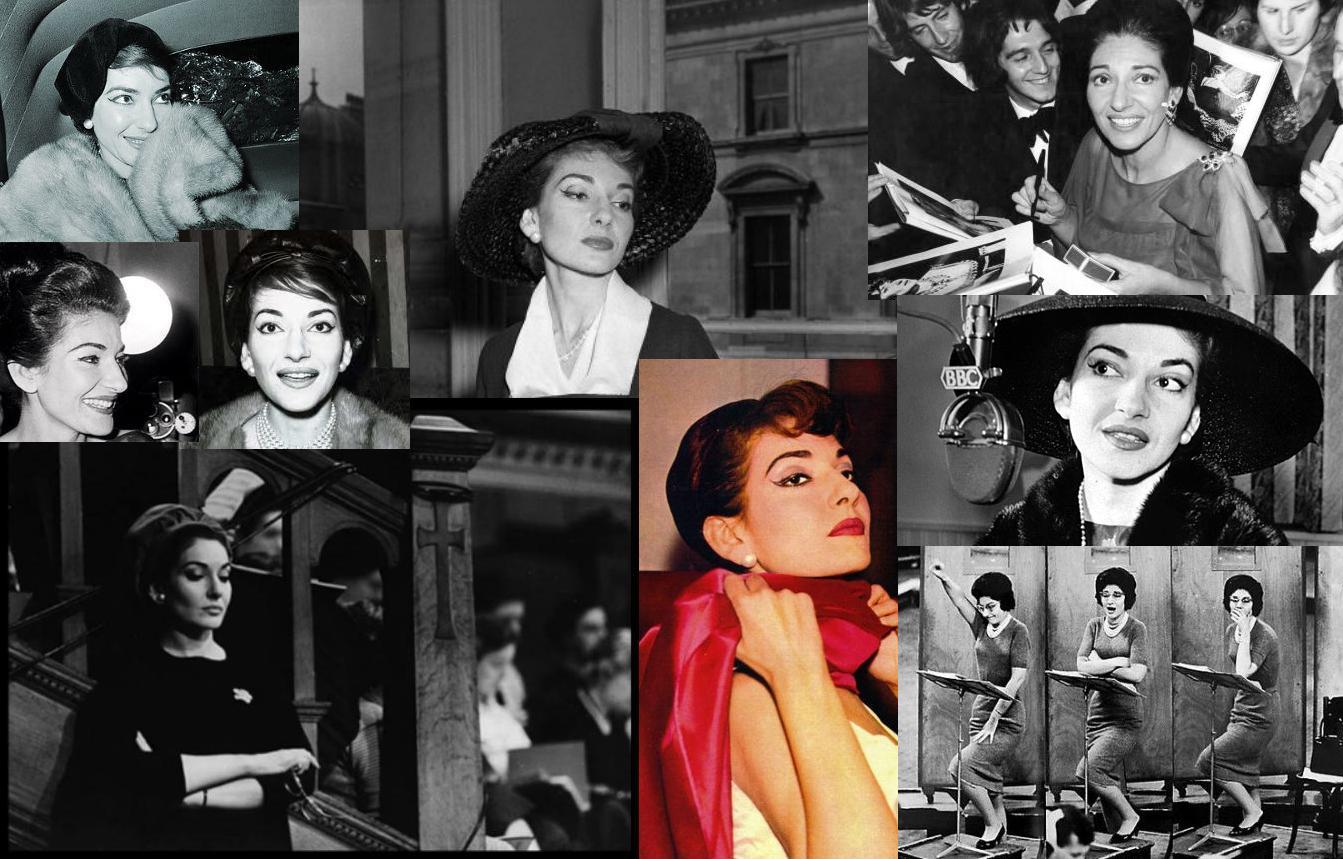
In honor of her 94th birthday, I have to revisit this clip of La Divina — because it’s phenomenal.
So, do you ever think about what someone like Maria Callas did on stage when the wheels started coming off the musical bus? I know I do. Well, if you're a YouTube-geek, like I am (and you know you are), you may have already seen this clip. If so, it's worth another look - for sure. If you've not seen it ... trust me, you'll find much pleasure in this week's Another Favorite Clip.
In this vintage-1958 Callas clip, we see La Divina hauling out another "Casta Diva" from Bellini's Norma. Only this time, when the chorus comes in part way through the first half, they begin singing a little late and while some try to catch up, others dig their feet in. What we're left with is a diva, center stage, flanked by a chorus that is singing out of sync.
La Divina is having NONE of that. As she joins the choir (approx the 1:57 mark), she holds up her hand in order to tell them to cease .... perfection. It doesn't just stop there, though. Shortly thereafter, she cues the choir to come in at the proper spot by tilting her head back slightly. Yes. She. Does.
Just when you think she's done ...
As soon as everyone gets back in sync with each other, she gives a look to stage left - I'm assuming the look is toward the offending party - and gives whomever she's looking at a *serious* up/down.
You think I'm joking? Have a look ... and, enjoy! I know I did.
Known in the opera world as La Divina, Maria Callas - some say opera's most celebrated and famous soprano - would have turned 90 years old today. To honor her, Google dedicated today's "Doodle" to her birthday:
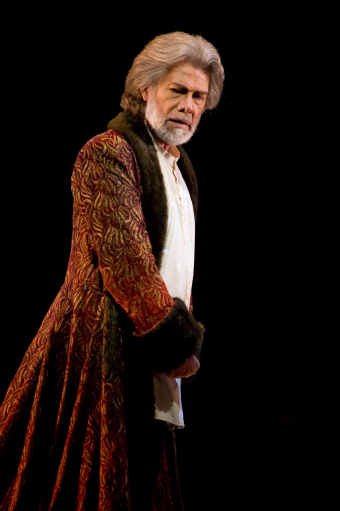
Today is a milestone in the life of bass Samuel Ramey - the operatic legend turns 70 today.
70?! Can you believe it?
Born in Colby, Kansas in 1942, this corn-fed, mid-western gentleman has been bowling over operatic audiences since his debut as Zuniga in Carmen with New York City Opera in 1973. 11 years later, he would make his Metropolitan Opera debut in Handel's Rinaldo in a cast that included Marilyn Horne and Benita Valente.
Since then, Ramey has appeared at the Met hundreds of times in addition to being a returning fixture at houses such as Teatro alla Scala, Covent Garden, Vienna State Opera, the Paris Opera, the Lyric Opera of Chicago and the San Francisco Opera - just to name a few.
Happy Birthday, Mr. Ramey! To celebrate, here are a few fave clips for you:
And finally, a number of years ago, Yours Truly was a 25-year old bass baritone who was faced with the daunting task of learning and performing the role of Rev. Olin Blitch in Carlisle Floyd's Susannah. A voice teacher put me in touch with Mr. Ramey via email and he acted as my own personal "Dear Abbey" as I navigated the treacherous waters of that role. I remain exceedingly grateful.
Here is Mr. Ramey singing the Revival Scene from Carlisle Floyd's Susannah:
Happy 70th Birthday, Samuel Ramey. You remain a cornerstone of opera and an inspiration to many of us who've grown up with your voice in our heads.
The other day, I caught part of the groundbreaking ceremony of the National Museum of African American History and Culture building at the Smithsonian. Streamed online, I wanted to make sure to catch it because I saw on Twitter that Thomas Hampson would be singing... little did I know that Ms. Denyce Graves (Montgomery) would also be lending her voice...
It got me thinking: Ms. Denyce ... where've you been hiding?
It seemed like the in the late '90s and early '00s, Denyce Graves was everywhere ... and then, it seemed that she - well - she fell off the Mainstream Operatic Radar. So, given that today is her 48th birthday, I decided to do some research on her life and career.
It turns out that Denyce Graves' stellar career, almost wasn't. After attending the Duke Ellington School for the Performing Arts high school in her native Washington DC, Graves went off to study with renowned voice teacher, Helen Hodam, first at Oberlin Conservatory and then, at the New England Conservatory (NEC). While in Boston at NEC, she took side jobs to support herself: cleaning dorms, working as an all-night hotel desk clerk. When she decided to enter the Metropolitan Opera Regional Auditions, she had all the makings of a finalist: a generous and richly luminous mezzo-soprano voice and a gorgeous stage presence. But, her performance was charged with a special determination. As the story goes, she was four months behind in her rent and couldn't even pay for the rented dress she was wearing.
Needless to say, she won.
After the competition though, her voice failed her. The problem later turned out to be a treatable thyroid condition. But her performance at the finals in New York City was an absolute disaster. Crippled by that experience, she quit singing and became a secretary.
Yet the word of this young African-American mezzo-soprano spread and it wasn't long before Graves received a phone call that would change her career - and life. Houston Grand Opera called to invite her to participate in its young artist program. She declined. When they called twice more, she accepted.
Thus began a career straight out of the Book of Operatic Fairy-tales: She was performing more than 150 times a year with conductors like Riccardo Chailly, Christoph Eschenbach, James Levine, Zubin Mehta, Lorin Maazel, Kurt Masur, Riccardo Muti, and Mstislav Rostropovich - on the stages of companies such as the Metropolitan Opera, Los Angeles Opera, Covent Garden, Washington National Opera, Houston Grand Opera, San Francisco Opera, Michigan Opera Theater, Cincinnati Opera, Opera Carolina, Opera Company of Philadelphia, Dallas Opera, Vienna Staatsoper, La Scala Milan, Grand Théâtre de Genève, Genoa’s Teatro Carlo Felice and Opernhaus Zürich... In fact, when Oxford University Press in London published a history of the opera, they put her picture -- and hers alone -- on the cover.
With a grand career such as this, Graves was on top of the world, right? Not so...
In 2000, Graves' personal life had begun to unravel. She had always suffered from severe headaches but, now they had become so severe that they were causing her to black out. Again, crippling self-doubt set in. Also, weighing heavily on the star was the fact that she so-badly wanted to have children - she had 4 surgeries to try help her - but, was ultimately told it wouldn't happen for her. She finally broke down in the fall of 2000.
Both Graves' mother and best friend received distressing phone calls from her: "I need you to come and I need you to come now." Stuck in a hotel room in Chicago, Denyce Graves was having a breakdown. This was something so deeply personal, that she hid it from everyone - including her then-husband, David Perry. But, the show had to go on.
Her headaches continued and their ferocity grew - she was being given cortisone injections every night and continued performing until one night while performing with Opera Delaware. Graves sang the first Act and then, during the intermission, sneezed and suddenly .... there was no voice. Denyce Graves had a hemorrhage on one of her vocal cords - which, as per usual, was created by a polyp on the opposite cord.
Her doctor's name, Dr. Steven Zeitels, probably sounds familiar to some of you who frequent this blog. He is the surgeon who recently operated on singer Adele. But, let's remember that 12 years ago, it was an absolute taboo for opera singers to have vocal surgery. And, if you did go and see Dr. Zeitels, you kept it secret for fear that you'd be considered "tainted goods".
After her period of silence and rehabilitation, Denyce Graves was just coming back to full voice when she received another call that would change her life and career. Shortly after September 11, 2001, she was called upon by our President to help comfort a grieving nation by singing at the National Service of Prayer and Remembrance. Here is part of that service:
She had barely stepped foot out of the cathedral that day when her cell phone started ringing. Former president Bill Clinton called her to personally thank her, Oprah Winfrey wanted her on her show and so did Larry King. Even NASCAR booked her for an upcoming event.
But, her silent battles raged on ... her marriage was falling apart. Graves and David Perry divorced shortly thereafter. Even though they remained friends and business partners as well, the dissolving of the marriage let to bouts of depression.
Graves then saw a ray of light - she fell in love with Vincent Thomas, a French composer who often accompanied her in concerts on the clarinet. And, despite what doctors had told her was impossible, she became pregnant. In 2004, during a performance in Europe, Graves began bleeding. After being rushed to the hospital, there was only one solution, her baby would have to be delivered via emergency c-section. And so, little baby Ella was born (named after Ella Fitzgerald, of course).
In 2006, Graves met Robert Montgomery, a Johns Hopkins doctor, on an airplane from Dulles Airport to Paris. They were married on June 29, 2009, in a family-only affair. In August of that year, the couple traveled to Kenya for a tradition Maasai blessing and in September, they had a five-day wedding celebration that featured a kick-off party in a private airplane hangar, a private dinner at their home, a reception at the Anderson House in Dupont Circle, and a day-after picnic on the grounds of Duke Ellington High School. The September event was covered by People Magazine.
It should be noted that Dr. Montgomery is now the Chief of Transplant Surgery at Johns Hopkins Medical Center.
As for Denyce Graves-Montgomery, she is still singing of course - although it doesn't seem that many staged operas are present on her books. In addition, her website shows a place for people to register for voice lessons with the famed mezzo-soprano - when you click on it, you see "Details will be be shared very soon! Check back for updates." Indeed, I will.
So ... what a story, huh? Happy Birthday, Denyce Graves-Montgomery! I'm sure I speak for many when I say that I wish you continued happiness and much success.
Now to celebration portion of this post ... here are a couple of my favorite performances by one of the fiercest divas around:
Gioachino Rossini was born on this day, Leap Year Day, in 1792. Composer of more than 30 operas, plus sacred music and chamber works ... creator of the classic Il barbiere di Siviglia -- said by many to be the most popular comic opera of all time -- and William Tell, which gave The Lone Rangerhis catchy theme ... it was actually Rossini's Tancredi and L'italiana in Algeri that put a young Rossini on the map. Some songs from Tancredi were so popular, in fact, that Italians would stand around in law court, singing the melodies in crowds, until the judge would tell them to cut it out.
Well, I'm pleased to report to you all that Maestro Rossini's birthday is being honored today by way of a Google Doodle:
And for me, I'd like to honor Maestro Rossini's birthday by bringing you clips of *some* of my Rossini faves ... of course, it's all mezzo-soprano repertoire.
On this day in 1927, Mary Violet Leontyne Price was born in Laurel, Mississippi. Happy 85th birthday to one of opera's greatest living legends.
To celebrate, here are some of my favorite pictures of Ms. Price - followed by a clip that is sure to produce goosebumps.
Happy Birthday, Miss Price.
Vintage Miss Price.
One of Miss Price's early TV appearances.
At a recording session with Maestro von Karajan
On the set of "Taming of the Shrew" with Elizabeth Taylor
Oil on Canvas by Bradley Phillips - National Portrait Gallery, Smithsonian
At home with the above portrait gracing her mantel.
One hell-uv-ah headshot.
As Aida in 1984, her final season at the Met.
Soprano Kathleen Battle with Miss Price at Oprah's Legends Lunch
And for your added enjoyment - here is Ms. Price's final Aida at The Met. She has just finished "O patria mia" - and the audience thunders. You must watch the entire clip, though - Ms. Price tries her hardest to stay in character but, becomes overwhelmed by the enormity of it all and finally acknowledges the audiences appreciation.
Ms. Martina was born in New York City on this day in 1937. The younger of two children of Demetrio Arroyo, an immigrant from Puerto Rico, and Lucille Washington, a native of Charleston, South Carolina, Ms. Martina enjoyed much success as a soprano - but, it might not have been.
In 1957, a 20 year old Ms. Martina auditioned for the Met but was declined. Somewhat disheartened, she began working on a Masters degree in comparative literature at New York University. The following year, she auditioned again and won the Met's Audition of the Air competition which was a pre-cursor to the National Council Auditions. In March of 1959, she made her official debut as the Celestial Voice in Verdi's Don Carlo.
After an operatic career that spanned 30 years, Ms Martina retired officially from the operatic stage in 1987. Always candid about her perceived status as second-best to her colleague Leontyne Price; once, when a Met doorman greeted her as "Miss Price", she sweetly replied, "No, honey: I'm the other one."
Yes. Yes, they do [see right]. Ladies and Gents, it's time for us to tip our hats to wish Elaine Stritch a very Happy Birthday for on this day in 1925, the legend was born. Indeed, that would make her 87.
I'll drink to that.....
Elaine Bawson Stritch was born in Detroit, Michigan to Mildred, a homemaker, and George Joseph Stritch, an executive with B.F. Goodrich. Her family was wealthy and devoutly Roman Catholic. Stritch was a niece of Samuel Cardinal Stritch, the former Roman Catholic Archbishop of Chicago.
I'd give you the run down of her career, but that would just be preaching to the choir, right? We all know this legend has been working her hysterical timing and brassy voice on stage, on film and on television since her stage debut in 1944 - some 68 years. And she's still going. Bless her heart.
Stritchy, here's to the Lady still lunching! Happy Birthday!
Leonard Bernstein called her "The Bible of Opera."
In 2006, Opera News wrote of her "Nearly thirty years after her death, she's still the definition of the diva as artist — and still one of classical music's best-selling vocalists."
In 2007, she was posthumously awarded the Grammy Lifetime Achievement Award. In the same year, she was voted the greatest soprano of all time by BBC Music Magazine.
Maestro Tullio Serafin called her "Una grande vociaccia" ("A great, ugly voice").
Maestro Carlo Maria Giulini said, "It is very difficult to speak of the voice of Callas. Her voice was a very special instrument. Something happens sometimes with string instruments—violin, viola, cello—where the first moment you listen to the sound of this instrument, the first feeling is a bit strange sometimes. But after just a few minutes, when you get used to, when you become friends with this kind of sound, then the sound becomes a magical quality. This was Callas."
Classical record producer Walter Legge said she possessed that most essential ingredient for a great singer: an instantly recognizable voice - also calling her the "supreme mistress" of bel canto.
Maestro Antonino Votto called her "the last great artist" ... he continued, "When you think this woman was nearly blind, and often sang standing a good 150 feet from the podium. But her sensitivity! Even if she could not see, she sensed the music and always came in exactly with my downbeat. When we rehearsed, she was so precise, already note-perfect... She was not just a singer, but a complete artist. She was an aesthetic phenomenon."
Sir Rudolf Bing said of her: "Once one heard and [her] — one can't really distinguish it — in a part, it was very hard to enjoy any other artist, no matter how great, afterwards, because she imbued every part she sang and acted with such incredible personality and life. One move of her hand was more than another artist could do in a whole act."
Many of her fans called her 'La Divina'.
When you look up 'force of nature' in the dictionary, the entry reads: "in physics, one of the four fundamental forces that occur in nature and affect the structure of the universe, including gravitation, strong force, and weak force". Whatever you choose to call her ... in the minds and hearts of so many people, Maria Callas was, indeed, a force of nature.
Wishing the happiest of birthdays to Maria Callas, who would have been 88 years old today.
Legendary composer, conductor, pianist, author and classical music celebrity Leonard Bernstein was born on this day in 1918.
Happy Birthday, Maestro!
Bernstein was born Louis Bernstein in Lawrence, Massachusetts, the son of Ukrainian Jewish parents Jennie (Resnick) and Samuel Joseph Bernstein, a hair-dressing supplies wholesaler from the Ukraine. His grandmother insisted that his first name be Louis, but his parents always called him Leonard, because they liked the name more. When Bernstein was 15, he officially had his name changed to Leonard.
Best known to the public as the longtime music director of the New York Philharmonic, Bernstein also conducted many other of the world's leading orchestras during his career.
Bernstein composing | 1968
As a composer, Bernstein is probably best known for writing the music for West Side Story, Candide, Wonderful Town, and On the Town. In 1952, Bernstein wrote a 1 act opera called Trouble in Tahiti for mezzo soprano, baritone and a greek chorus type trio of "radio singers". In 1983, Bernstein wrote a sequel to it called A Quiet Place. In it's original form, A Quiet Place was also a 1 act opera which was followed by Trouble in Tahiti after an intermission.
When the original version of the paired 1 acts premiered at Houston Grand Opera, the show was smacked down in the press. In fact, the New York Times said"To call the result a pretentious failure is putting it kindly". Bernstein and librettist Stephen Wadsworth subsequently pulled the show and began revising it. In the revision process, they cut many scenes and folded Trouble in Tahiti into A Quiet Place as a flashback sequence.
Last season at NY City Opera, I had the chance to see A Quiet Place and I am of the opinion that it should have a place on more stages. But, being that the show is very much a musical theater piece sung operatically, I can understand why some people are confused as to how, where and when it should be produced. Regardless, it should be produced - the story is poignant and the music is ... well ... it's Bernstein. Need I say more?
To call Bernstein a legend is a severe understatement. He was not only a legend, but also truly a lover of and advocate for all kinds of music, as well as a member of that very first class of major celebrities from the classical music world.
As with many legends, it seems that we lost Bernstein to early. He conducted his final performance at Tanglewood on August 19, 1990, with the Boston Symphony playing Benjamin Britten's Four Sea Interludes from Peter Grimes, and Beethoven's Seventh Symphony. A life long smoker - he had battled emphysema from his mid-50s - this final performance stretched him to the brink and he suffered a coughing fit in the middle of the Beethoven. The concert nearly ended - quite abruptly.
On October 14, 1990, Leonard Bernstein died of a heart attack caused by progressive lung failure - just five days after announcing his retirement. According to his Wikipedia page, on the day of his funeral his procession slowly moved through the streets of Manhattan where some construction workers removed their hats and waved, yelling "Goodbye, Lenny."
For your viewing ... Leonard Bernstein displays his fiery conducting style as he conducts the final movement of Verdi's Requiem. Soprano Martina Arroyo is the soloist.
Friends, let's give a hearty round of Birthday wishes to the one-and-only Roberta Peters - who turns 81 today.
Roberta Peters was born Roberta Peterman in The Bronx, NY. She started study voice at age 13, encouraged by tenor Jan Peerce, with William Herman, a strict teacher known for giving exhaustive (and exhausting) training. Herman made sure Peters had French, German and Italian lessons and made her sing scales from a clarinet training book.
After six years of training, Herman introduced her to Sol Hurok, an impresario of sorts who arranged for an audition with Rudolf Bing - General Manager of the Met.
Bing had her sing the Queen of the Night's vengeance aria from Die Zauberflöte which contains four high Fs ... for those who might not understand: that's F above high C. (please see below) Bing didn't hear it once, he had young Roberta sing it seven times - if you do the math, that would be 28 high Fs. All the while, Bing listened from all parts of the hall to make sure she could fill the hall with sound. He then scheduled her to sing Zerlina in February of 1951.
Things were not to work out that way as fate stepped in. Peters received a phone call from Rudolf Bing on November 17, 1950 asking if she could sing that night as that evening's Zerlina, Nadine Conner, could not perform. Peters obviously knew the role, but had never sung with a full orchestra, never performed in a full opera production, never even performed on stage, professionally or otherwise, except for her audition. She accepted and thus, a 20 year old Roberta Peters made her MET debut in Don Giovanni. Fritz Reiner conducted the cast that included Jerome Hines as the Commendatore and Eleanor Steber as Donna Elvira.
Quaintance Eaton reviewed the performance for Musical America, saying in part:
The surprise debut of twenty-year-old Roberta Peters, who was summoned to sing the role of Zerlina when Nadine Conner fell ill at three o'clock on the afternoon of the performance, gave the first Don Giovanni of the season an air of unusual excitement. The attractive girl won an immediate place for herself in her first appearance on any stage, and her fresh youth, pretty voice and stage wisdom provided the chief interest of the evening. From her first entrance at the head of a line of dancing country girls, Miss Peters never faltered in what seemed an ideal embodiment of the peasant bride and her gaiety and charm pervaded the scenes in which she appeared. Her voice was clear, accurate in pitch and focus and lovely in quality.
Roberta Peters continued to sing at the MET for 35 years until her last performance there as Gilda in Rigoletto on April 12, 1985.
A little known fact about Roberta Peters: she appeared a record 65 times on the popular TV Variety Show: The Ed Sullivan Show, making her the show's most frequent guest.
Let's celebrate Ms. Peters' birthday with a couple of spectacular clips, shall we?
The first is from a 1964 production of Die Zauberflöte in which Ms. Peters sings the previously referenced vengeance aria: "Der Hölle Rache kocht in meinem Herzen".
Fast forwarding 30 years to 1994, we have a 64 year old Peters singing Norma's aria "Casta Diva".
There have been very few times in the history of opera when a young singer - and by young, I mean early '20s - walks onto the stage and is immediately thrust from a young, aspiring artist to main stage prima donna. Aprile Millo is one of those singers.
Today, we celebrate Aprile Millo who was born on this date in 1958.
Born in New York City to two opera singers, tenor Giovanni Millo and soprano Margherita Girosi, Millo became interested in music at an early age and received her musical education primarily from her parents. After her family moved to California, Millo graduating from Hollywood High School. Shortly, she was invited to join the San Diego Opera Center and took part in the inaugural San Diego Opera Ensemble apprentice program - from which Yours Truly is also an Alum.
Now, this is where the "immediately thrust to main stage prima donna" part happens ...
After leaving San Diego Opera, Millo sang her first major role, Aida, with Utah Opera in the Fall of 1980. She was 22 years old. I'm sorry Friends, but when I was 22, I was still trying to decide whether I should go into Human Resources or become an opera singer. No joke. Those were the top two contenders.
Anyhoo ... in early 1981, Millo returned to Utah Opera. This time to perform the role of Santuzza in Mascagni's Cavalleria Rusticana. But, New York was calling the young diva. After her move to New York City, she auditioned for the New York City Opera where her Father had sung from 1942–1946. Millo was immediately offered a contract with several roles. The Metropolitan Opera also had an offer for the 22 year old: to become a member of the Met's Young Artist Program, as well as to cover - not star in - leading roles. Up until this point, Millo had studied voice exclusively with her parents - so, she chose the Met's program in order to continue to hone her craft.
Millo, Tebaldi, Horne - As Millo calls it "the battle of the cheekbones."
While in the Met's program she worked with Dick Marzollo, David Stivender and Rita Patanè. In short order, she also had the opportunity to work with Elisabeth Schwarzkopf who took her to Herbert von Karajan - which opened the doors to mentoring from Renata Tebaldi, Zinka Milanov and Licia Albanese. In other words, Aprile Millo almost literally grew up at the Met while being taught, coached and mentored by some from the operatic A-List.
In November 1982, Millo made her European debut as Aida in Karlsruhe, Germany and in December at La Scala as Elvira in Ernani when she replaced an ill soprano ... Mirella Freni. In January 1983 - two months later - she had performances of Ernani at La Scala of her very own.
Millo's New York City debut came under the baton of Eve Queler and the Opera Orchestra of New York in November 1984. This debut forged a long lasting friendship with the Maestra. Millo would later say of Queler:
Eve has always been a lightening rod in my life ... My most treasured moment was in La Fanciulla del West. My mother had always wanted me to sing Minnie, and she inspired me so much with her love and understanding of this beautiful tale of love and redemption. She was battling cancer and it would prove to be sadly the last thing she would hear me sing. The audience just loved it, and as she struggled to join the standing ovation at the end, I got to throw her a bouquet of flowers as the audience cheered. That is what it is like with Eve. It is a very rare thing these days -- music has become a business. The Opera Orchestra of Eve Queler is like a family; she gave me a chance to fulfill my Mom's fondest wish, and she got me through the worst time of my life. I will never forget it.
3 weeks after her debut with Queler, in December 1984, Millo made her Metropolitan Opera debut in dramatic fashion replacing an ailing Anna Tomowa-Sintow as Amelia in Verdi's Simon Boccanegra with James Levine on the podium. Not only did Maestro Levine fall in love with this young soprano, the critics praised Millo's performance with the New York Times proclaiming that her voice had "a breadth and a shining ring that would have won her a midscene ovation in any Italian opera house". Later, she'd be heralded by the New York Times as "...the Verdi soprano we’ve been waiting for."
Eva Marton, Millo and opera lover Elizabeth Taylor
What would follow is an operatic career that many singers only dream about. Not only did Millo sing at the wedding of Elizabeth Taylor and Larry Fortensky - sorry, I just *had* to get that in - she has performed on the stages of Chicago, San Francisco, New York, Frankfurt, Barcelona, Parma, Rome, Bologna, Torino, the Arena di Verona, The Baths of Caracalla, Munich, Berlin, Vienna, Zurich, Paris, Orange, Moscow, Seville, Bilbao, Rio de Janeiro, São Paulo, Santiago, Buenos Aires and La Scala, Milan among others.
Her fans love her - as did many of the critics ...
A voice unlike any other ... Opera Italia.
The High-Priestess of that old time operatic religion ... Newsday.
To many, Millo is considered the last of the Golden Age sopranos ... The New York Times.
But, perhaps the most fitting quote regarding Aprile Millo comes from the prima donna herself:
To have won acclaim from all my idols and made music with some of the greatest musicians in the world....all in front of the most passionate and involved audiences in the world and hear them cheer. That is what I hold closest to my heart. My cup runneth over! I am thrilled and cannot wait to give more....... a privilege and a joy ... PlaybillArts.com
To celebrate, I've got a clip for you, Chiclets. Here, we have Luciano Pavarotti and Aprile Millo singing "Teco io sto..." from Verdi's Un Ballo in Maschera. One of the reasons I love this particular clip as much as I do (aside from the music, these singers etc.) is that at about the 6:26 mark, something happens. It's definitely one of those funny things that happens between two singers that the audience knows nothing about ... but, since it's caught on camera we can see it. By "it", I mean that we can see Millo shake her head at Pav and start to smile. If you think it's a fluke, just wait - it happens a second time. Hmmmmmm - what was he doing to try to get her to laugh?
This morning, I had a fantastic experience. I walked into Starbucks for my morning prayer and smiled at what I was hearing. Yes, much to the displeasure of many, I consider going to Starbucks everyday to be my version of attending morning Mass.
Anyway, playing overhead this morning was none other than the incomparable Miss Billie Holiday singing Them There Eyes. I sighed with delight because no one sings about Them There Eyes like Miss Billie Holiday. Well, my Chickpeas guess what? Little did I know ...
On this date in 1915, Eleanora Fagan was born. Ms. Fagan would later adopt the name Billie Holiday - from Billie Dove, an actress she admired, and the musician Clarence Holiday, her probable father.
Ms. Holiday, or Lady Day as her friends called her, had an overwhelming and lasting influence on jazz and pop singing. Her vocal style, strongly inspired by jazz instrumentalists, inaugurated a new way of turning a phrasing and maneuvering in and out of a tempo.
Billie Holiday's troubled personal life - a life of prostitution, addiction to alcohol and heroine, as well as having a string relationships with abusive men - was chronicled in the 1972 film Lady Sings the Blues, which starred Diana Ross and Billy Dee Williams. Based on Holiday's autobiography of the same title, the film was nominated for five Academy Awards - including a Best Actress in a Leading Role nod for Miss Ross.
On November 10, 1956, Billie Holiday performed two concerts before packed audiences at Carnegie Hall, a major accomplishment for any artist, especially an African-American artist of that certain period of our country's history. This seemed to be the pinnacle of her career.
The toll of her addiction and seemingly unknown illness were apparent, however. Gilbert Millstein of The New York Times wrote of the evening:
It was evident, even then, that Miss Holiday was ill. I had known her casually over the years and I was shocked at her physical weakness. Her rehearsal had been desultory; her voice sounded tinny and trailed off; her body sagged tiredly. But I will not forget the metamorphosis that night. The lights went down, the musicians began to play and the narration began. Miss Holiday stepped from between the curtains, into the white spotlight awaiting her, wearing a white evening gown and white gardenias in her black hair. She was erect and beautiful; poised and smiling. And when the first section of narration was ended, she sang – with strength undiminished – with all of the art that was hers. I was very much moved. In the darkness, my face burned and my eyes. I recall only one thing. I smiled.
Nat Hentoff of Down Beat magazine said of the same night:
Throughout the night, Billie was in superior form to what had sometimes been the case in the last years of her life. Not only was there assurance of phrasing and intonation; but there was also an outgoing warmth, a palpable eagerness to reach and touch the audience. And there was mocking wit. A smile was often lightly evident on her lips and her eyes as if, for once, she could accept the fact that there were people who did dig her.
The beat flowed in her uniquely sinuous, supple way of moving the story along; the words became her own experiences; and coursing through it all was Lady's sound – a texture simultaneously steel-edged and yet soft inside; a voice that was almost unbearably wise in disillusion and yet still childlike, again at the centre. The audience was hers from before she sang, greeting her and saying good-bye with heavy, loving applause. And at one time, the musicians too applauded. It was a night when Billie was on top, undeniably the best and most honest jazz singer alive.
Even with an adoring audience and loyal fan-base, addiction still had it's hold on her through the coming years. On May 31, 1959, Holiday was taken to Metropolitan Hospital in New York suffering from liver and heart disease. As she lay dying, she was arrested for drug possession and her hospital room was raided by the police. Holiday remained under police guard at the hospital until she passed away on July 17, 1959.
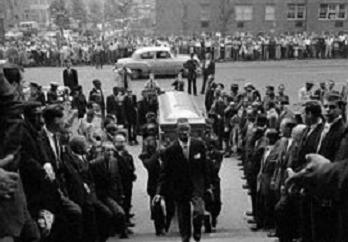
The funeral of Billie Holiday | New York City 1959
In the final years of her life, she had been scammed out of almost every dollar she had. At the time of her death, she had only $.70 in the bank and $750 in her purse. The cash in her purse was payment from a tabloid for her story.
Her funeral mass was held at St. Paul the Apostle Catholic Church in New York City and she was laid to rest at Saint Raymonds Cemetery New in the Bronx ...
God Bless the Child
Them that's got shall get
Them that's not shall lose
So the Bible said and it still is news
Mama may have, Papa may have
But God bless the child that's got his own
That's got his own
Yes, the strong gets more
While the weak ones fade
Empty pockets don't ever make the grade
Mama may have, Papa may have
But God bless the child that's got his own
That's got his own.
Happy Birthday, Miss Holiday. Your imprint is forever cemented on jazz and the music world in general.
Renata Scotto "Blackglama is the world's finest natural dark ranch mink."
With a career in opera that has spanned almost 60 years, soprano and stage director Renata Scotto is one of the last remaining life-lines that we have to a period of the art form that draws no parallel. La Scotto, who turns 77 today, has indeed sung with many of the operatic legends of yesteryear: Maria Callas, Renata Tebaldi, Mario del Monaco, Jon Vickers, Tito Gobbi and Alfredo Kraus.
Then, of course, there was the first ever Live from the Met telecast ... La Boheme with "a certain tenor" singing Rodolfo. Why say "a certain tenor", you ask? Well, as Zachary Woolfe reports CapitalNewYork.com:
For one thing, the name “Pavarotti” was rigorously excised from [La Scotto's memoir] More Than a Diva; he is strictly “a certain tenor” in stories of his laziness and selfishness, and he was even scrubbed from the discography in the back.
In fact, since her operatic debut in 1952 in which the 18 year old Scotto sang Violetta in Verdi's La Traviata, she has sung more than 45 roles by 18 different composers. As an Emmy Award winning opera director, La Scotto has staged performances at the Met, NY City Opera, Florida Grand Opera, Palm Beach Opera, The Dallas Opera, Michigan Opera Theater, Finnish National Opera, and Lyric Opera of Chicago.
It goes without saying that her career is one that "baby singers" dream about.
Opera Chic had this to say:
Opera has its Queen Bee. The Italian soprano and living legend Renata Scotto (~living legend, you can look, but don't touch~) has done it all. She's been Norma and Violetta and Mimi -- among the best in the modern era. She rediscovered La Voix Humaine back when it wasn't fashionable and also sang Schoenberg's Erwartung. In the span of an enormous career, she’s as intimate with the stage as with the backstage: La Scotto’s made the graceful transition from singer to director to teacher – a versatility that’s made her modern. Her vocal skills spanned from the lightest bel canto to the densest verismo. With ninja-sharp musicianship (and acting skillz) and a deep understanding of each composer, her style was intelligent, authoritative, and passionate.
For an in-depth post on La Scotto's life, including an interview with the living legend, hop on over to Opera Chic's Blog. Also, make sure to check out Zachary Woolfe's article at CapitalNewYork.com.
I missed one yesterday. And if I let it go by, I will have hell to pay from many of you.
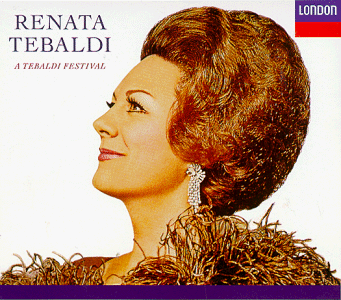
Born on February 1st in 1922 ... the Patron Saint of Cotton Candy Hair, Renata Tebaldi. You laugh, I know. But check out that head of puffiness!
Tebaldi primarily focused on the verismo roles of the lyric and dramatic repertoires. Many acclaim her to be the most beloved opera singers of all time - and they, of course, are not Maria Callas fans.
After debuting at the Met as Desdemona in 1955, Tebaldi continued to sing there quite often ... making it her operatic home. According to many fans, she developed a special relationship with the Met audiences and quickly became known as "Miss Sold Out". She sang there some 270 times making her final appearance there, again as Desdemona, on January 8, 1973.
As an early Happy Birthday SLAP in the face to Placido Domingo, Anne Midgette at the Washington Post played Monday morning quarterbackreported yesterday on the merger between Washington National Opera and The Kennedy Center for the Performing Arts in some less than flattering terms.
Midgette says in part:
In what amounts to a rescue operation, the Kennedy Center announced Thursday that it is taking over the Washington National Opera, a company that has been floundering artistically and financially for years.
Under the new "affiliation," as officials described the agreement, the opera aims to restore some of the luster it had lost in recent seasons and increase its productions...
...Without the affiliation, the WNO, which was carrying a debt of $12 million, lacked strong leadership and was reduced to a mere five operas a year, appeared doomed.
Now, as you may remember, I reported here that after talks of this merger began, a certain benefactress was threatening to pull her millions in pledges to WNO and give them to the MET Opera.
Ms. Betty Brown Casey, the benefactress in question, has come to her senses. Again, from Midgette's article:
The opera and the Kennedy Center have discussed a possible merger for at least a year, conditional - from the Kennedy Center's side - on the WNO's ability to pay off its debts. One obstacle was the resistance of one of the opera's principal benefactors, Betty Brown Casey, who had said that if the WNO ever merged with the Kennedy Center, she would withdraw her donations, including the company's $30 million endowment, and give the money instead to New York's Metropolitan Opera.
Casey, who is life chairman of the WNO, recently realized that there was no other option if opera in Washington is to survive, according to someone familiar with the negotiations who spoke on the condition of anonymity because of the sensitivity of the situation. Casey offered a matching donation of an unspecified amount, which the company was able to meet, to enable the WNO to pay off its debt and come to the Kennedy Center with its endowment intact.
That's rich - "someone familiar with the negotiations who spoke on the condition of anonymity because of the sensitivity of the situation."
Here's what I'm wondering about ... why hasn't anyone discussed the fact that our economy took a dump, thus effecting the bottom line of all businesses including the arts? Why hasn't anyone discussed the fact that when wealthy patrons get huge tax breaks from the government, as they have for the last decade, charitable giving goes way down because those wealthy patrons no longer need the tax write-off?
HELLO!?! Is this thing ON?!?!? [thump thump thump]
Doesn't anyone, other than Yours Truly, see a direct correlation between the huge tax breaks for the wealthy and the current financial woes in the artistic community? Do I need to draw a diagram? The wealthy patrons no longer have a financial NEED to give out $$ in order to get the tax break. They get the tax break for free. Let's be honest - it's a crude but very real point.
When it comes time to hand out the blame for floundering opera companies, it's much easier to point fingers at the guy who is on his way out, instead of taking a look at the bigger picture.
On that note - Happy Birthday 70th, Placido Domingo. I hope that being saddled with every ounce of blame for WNO's issues hasn't put too much of a damper on your big day.
Composer Vincenzo Bellini was born on this day 1801. Sadly, Bellini died only 33 years later - but, during his short time on this earth, he composed 11 operas and many other pieces of music.
To help you celebrate one of the forefathers of Bel Canto, we have Montserrat Caballe and Tatiana Troyanos singing Mira o Norma from Bellini's Norma in a live performance at La Scala in 1977.