Friday, July 27, 2012

Mercury and Caballé - "Friends until the end ... Viva - Barcelona!"

Tonight, the Summer Olympics open in London. I'm sure the Opening Ceremony will be a grand spectacle as always ... Remember the Summer Olympics in Barcelona 20 years ago?

Barcelona 1992

If you had asked me in the late '80s who Freddie Mercury was, much less Queen, I couldn't have been able to tell you to save my life. That all changed in the very early '90s. I'd like to say it was because my liberal heart and mind were tuned to the AIDS crisis, of which Mercury became a victim. But, actually - it was because of Barcelona.

Freddie Mercury was a true musician - and above that, a lover of all types of music. Believe it or not, you can be a musician and be particularly close-minded when it comes to other types and genres of music.

That love for all genres became evident when he developed a deep friendship with Spanish soprano Montserrat Caballé. He was truly in love with her voice and what she could do with it. It all began when he attended a performance of Verdi's Un Ballo in Maschera at London's Royal Opera House - Covent Garden in 1983. He was hooked. In fact, the love of her voice became so strong that Mercury flew to Barcelona in 1987 to personally give Caballé a cassette tape (remember those?) with a few songs that he hoped she would like and would ultimately agree to perform with him.

The collaboration began when the rocker sat down at a piano and played various melodies for the operatic legend - asking which one she preferred. By April of that year, Caballé was committed to the project and Mercury began work.

Caballé said of Mercury's abilities:
The difference between Freddie and almost all the other rock stars was that he was selling the voice. His technique was astonishing. No problem of tempo, he sung with an incisive sense of rhythm, his vocal placement was very good and he was able to glide effortlessly from a register to another. He also had a great musicality. His phrasing was subtle, delicate and sweet or energetic and slamming. He was able to find the right colouring or expressive nuance for each word.
At the end of May the island of Ibiza staged a huge festival at which Mercury agreed to be a guest of honour - on one condition. He requested to close the event with Montserrat Caballé singing the song he had written for her and her home city, Barcelona.

A little over a year later, on October 8th, 1988 Mercury and Caballé performed Barcelona to celebrate Caballé's home city being chosen as the site for the Summer Olympics of 1992. It was quite the spectacle.

Because it was outdoors with fireworks and other crazy festiveness, Caballé had asked that they not sing live - afraid that she might strain her voice under the circumstances (she didn't want microphones). So, they used a playback. Here is that version of Barcelona:


I have always held Barcelona near and dear to my heart... not because I have any ties to the 1992 Olympics or Barcelona - but, because it was the first time I had heard an operatic superstar doing something that was mainstream... this was before the Three Tenors became a phenomenon.

And, I'll be honest - after hearing Barcelona, I fell in love with Caballé and her voice.

The success of the song Barcelona led to it becoming the official anthem of the 1992 Summer Olympics. And, it even led to a music video being produced. Yes... remember music videos? Below is that video... we'll discuss Mercury and Caballé's relationship on the other side...


That last frame of the two holding hands is particularly touching. As I said, the duo had a very deep friendship. So deep, in fact, that Mercury confided in Caballé that he had AIDS long before the public knew. Caballé discusses it in this brief interview.

Freddie Mercury died of bronchopneumonia brought on by AIDS on 24 November 1991, only one day after publicly acknowledging he had the disease. His 1988 performance with Caballé in Barcelona was the last time he performed on stage.

At the Opening Ceremonies of the 1992 Summer Olympic Games, just months after Mercury's death, Montserrat Caballé sang the Barcelona duet with Freddie Mercury's likeness projected onto a screen. It was an extremely moving moment.

"If God is willing
Friends until the end
Viva - Barcelona"

Wednesday, July 25, 2012

Who is the soprano behind John Malkovich in Apple's iPhone Siri ad?

Yesterday, Apple released it's latest iPhone 4S TV ad featuring director Martin Scorsese. Mr. Scorsese’s ad is the fourth in a series of shorts which feature Siri being used by the celebrities in ways that match the celebrities public personas. The previous ads feature Zooey Deschanel, Samuel L. Jackson and John Malkovich.

You've have seen the iPhone ad with John Malkovich chatting-it-up with Siri, right?

Released in May, the ads, titled "Life" and "Joke", begin with Malkovich sitting in his comfy chair and listening to Puccini's Madama Butterfly. He begins challenging Siri with a variety of tasks, such as checking the weather and his calendar. Malkovich also asks his iPhone for a joke - at which point Siri replies: "Two iPhones walk into a bar ... I forget the rest."

[Inserting pause for laughter here]

But, who is the soprano singing Butterfly's aria "Un bel di" for these John Malkovich iPhone ads? In all of the press coverage I've seen surrounding the ads - and there was plenty - no one asked the question.

So, here I am ... asking the question. Who is that soprano? Any guesses?

Yours Truly has the scoop. But first, watch the ads...


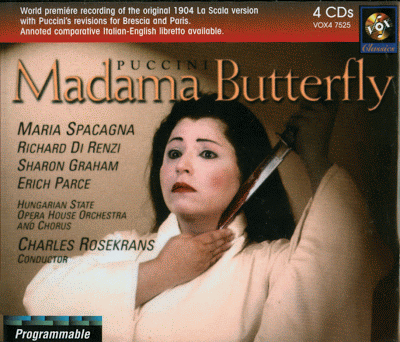
I only had to get through the opening "Un bel di vedremo..." to tell you that it's a soprano voice which I am very accustomed to hearing. The recording from which it comes is actually a unique recording that exists in a world all on it's own.

As many of us opera-geeks know, Puccini's Madama Butterfly is not an opera that was shaped into a perfect final revision. Instead, it's one that exists in several versions, none of which are definitive.

After its disastrous 1904 premiere in Milan, Puccini hastily revised the Madama Butterfly score, heavily cutting Act 1, dividing Act 2 into two parts and providing the tenor with a brief aria in the final scene. The result, in Brescia less than four months later, was triumphant to say the least, but the process of revision was not over.

For the first Paris production, in 1906, many more edits were made. In fact, it is this 1906 version of the score that is normally performed nowadays. BUT Chiclets, there is evidence that even as late as 1920, Puccini was making yet further adjustments, including the restoration of some of the previous cuts.

In the early and mid 1990s, there were several revivals of Puccini's original version. But alas, controversy still erupted due to a climate of political correctness. You see, in the original 1904 version, Pinkerton is pretty disrespectful of the Japanese — though less so than in the first draft of the libretto. And additionally, Cio-Cio San (Butterfly) was a more developed and three-dimensional character ... much less of a victim than we see in the later versions.

There is but one single recording of Madama Butterfly - ONLY ONE - that includes every version of Puccini's masterpiece. And it is from that one-recording that Apple chose to pull it's "Un bel di". The soprano singing Cio-Cio San on that recording - and on Apple's iPhone TV ad featuring John Malkovich - is ... Maria Spacagna.

Full disclosure: Maria Spacagna has been my voice teacher and mentor for many years ... no wonder I am accustomed to that voice, right?

Maria Spacagna truly forged her career singing the role of Cio-Cio San ... even becoming the first American-born singer to perform the role at La Scala, Milan ... thanks to a certain Maestro Lorin Maazel. This trailblazing moment was so monumental that it garnered Ms. Spacagna a place in La Scala's Encyclopedia of the Opera.

Under the baton of conductors such as Julius Rudel, James Levine, Edoardo Müller, Riccardo Chailly, Nello Santi, Placido Domingo and Marco Armiliato, Maria Spacagna has sung in nearly every major opera house in the world ... La Fenice in Venice, Arena di Verona, Festival Pucciniana in Torre del Lago, Deutsche Oper Berlin, New York City Opera, Dallas Opera, San Francisco Opera, Opera Theater of Montreal, and Canadian Opera in Toronto - just to name a few.

After establishing a reputation as a remarkably skilled soprano and consummate actress, it was time for Maria Spacagna to make her debut at the Metropolitan Opera. That debut came in the title role in Verdi’s Luisa Miller. Her tenor that night was some guy named Luciano Pavarotti [wink wink].

Soon thereafter, Ms. Spacagna was tapped by another tenor. This time, at Placido Domingo's request, Ms. Spacagna was invited to sing at a White House State Dinner at which President Bill Clinton and First Lady Hillary Rodham Clinton honored the Prime Minister of Italy.

A native of Rhode Island, Ms. Spacagna has been honored with the Rhode Island Pell Award for Excellence in the Arts, was the first recipient of the Distinguished Artist Award presented by the Rhode Island Civic Chorale and Orchestra and is a member of the Rhode Island Heritage Hall of Fame. She also recently received an award from the Italian Consulate General in Boston for Outstanding Achievement in Art, Culture and Entertainment.

Before her stellar operatic career, Maria Spacagna did what many singers don't these days ... she cultivated her voice and educated herself. After receiving Bachelor of Music and Master of Music in Voice degrees from the New England Conservatory of Music - where she was a student of Gladys Childs Miller - Ms. Spacagna furthered her studies as a member of the Juilliard Opera program in New York.

Inevitably, the combination of her education and her experience as an accomplished performer would make Ms. Spacagna an often-sought-after voice teacher. Ms. Spacagna maintains private voice studios in New York City, Boston and Providence, RI. She was also a member of the Boston University voice faculty, recently vacating her post to begin a new chapter this fall as Associate Professor of Voice at Carnegie Mellon's School of Music.

Above and beyond all of that, Maria Spacagna's voice is now the stunning soprano which sets the scene for John Malkovich and Siri - being forever woven into the fabric of our popular culture. And, she's in great company as she joins Maria Callas ... another soprano who lent herself to an Apple ad campaign.

Monday, July 23, 2012

I've been thinking: OPERA NEWS and the optics of the future

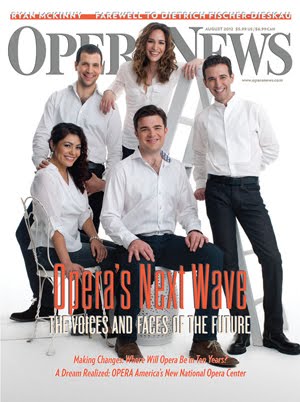
August 2012 issue of OPERA NEWS
A word has been thrust onto the political stage over the last few years. It's actually not a new word, but during the last two or three election cycles the word has gone from being an obscure one that was chiefly used by political operatives, to being commonly used by the media ... the word is, optics.

Look up the word optics in a dictionary, and you're likely to find a very scientific definition along the lines of 'the study of light and vision'. Put in the context of a politician or political campaign, optics refers to the way a situation is perceived by the general public; how an event, course of action, etc. looks to the general public.

It's the politically motivated definition that I'm chewing on today.

On Saturday, I received my August issue of OPERA NEWS magazine. And, as many of you know, I do tend to glom onto - and save - my OPERA NEWS magazines ... yes, I save them all. I have every issue since 1999.

Cray-zy. I know.

Generally when I see the cover at first, I can tend to be a little critical if the image isn't good. Sometimes, I even wonder - quite out loud - "Who is in charge of picking these damned cover photos?" There was one in particular in which a female opera singer was wearing a summery sun-dress, under which, she clearly could have benefited from a well fitting undergarment.

But, I digress.

August's issue of OPERA NEWS might take the critical-cake for me, though. The issue highlights Opera's Next Wave - The Voices and Faces of the Future. On the cover [upper right], we see soprano Ailyn Perez, bass baritone Luca Pisaroni, mezzo-soprano Kate Lindsey, conductor Michael Christie and countertenor Anthony Roth Costanzo, seated or standing in various positions, all looking quite happy and jovial against a white backdrop. The photo itself, taken by James Salzano, isn't bad - but, to be honest, it looks more like a high school dance photo than it does a magazine cover.

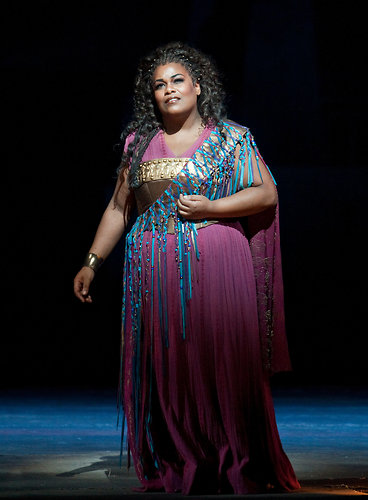
Latonia Moore as the Met's Aida
Now, let me be perfectly clear, I have no doubt whatsoever that these folks are, or at least have the potential to be, the future of opera ... as are the many who are not featured on the cover but, are featured inside the magazine: sopranos Angela Meade, Amber Wagner and Latonia Moore [pictured right], mezzo-soprano Isabel Leonard, composer Nico Muhly, conductor Anne Manson and the like.

As OPERA NEWS very carefully explains in their Viewpoint section:
This issue of OPERA NEWS takes a look at some of the people we feel will be increasingly important during opera's next decade. The list of names that we have chosen isn't meant to be exhaustive or all-inclusive; in a field as well stocked with talent as opera, there were literally scores of possibilities for this issue. We chose to concentrate on individuals whose artistic and professional progress had caught our attention in the past few seasons - and whose exceptional talent, ambition and energy have allowed them to thrive in a field that will always be rich in challenges. These are men and women who have come a long way in the past decade: for example, in 2002, the majority of the singers featured in this issue had not yet made their professional debuts.
Let me be clear, again... the biggest issue for me has nothing to do with those listed as the future of opera. Indeed, my biggest issue has to do with optics.

There's that word, again - optics - how an event, course of action, etc. looks to the general public.

OPERA NEWS has stated that the question of how to attract new audiences to a seemingly "old" art form is one that needs to be answered urgently, as consumers today are bombarded with a mind-boggling array of entertainment options. And, the Met in particular, has spent quite a lot of time and money trying to make opera appear to be more accessible. Not only by physically making it accessible through its Live in HD and On Demand programs but, also by making the productions themselves look more mainstream ... more "Broadway-like".

The saying goes: as goes the Met, so goes the REST of the opera world.

In the opinion of Yours Truly, the Met has spent precious artistic resources trying to shove opera into a small, mainstream box, rather than using their powerful position to educate the audiences about what makes opera different, grand, unique - and, in fact, what sets opera apart from everything else out there.

And now, here we have what is undoubtedly opera's premiere news magazine - published by the Met's Opera Guild, NOT the Metropolitan Opera - discussing the future key players in opera. And, on the cover of the issue, we see the future of opera in dark jeans and white shirts against a white background ... plain, vanilla, stark, barren and, quite frankly, vapid. THIS is the future of OPERA? Generic, void, cold, bland and characterless?

My God, I hope not.

OPERA NEWS, you might do well with a short course in optics. Perhaps after which, you might think differently about how you visually portray the future of this distinctive, exceptional, unparalleled and most epic of art forms.

Tuesday, July 17, 2012

Merola Opera Program gives prestigious award to mezzo-soprano Susan Graham

During a private reception on Saturday, July 14, the Merola Opera Program presented mezzo-soprano Susan Graham with the Merola Distinguished Alumni Award. The award, which has only been given out six times in the program’s 54 year history, is given to recognize extraordinary contributions to the world of opera by graduates of the Merola Opera Program. Susan Graham will join past winners Thomas Hampson, Patrick Summers, Ruth Ann Swenson, Carol Vaness, Deborah Voigt and Dolora Zajick as a recipient of Merola’s highest honor.

Donna Blacker, Merola Board President lauds Graham's achievements by saying:
This award recognizes those Merola alumni that have gone on to forge truly remarkable careers – careers that change the face of opera. As one of the world’s foremost stars of opera and recital, the compelling and versatile Susan Graham is most deserving of this honor. Regarded as ‘America’s Favorite mezzo’ by Gramophone magazine, Susan’s astonishing voice, presence and charisma have captivated audiences around the world. Merola is extremely proud to have her as a distinguished alumna.
Celebrated as an expert in French music, Graham was named Chevalier de la Légion d'Honneur by the French government. Recently, she sang Mahler's Rückert-Lieder with Michael Tilson Thomas and the San Francisco Symphony and recorded the song cycle for the Symphony's own record label. Other recent performances include: Octavian in Der Rosenkavalier with the Metropolitan Opera; Dido in Purcell's Dido and Aeneas with Philharmonia Baroque Orchestra and Nicholas McGegan; Berlioz's Damnation de Faust with Lyric Opera of Chicago, the title role in Handel's Xerxes with San Francisco Opera; and Chausson's Poème de l'amour et de la mer with the New York Philharmonic under Sir Andrew Davis.

Graham as Marguerite in the Met's 'Damnation of Faust'
Known for her performances reviving Gluck operas, Graham sang the title role of Iphigénie en Tauride in a new production staged for her by the Metropolitan Opera which was also performed at Lyric Opera of Chicago, San Francisco Opera and Royal Opera House.

At home and abroad, Susan Graham has sung leading roles from the 17th to 20th centuries in the great opera houses of the world, including The Metropolitan Opera, Milan's La Scala, Royal Opera House, Vienna State Opera, Opéra national de Paris, Dresden's Semperoper and the Salzburg Festival. In addition, she has appeared with many of the world's leading conductors and orchestras.

Born in New Mexico and raised in Texas, Susan Graham studied at Texas Tech University and the Manhattan School of Music, which awarded her an honorary Doctor of Music in 2008. She won the Metropolitan Opera National Council Auditions and the Schwabacher Award from San Francisco Opera's Merola Opera Program, as well as a Career Grant from the Richard Tucker Music Foundation. Graham was Musical America's 2004 Vocalist of the Year, and in 2006 her hometown of Midland, Texas declared September 5 “Susan Graham Day” in perpetuity.

As for the Merola Opera Program, Susan Graham says:
Merola changes the lives of young singers, making possible something that, 25 years ago, I never dreamed would happen to me. It provides a springboard and exposure to the opera world and as they say in New York, ‘If you can make it there, you’ll make it anywhere.’ I cherish this award and Merola will be in my heart forever.

Thursday, July 12, 2012

Fifty Shades of Tallis: EL James' book effects classical music sales.

Who knew that the book Fifty Shades of Grey - which has been dubbed 'mommy porn' due to its steamy plot - would become a publishing phenomenon have an effect on the classical music industry?

[Let us pause for the chuckles and chortles.]

With sales of the novel on the Kindle reaching one million earlier this week, Fifty Shades of Grey has now broken print sales records, too.

The first book in the trilogy has sold one million print copies in just 11 short weeks, beating The Da Vinci Code's previous record of sales of one million in 36 weeks.

Oh... and that ain't all, Chiclets - according to Nielson Bookscan the book has also broken the weekly record for paperback sales, selling 397,889 copies.

EL James's, who was a former self-published Kindle Direct Publishing author, attributed the book's success on the fact that the story offers women a "holiday from their husbands".

Well, little did you know ... while women are taking holidays from their hubbies, they're creating a climax in the UK's classical music industry - having sparked an increase in the sales of a particular piece of classical music.

The novel features the piece Spem in Alium - and readers have been so excited about that piece of music, that they've downloaded the Tallis Scholars version on iTunes. So many downloads, in fact, that the single rose from number 20 to number 13 to number 8 and then, this week, to number 7 on the UK Classical Music Charts.

The founder and director of the Tallis Scholars, Peter Phillips, told The Telegraph: "I haven't read Fifty Shades of Grey but, I am most grateful to the author for introducing so many new listeners to the musical sensation that is Thomas Tallis's Spem in Alium."

Spem in Alium features 40 individual voices singing in Latin and was written during the reign of Queen Elizabeth I.

And for those, like me, who are not well versed in Latin: the words 'Spem in alium' are translated as 'Hope in any other'.

Friday, July 6, 2012

It's Summer. It's hot. So, let's stay inside and get back to basics

Well, here we are Chickpeas ... Summer. And, if you're in NYC - it's REALLY Summer.

Hot. Hot. Hot.

There's not much happening in the world of opera. Many singers are at Summer Festivals or are taking some well deserved time off while companies reset and get ready for the coming season.

And, speaking of "reset" - I thought this would be the perfect opportunity to stay inside of our air conditioned environs and get back to basics. Well - at least some basics of singing, anyway ...

"Bel canto".

What does that mean exactly? Many of us try to achieve it. Other of us try to emulate it. And there are those select few in the opera world that couldn't give a tinker's damn about "Bel canto". (You know who you are - don't lie)

"Bel canto", quite simply, is "beautiful singing". The earliest use of the term "bel canto" occurred in late 17th-century Italy, when it was applied to a sophisticated model of singing that was being practiced among the great singers of operatic and sacred music. The term did not become widely used, however, until the middle of the next century, which was the heyday of opera seria and, the static but technically challenging da capo aria.

In other words: the era of park and bark ... standing still and letting the vocal fireworks fly.

As opera gained popularity as a dramatic vehicle in the mid-19th century, composers favored larger sounds - often pitting performers against louder and denser orchestrations. Larger orchestrations, in larger opera houses forced many singers to produce a sound that could compete, but wasn't always beautiful. It was during this time period when "bel canto" gained a more specific meaning as a term to distinguish the traditional Italian vocal model from this more forceful use of the voice.

Additionally, the term "bel canto" is sometimes attached exclusively to Italian opera of the time of Gioachino Rossini (1792–1868), Vincenzo Bellini (1801–1835) and Gaetano Donizetti (1797–1848). Rossini, Bellini and Donizetti wrote many works for the stage during what musicologists call the Bel Canto Era. This Bel Canto Era preserved many of the Baroque's musical values, although its characteristic formula, such as the da capo aria, did not survive the passing of the 18th century. Changing tastes and social standards also killed off the operatic castrato voice and ensured the meteoric rise of the prima donna soprano and the virtuoso tenor.

In order to perform the operas of Giuseppe Verdi (1813–1901) with all of the dramatic fortitude that they require, the popularity of the bel canto style as espoused by Rossini, Donizetti and Bellini faded. It was overtaken by a heavier and more intense approach to singing that was necessary.

Although the singing became bigger, more vivid and dramatically intense, it could still be counted upon to be "beautiful singing" - as opposed to the speech-inflected singing associated with German opera, namely Richard Wagner's revolutionary music dramas. Wagner (1813–1883) decried the Italian "bel canto" singing model, alleging that it was only concerned with a "round sound". Instead, Wagner advocated the Germanic school of singing which would produce a huge, dramatic sound based on brute strength - not ease of production.

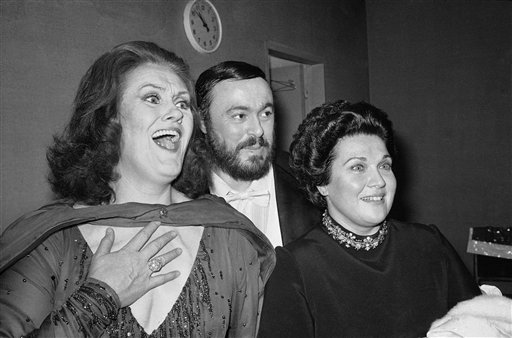
For more on "bel canto", we turn to four masters: soprano Joan Sutherland, mezzo soprano Marilyn Horne, tenor Luciano Pavarotti and conductor Richard Bonynge. In the following two YouTube clips, these four operatic legends sit down and chat-it-up about "bel canto".


And, finally - some modern-day "bel canto" singing from soprano Angela Meade - "Casta Diva" from Bellini's Norma:

Monday, July 2, 2012

In Memoriam: soprano Evelyn Lear 1926-2012

Great American sop­rano Evelyn Lear died yes­ter­day near Baltimore, MD. She was 86.

As one of the twen­ti­eth century’s most celebrated American opera and con­cert sing­ers, Lear cultivated a long and remarkable career spanning some 5 dec­ades and includ­ing 7,500 operatic and con­cert performances.

Between 1959 and 1992, she appeared in more than forty operatic roles, appeared with every major opera com­pany in the US and won a Grammy Award in 1966 for the record­ing of Wozzeck with Diet­rich Fischer-Dieskau and Fritz Wunderlich.

Evelyn Shulman was born Jan, 8, 1926, in Brooklyn. Her father, a Siberian immigrant, became a lawyer, and her mother was a professional classical singer. Her grandfather was a Jewish cantor. As a girl, Mrs. Lear studied the piano and played the French horn with a Tanglewood student orchestra conducted by a young maestro - Leonard Bernstein.

When she was about 18, she married Walter Lear, a doctor, and shortly thereafter, moved to Arlington, VA. Her nonprofessional opera debut took place, oddly enough, at the Agriculture Department, where she sang in Kurt Weill’s American folk opera Down in the Valley.

After she and her first husband divorced, Mrs. Lear returned to New York in the 1950s and began studying at Juilliard, where she met baritone Thomas Stewart while working on a duet from Porgy and Bess.

Her death comes six years after Mr. Stewart - to whom she had been married for 51 years. Each singer enjoyed a remarkable career; as a team, they were even more formidable and delectable, onstage and off.

Evelyn Lear is survived by children from her first marriage, whom Thomas Stewart legally adopted, Jan Stewart of Arlington and Bonni Stewart of Mississauga, Ontario. She also had two grandchildren.

Related Posts Plugin for WordPress, Blogger...