Thursday, August 23, 2012

José Iturbi Foundation sponsors LA Phil's "Dudamel and Domingo"

Maestro Dudamel, JIF's Donelle Dadigan and Maestro Domingo
at the Hollywood Bowl Rooftop Grill after party.
My obsession for old-school Hollywood history (and icons) is no secret. It's been a life-long obsession that dates back to my childhood in Los Angeles. In fact, all you have to do is take a tour around my Pinterest boards to know that I get crazy about it sometimes.

Well, in honor of old school Hollywood history I thought I'd bring you this tidbit of news. This last Sunday, the José Iturbi Foundation sponsored the LA Philharmonic's "Dudamel and Domingo!" concert. Held at the historic Hollywood Bowl, Music Director of the Los Angeles Philharmonic Gustavo Dudamel was joined in an unforgettable evening of Latin songs and operatic arias by tenor Plácido Domingo and soprano Ana María Martínez.

Carrying on Iturbi's legacy, the José Iturbi Foundation showcases the world's greatest classical music talent of tomorrow in conjunction with Iturbi Hollywood Concerts which feature dynamic performances in a setting that reflects Hollywood's Glamour years of the '30s and '40s. Each year of the competition, the José Iturbi Foundation awards more than $250,000 and is the largest cash prize classical music competition in the world.

They certainly have a history of awarding prizes to marvelous talent:
  • Angela Meade, soprano | First Prize in Voice 2008
  • Andrew Garland, baritone | Second Prize in Voice 2008
  • Leah Crochetto, soprano | First Prize, Spanish Prize and People's Choice in Voice 2009
  • Amber Wagner, soprano | President's Prize in Voice 2009
  • Sasha Cooke, mezzo-soprano | First Prize, American Prize in Voice 2010 

To the evening's sold out audience, the links to José Iturbi's history at the Hollywood Bowl were evident everywhere...from opera singers in the plaza to rotating shots of Iturbi with legendary performers at the Bowl projected onto screens before the show and at intermission.

Classical pianist and conductor José Iturbi not only toured the world giving sold out concerts, but he also appeared in several movies - as himself, of course - including Anchors Aweigh in 1945. After meeting Frank Sinatra on the set of Anchors Aweigh, the two men became friends and shared their camaraderie until Iturbi's death in 1980.

Iturbi and Sinatra relax before Sinatra's Hollywood Bowl appearance.
August 14, 1946
(Photo courtesy of the José Iturbi Foundation.)

Wednesday, August 22, 2012

OPERA NEWS incites dialogue on the bland and generic future of opera.

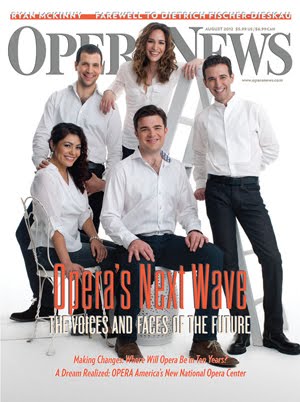
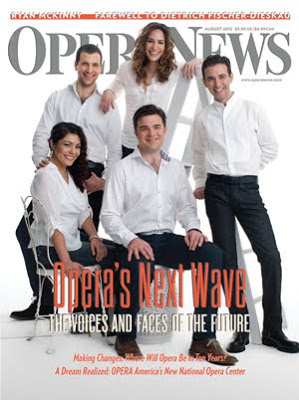
August 2012 issue of OPERA NEWS
I know. I'm kind of shocked, too. The August issue of OPERA NEWS has sparked debate about the future of opera.

As you'll remember, last month I discussed the OPERA NEWS issue from the stand point of optics. But, if by some act God you were not able to read the post - not worries ... we'll review:

A word has been thrust onto the political stage over the last few years. The word is, optics. Look up the word optics in a dictionary, and you're likely to find a very scientific definition along the lines of 'the study of light and vision'. Put in the context of a politician or political campaign, optics refers to the way a situation is perceived by the general public ... as in: how an event, course of action, etc. looks to the general public.

Generally when I see the cover of OPERA NEWS upon its arrival, I can tend to be a little critical if the image isn't good. (I've been concentrating like crazy on images lately.) I'd be lying if I denied the fact that sometimes I do wonder quite out loud: "Who is in charge of picking these damned cover photos"?

There was one in particular in which a female opera singer was wearing a summery sun-dress, under which, she clearly could have benefited from a well fitting undergarment. All truth. Go ahead: hashtag it.

August's issue of OPERA NEWS highlighting Opera's Next Wave - The Voices and Faces of the Future might take the critical-cake for me, though. On the cover [upper right], we see soprano Ailyn Perez, bass baritone Luca Pisaroni, mezzo-soprano Kate Lindsey, conductor Michael Christie and countertenor Anthony Roth Costanzo, seated or standing in various positions, all looking quite happy and jovial against a white backdrop. The photo itself, taken by James Salzano, isn't all that bad - but, to be honest, it looks more like a high school dance photo than it does a magazine cover.

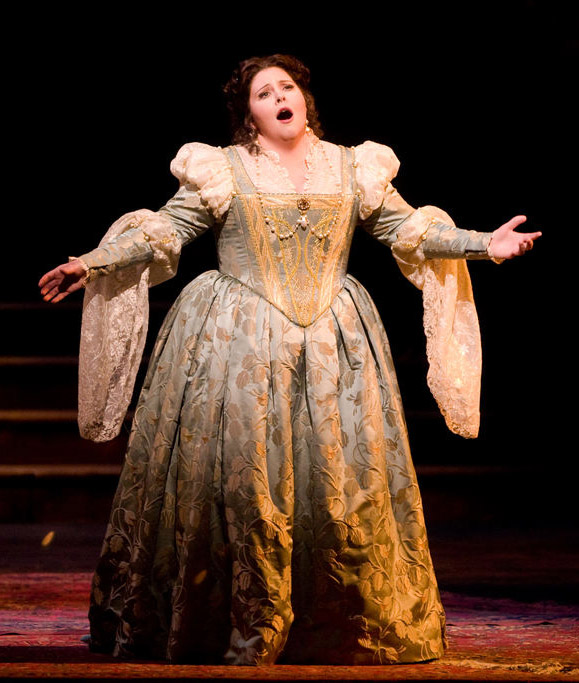
Now, let me be perfectly clear, I have no doubt whatsoever that these folks will contribute to the future of opera. So too will the many folks who are not featured on the cover but are featured inside the magazine: sopranos Angela Meade [R.], Amber Wagner and Latonia Moore, mezzo-soprano Isabel Leonard, composer Nico Muhly, conductor Anne Manson and the like.

As OPERA NEWS very carefully explains in their Viewpoint section:
This issue of OPERA NEWS takes a look at some of the people we feel will be increasingly important during opera's next decade. The list of names that we have chosen isn't meant to be exhaustive or all-inclusive; in a field as well stocked with talent as opera, there were literally scores of possibilities for this issue. We chose to concentrate on individuals whose artistic and professional progress had caught our attention in the past few seasons - and whose exceptional talent, ambition and energy have allowed them to thrive in a field that will always be rich in challenges. These are men and women who have come a long way in the past decade: for example, in 2002, the majority of the singers featured in this issue had not yet made their professional debuts.
But, back to optics - or how an event, course of action, etc. looks to the general public.

OPERA NEWS has stated that the question of how to attract new audiences to a seemingly "old" art form is one that needs to be answered urgently, as consumers today are bombarded with a mind-boggling array of entertainment options. And, the Met in particular, has spent quite a lot of time and money trying to re-brand opera ... making it appear to be more accessible. Not only by physically making it accessible through its Live in HD and On Demand programs but, also by making the productions themselves "look" more "mainstream".

And now, here we have what is undoubtedly opera's premiere news magazine - published by the Met's Opera Guild, NOT the Metropolitan Opera - discussing the key players in the future of opera. On the cover of the issue, we see the future of opera in dark jeans and white shirts against a white background ... plain, vanilla, stark, barren and, quite frankly, vapid.

THIS is the future of OPERA? Generic, void, cold, bland and characterless?

Say it ain't so! Or is it?

Since the issue went into circulation many have cussed and discussed the future of opera.

Zachary Woolfe wrote for the New York Times:
This art form, with its enormous casts, sets and orchestras, and its armies of stagehands and administrative staff, was a dubious financial proposition even before the most recent downturn. I was once told that the good opera company directors are those who lose money responsibly...

...The repertory is largely stagnant, focused on the same small group of hits. The few big stars who remain — the Plácido Domingos, Renée Flemings and Anna Netrebkos — are needed to sell almost anything that is not “Aida,” “Carmen” or “Turandot.”

The typical production style is blandly nostalgic escapism rather than vibrancy or relevance. This was the case through much of America in the 20th century, and there hasn’t been much change so far in the 21st...

... But until opera stops being associated with escapist nostalgia
[Woolfe speaks specifically of movies like Moonstruck and Pretty Woman.] and fancy dates, it is doomed to struggle for relevance.
While Anne Midgette writes for The Washington Post:
...I say I’d like to see more focus on the music — not just in such discussions, but from those who are casting and conceiving of opera seasons for the coming years.

Here’s a case in point: the soprano Angela Meade, who gets a lot of deserved praise in this discussion. Does she have the voice? Indubitably. Does she have the stage presence? Not yet, and I don’t think it’s entirely her fault...

...Meade has the vocal chops, and she also seems like an appealing personality, but in trying to shoehorn herself into a serious tragic-heroine mode in “Ernani,” she squeezed the personality, and consequently some of the thrill, right out. I hope she figures out how to insert more of herself into her dramatic performances, because ultimately, the future of opera rests precisely on the vocal presences and vocal personalities that get audiences excited and make them want to come.
After "someone misconstrued" her post, Midgette qualified her remarks in a separate post saying in part:
This quality of persona has always been a part of what makes opera exciting. And you can’t always predict who will develop it. Take Luciano Pavarotti. At the start of his career, he wasn’t, by all accounts, anything special to watch on stage at all. He developed into something of a stage animal, with a legendary magnetism. He certainly luxuriated in the music he was singing. But he was never much of an actor.

This is what I meant about Angela Meade; and this is an aspect of the operatic art that I think tends to get lost today in training that focuses on all of the individual elements of opera -- singing, diction, language, and, yes, acting -- but not enough on what it takes to get out there and dazzle an audience.
Indeed, the OPERA NEWS snippet on Angela Meade - which was then tweeted from @OPERANEWS - doesn't shy away from pointing out quite vividly that Angela Meade is an opera SINGER not an opera PERFORMER: "she has become a kind of heroine for opera-lovers who place vocal standards well above theatrical ones."

NPR also got into the fun by using the OPERA NEWS cover story as a jumping off point for the discussion Is Opera Ailing? A Conversation About The State Of The Art. You'll have to check that one out on your own so I can get to my point.

Here's the bottom line for Yours Truly...

No one is going to agree on what the future of the art is. But, I have contended here before that ultimately, it appears that the fundamentals of the opera world are changing - not necessarily for the better. And, I think it's key that we have to understand why that is before we can settle on what the future holds.

Opera is a big art form which requires big voices, big gestures and big personalities. It has always been centered around the voice and around making a sound big enough to cut over the orchestra and to fill a house without amplification. In addition, gestures and movements have traditionally been very big in order for those seated at the back of the house to be able to see what's going on.

But at this point in time, some people are trying to change that ... they're trying to fit a grandiose package into a small, very confining space. In fact, I think Zachary Woolfe was onto something... but, perhaps it's not the movies that are the problem - it's the movie screen.

I'm sure you've read about when the movie business transitioned from silent pictures to "talkies". The actors and actresses had to transition they way they acted from overly theatrically-big gestures and facial expressions (which compensated for the lack of spoken word) to a much more subdued way of acting. Today, opera singers who appear on the HD screen are having to do the same. A gesture that would be used during a performance in order for the people in the back of the house to see it, will have to be toned down when the HD cameras are running. And what's more is that the facial expressions that we singers make from time to time in order to produce the sound needed to fill the house, also have to be toned down.

I see it akin to putting a beautiful butterfly into a jar so you can look at it. Not only will the butterfly die sooner - but, part of what makes a butterfly beautiful is seeing it flit about.

I'm suddenly reminded of a tweet I saw in which a singer had asked her father how he like the HD Broadcast he saw that day. Her father's response was something akin to "I really liked it because they didn't look like they were singing.... they looked like real people."

Whether in HD Broadcasts or perhaps in the Movies too, I think putting opera in the movie theaters is skewing the desires of opera's true audience - in a purely psychological manner. When we go to a movie at the local movie house, we see perfectly made-up, perfectly dressed, perfectly sculpted, perfectly scripted, high-budget movies starring the Hollywood-ideal of men and women. So, it also stands to be true that when we go to the local movie house again, but this time to watch Tristan und Isolde, Lucia di Lammermoor, Tosca or even La Boheme - we can’t help but assume that since we’re sitting in the comfortable seats with our nachos, popcorn and silo of Diet Pepsi, that the people on the screen will look just like they do in a Hollywood movie.

It might be over simplified ... but, remember Pavlov and his dog? I think they were onto something there.
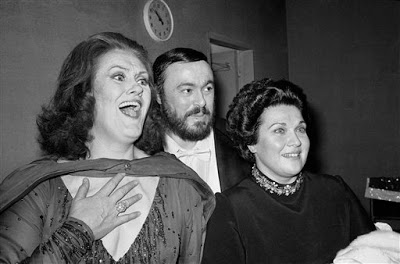
Legends Joan Sutherland, Luciano Pavarotti and Marilyn Horne.
I’m afraid that the days are numbered for opera singers who are magnetic on stage and sing the hell out of a role, but don’t have the Hollywood looks. It makes me wonder: would singers like Caballe, Sutherland, Horne, Norman, London or even Pavarotti have ever had a chance in this day and age? They were all beautiful in their own way, but certainly didn’t fit a “mold”.

It seems that as soon as opera was put on the HD screen, it was assumed that audiences were no longer smart enough to employ the suspension of disbelief. Remember when a singer was cast to sing a role because he or she would truly be remarkable doing so? They may not have even "looked the part" but, the voice carried the performance ... As in when African-American soprano - and legend - Leontyne Price sang the role of a Japanese Geisha Cio-Cio-San. Stunning.

I believe that beyond the gestures and what people are accustomed to seeing in a movie theater, the movie screens are contributing to a larger problem. I think that opera is on the road to Bland-ville. And interestingly enough, the OPERA NEWS cover illustrated my point rather well.

Opera is on a path where emphasis is no longer about the singing, what makes opera unique or what makes opera the grand art form that it is (or was). Instead, a great deal of focus is being placed with laser-like precision on people looking like a Hollywood star. Or, at least "looking the part" ... however bland that might be. All so the-powers-that-be can fool themselves into thinking that opera is becoming more "mainstream" - which, it's not ... nor should it.

What we do as opera singers is far from "mainstream". What we do is different. Opera is huge, loud, colorful, awe-inspiring, distinctive, incomparable and let's be honest ... a little abnormal. Perhaps they we should be celebrating what sets opera apart from everything else out there and should be educating people about what makes it unique, grand and marvelous ... as opposed to forcing opera into a teeny-tiny space.

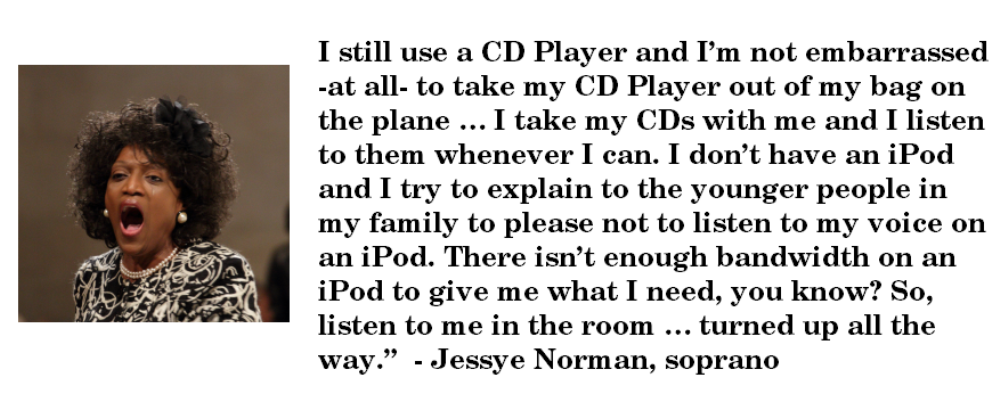
Jessye Norman was recently discussing whether or not she listened to an iPod. She said something that I think is very true when it comes to forcing opera into a teeny-tiny-little space:


Dumbing opera down, making opera more bland, making opera more "mainstream", shoving opera into a small box, simply cannot be the long term future of opera. It simply cannot. Opera deserves better. And, to be perfectly honest, audiences deserve to be given more credit.

Instead of dumbing opera down because some assume general audiences wont get it... we must educate them. Instead of making opera more bland because some are afraid the spectacle will drive them away, we must let it be grand and give them the opportunity to fall in love with it. If we don't, we are enticing an entire generation of audiences to fall in love with something that is not true opera.

Iyanla Vanzant said it best:
"When you don't show up as who you are, people fall in love with who you're not. Then when they find out who you are, that's when they leave."
Hojoto!

Thursday, August 16, 2012

A PSA: Don't let your vote be adulterated.

Today is the day... the day for a Public Service Announcement.

We are a little over 80 days until the 2012 Presidential Election. And, with President Obama and Vice President Biden going head-to-head with the presumptive nominees of the Republican Party, things are heating up.

But, with all of the talk of certain candidates withholding tax returns, the lying about the Presidents cuts to Medicare and what they actually do - as well as, the all-out assault on Women's Rights ... the choice for this November is clear. At least it is for me. Perhaps it's not for you yet.

Regardless of political party, we must move forward in this country. And, that starts by voting this November.

Unfortunately, many state Republicans - trembling in fear that President Obama might get re-elected - are changing voting rules in order to keep certain segments of the population away from the polls. They say it will help deter a form of voter fraud called "voter impersonation" - even though recent research shows that UFO sightings are 3,615 times more common than instances of voter fraud.

What they're not telling you is that they're trying to "fix" the election in Romney's favor because they know that he is incredibly unlikely to win on his own merit.

You think I'm joking?

The passage of the Voter ID law in Pennsylvania was praised by Pennsylvania's Republican House Majority Leader Mike Turzai because in his estimation the "Voter ID law ... is gonna allow Governor Romney to win the state of Pennsylvania".

Now, to be fair: there is a voter-education effort underway in Pennsylvania. Of course - as per usual - it's been contracted out. And, wouldn't you know ... the private lobbying firm that has been hired to educate Pennsylvania voters on the new Republican penned Voter ID law is run by the former executive director of the state Republican Party -- who also happens to be a generous Romney donor.

Despite the best efforts of groups like the ACLU to get the law overturned, on Wednesday morning, a Pennsylvania judge declined to grant a preliminary injunction on the state's controversial Voter ID law. This means that for now, the law remains on the books.

And Pennsylvania is not alone in it's voter suppression efforts. According to the Brennan Center for Justice at NYU, ten states have passed voter ID laws since the beginning of 2011, including the key swing states of Pennsylvania, Virginia and Wisconsin. It has been estimated that these laws would affect as many as 11% of eligible voters nationwide.

11% of Americans being turned away from the polls. TURNED AWAY. And, who does this effect? Older people who no longer have valid state-issued photo ID, students who are at college in a state other than the one in which their Drivers License was issued, poor people who are unable to afford to pay the fee to get a state-issued photo ID and minorities who may not have the pertinent documentation to jump through the hoops required for a state-issued photo ID. All of whom would most like vote for President Obama.

It's happening in Ohio, too.  The Republican lawmakers there have tried repeatedly to restrict the state’s early voting window. Why is having the ability to vote early important? Because on election day, many people who work try to vote on their lunch hours - and, as you'll remember from the heavily Democratic precincts in the 2004 election, people were forced to wait up to seven hours in order to vote. So, early voting reforms were put in place and have been shown to be extremely popular. Now, for this election, the Republicans are trying to trim them back - cutting early voting hours and closing the polling places on Saturdays.

As the law stands right now, early voting in Ohio ends for many voters on Friday, November 2nd, instead of Monday, November 5th. So, on the day when many African-American churches would have gather their hard-working congregations to go cast their early-voting ballot - on that Sunday, November 4th - the polls will be closed in Ohio.

What does it say about a party that has to "fix" elections in order to win? What does it say about their ideas?

Steve Benen at the The Maddow Blog put it best:
[I]f Obama has been such an awful failure, why do so many Republicans feel the need to rig the elections process in the GOP's favor? Shouldn't they consider it easy to defeat the president in a fair fight?
We can't let this happen. We have to do everything we can to help everyone vote. Democrat AND Republican.

Visit NBCNews.com for breaking news, world news, and news about the economy
It is our fundamental right as Americans to participate in the election of our government. It is a key principle upon which our great country was founded. If you sit by and let a nervous political party corruptly muck-up your chances to take part in that vote ... if you allow them to bully you into not being allowed to cast your vote ... then, you have allowed them to adulterate our elections.
Visit NBCNews.com for breaking news, world news, and news about the economy
What can you do? You can volunteer to go door to door, make calls, and talk with our neighbors to make sure everyone in your community is registered and ready to vote on Election Day. You can volunteer to help older people, students and minorities get their photo IDs updated. You can post current Photo ID requirements on your Facebook page or other social media outlets. Or, you can simply ask your co-workers, congregation members, friends and family: Are you ready to vote? Do you have the proper "documentation" to do so? To learn more about what you need on election day - and, to register - visit gottavote.org and click on your state.

Tuesday, August 14, 2012

A Review: Frederica von Stade - Duets, Arias, Scenes & Songs

Shortly after my last post regard mezzo-soprano Frederica von Stade, I went on a listening frenzy.

And, look what I found, Chiclets...

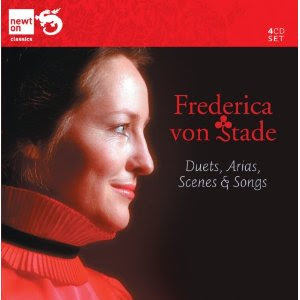
Recently released on the Newton Classics label, Frederica von Stade: Duets, Arias, Scenes & Songs is a 4-disc set that wonderfully captures a snapshot of Frederica von Stade's one-of-a-kind artistry and demonstrates the technical prowess on which this star mezzo-soprano built her stellar career.

During the mid-late '70s when these recordings were laid down, Marilyn Horne and Shirley Verrett were the powerhouse mezzos that everyone was emulating. In the privacy of a rehearsal room, von Stade tried out, what I call, the big-girl arias on which many careers were built. As the story goes, she quipped that she sounded like Minnie Mouse. So, she chose a different path...

Brilliantly paired with soprano Judith Blegen, disc 1 showcases a wealth of beauty and an attention to detail that we so rarely see in today's current array of singers. Recorded with the Chamber Music Society of Lincoln Center, this recording ranges from purely stunning Robert Schumann duets, to von Stade's first recording of Cherubino's "Non so piu" - an arrangement by Mozart for violin and piano.

The second disc in the set trots out the kind or recording that everyone, who is worth their salt, does. But, von Stade's Italian Opera Arias is not your usual Verdi sing-a-long... for reasons outlined above. Cleanly negotiating Rossini's "Bel raggio lusinghier" from Semiramide could give many other mezzos a tutorial in comfortably singing Rossini - as opposed to what many do: fire off as many fireworks as possible, thus overwhelming their audience. Joining forces with mezzo-soprano Janice Taylor, von Stade also amazes in Monteverdi's "Torna, torna" from Il Ritorno d'Ulisse in patria. The use of breath control - and thus, legato line - leaves me with a severe case of goosebumps. No joke.

Showing off her stunning aptitude for the Art Song, Frederica von Stade gives us quite an array of heartfelt songs from John Dowland, Henry Purcell, Franz Liszt, Claude Debussy, Joseph Canteloube and Carol Hall. Accompanied by master-collaborator Martin Katz, the Song Recital recording on disc 3 is sure to inspire you to pull out your Art Song books and get to work.

Speaking of Art Song - disc 4 is of particular interest to me. A self-proclaimed Mahler nut, I am over the moon. Andrew Davis (before he was SIR Andrew Davis) conducts the London Philharmonic Orchestra and von Stade through "Lieder eines fahrenden Gesellen", Ruckert Lieder and two songs from "Des Knaben Wunderhorn". While Davis shows off his buttoned-up, English side in his conducting - the pieces on-the-whole show a youthful animation and buoyancy from the then 35-year-old conductor and 34-year-old singer.

If you are looking to take a tour of Frederica von Stade's career, Frederica von Stade: Duets, Arias, Scenes & Songs is not the recording set for you - as it does not cover the large number of operatic roles that she performed (Strauss, Rossini, Mozart... and even a little Verdi and Bellini). But, it should - most definitely - be on the top of your "To Buy" list.

Friday, August 10, 2012

Another Favorite Clip: Frederica Von Stade reflects and inspires.

In 2009 - during the twilight of her singing career - mezzo-soprano Frederica Von Stade sat down with Emmy-winning interviewer Ernie Manouse for a candid conversation about her career - from it's beginning to the challenge of continuing to perform at an elite level after more than three decades on the stage.

So wise ... so smart ... truly inspiring. Another Favorite Clip.

Tuesday, August 7, 2012

In Memoriam: Marvin Hamlisch (1944-2012)


Like so many people, I was very saddened to hear this morning that Marvin Hamlisch has died at the age of 68.

A statement from his family, which was released through a representative on Tuesday, said that Mr. Hamlisch collapsed after a brief illness and died on Monday in Los Angeles. They did not provide additional details.

His sudden death took many by surprise. On his own Facebook page, he said he was looking forward to returning to the podium of the Pasadena Symphony and Pops: "Love you Pasadena symphony ! ... Wow ! Can't do it without you ! See you in September!"

In a career that extended from small screen to big screen and Broadway to Symphony Pops, Marvin Hamlisch won almost every award available to someone of his stature. He was nominated for an Academy Award twelve times and took home three: for the score of The Sting as well as the score and title song from The Way We Were. He won a Tony Award for his score to the musical A Chorus Line, which also won the Pulitzer Prize for Drama in 1976. Hamlisch also took home four Grammy Awards and four Emmy Awards - two of those Emmys were for the television special, Barbra Streisand: The Concert.

In fact, it was with Barbra Streisand that Marvin Hamlisch had one of his deepest artistic collaborations.

The duo met in 1964 when Hamlisch was the rehearsal pianist for the Broadway production of Funny Girl starring Streisand. Later, not only did Hamlisch write the ballad The Way We Were - which is synonymous with Streisand's name - but, he also wrote the score for her 1996 film The Mirror has Two Faces, and also served as musical director and arranger of Streisand’s 1994 concert tour. It was during those concerts that she introduced him as her "conductor, arranger and dear, dear friend, Marvin Hamlisch".

Broadway music held a special fascination for him. In 1986, Marvin Hamlisch told The Associated Press:
Maybe I'm old-fashioned, but I remember the beauty and thrill of being moved by Broadway musicals — particularly the endings of shows. The end of West Side Story, where audiences cried their eyes out. The last few chords of My Fair Lady. Just great.
Marvin Hamlisch also felt at-home on the conductors podium of numerous symphony orchestras. At the time of his death, he was the principal pops conductor for the Pittsburgh Symphony Orchestra, Milwaukee Symphony Orchestra, Dallas Symphony Orchestra, Seattle Symphony, San Diego Symphony and the Pasadena Symphony and Pops - with whom he had just signed a 3 year contract. And, Hamlisch was just about to add another appointment to his list. Next week, he was to be announced as the principal pops conductor of the Philadelphia Orchestra.

In addition to his current conducting duties, Hamlisch was working on a musical adaptation of the Jerry Lewis comedy The Nutty Professor, for which he wrote the score - as well as a new Broadway musical called Gotta Dance. He had also just finished writing the score for a coming HBO movie, Behind the Candelabra, about the life of Liberace.

The legacy that Marvin Hamlisch leaves behind - as well as the passion and fervor with which he constantly worked - will be admired and lauded for decades and decades to come.

In an interview this last July, Mr. Hamlisch talked about the passion he put into each piece of music he composed.
I’m not one of those people who says, ‘I never read reviews,’ because I don’t believe those people. I think they read ‘em. These songs are my babies. And I always say, it’s like having a baby in a hospital, taking a Polaroid and going up to someone and saying, ‘What do you think?’ And he goes, ‘I give you a 3.’ That’s what criticism is like. You’ve worked on this thing forever — ‘I give you a 3.’ And it’s part of you. That’s the bargain you’ve made.
Marvin Hamlisch is survived by his wife of 25 years, Terre.


--UPDATE--

Barbara Streisand just released the following statement on her website:
I’m devastated. He was my dear friend. He’s been in my life ever since the first day I met him in 1963, when he was my rehearsal pianist for 'Funny Girl'. He played at my wedding in 1998… and recently for me at a benefit for women’s heart disease. The world will remember Marvin for his brilliant musical accomplishments, from 'A Chorus Line' to 'The Way We Were,' and so many others, but when I think of him now, it was his brilliantly quick mind, his generosity, and delicious sense of humor that made him a delight to be around. Just last night, I was trying to reach him, to tell him how much I loved him, and that I wanted to use an old song of his, that I had just heard for the first time. He was a true musical genius, but above all that, he was a beautiful human being. I will truly miss him. ~ Barbra Streisand
For more reaction from stars like Liza Minnelli, Aretha Franklin, Idina Menzel, Alan Menken and former First Lady Nancy Reagan, just click over to The Huffington Post.

Thursday, August 2, 2012

Soprano Angela Gheorghiu on being a 'Diva'.

What does it mean to be a 'Diva'? Over the last few decades the term has gone from being one of unbridled admiration to being another way to say "cantankerous, unprofessional b*tch".

In our great world of opera, the term 'Diva' has become truly synonymous with two names: Maria Callas and Angela Gheorghiu.

Common opera folks, back me up. Am I right, or what?

Trust me, Chiclets: I don't think Gheorghiu minds being paired with Callas ... in fact, it seems that she (or her PR folks) have designed it that way.

As you may remember, late last year soprano Angela Gheorghiu (aka: Mrs. Roberto Alagna ... yes, they're still married.), released Homage to Maria Callas - Favour­ite Opera Arias - a collection of beloved French and Italian operatic masterpieces - apparently inspired by the career and recordings of Maria Callas.

In discussing her 'homage' to Callas, Gheorghiu - who, it seems, has fancied herself as the next Callas for quite some time - says:
Callas was original in everything she did; she was a phenomenon. In every performance she gave her all. She was the most wonderful painter and you can always hear exactly the right color in her voice. Just hearing her sound, you understand all the power or fragility of her emotions. That's a rare talent and a great gift ... EMI was her record label and it's mine too. It feels like a family.
I'm afraid that's right where the "family feel" stops ... that is to say: diehard Callas' fans have not been so quick to embrace Gheorghiu's self-coronation as the next La Divina.

Shortly after the release, Michael White of The Telegraph blogged about his experience at the party celebrating EMI's latest ploy to make money off of Callas' name the launch of Homage to Maria Callas.
A depressing evening last night at the Ivy where EMI were hosting a party for Angela Gheorghiu and her new CD ...

... Most depressing was the rictus-grinning phoniness of the whole thing, as EMI staff fawned over the diva, choked with laughter at her least remarkable remarks, and smothered her with flattery so absurd she should have been offended by it – as any self-respecting artist of integrity could only be. It felt like people humouring a madwoman.

Underneath it all was the sense of desperation that is presumably endemic at EMI these days. Commercially, artistically, this once great company seems to have lost its way. Its modest presence in the recent Gramophone Awards was thanks entirely to Antonio Pappano. The rest of its catalogue doesn't appear to be doing much of interest. And as for this new release, it plants Gheorghiu on dangerous ground – particularly as it comes with a promotional video that splices and superimposes performances of Callas and Gheorghiu singing the same aria from Carmen and making the clear suggestion that they're artists of equal, interchangeable calibre.

That Gheorghiu is a singer of outstanding qualities I don't dispute. But Callas she is not.
One thing that Gheorghiu does have in common with Callas is her propensity for difficult relationships with opera house managements and directors. Some, but not all, of them have stemmed from her opposition to directors who, as she put it in an interview with ABC "want to express their own fantasies, forgetting about the characters. At times ... what they put on stage goes against both the story and the music."

This sounds very similar to an argument between Callas and Sir Rudolf Bing - who was the general manager at the Met during Callas' operatic-reign. Yes, THAT argument... the one that got her fired from the Met.

Gheorghiu's problematic behavior started to become public knowledge back in 1996 when she was cast as Micaela in the Met's new Franco Zeffirelli production of Carmen Singing opposite Waltraud Meier's Carmen and Plácido Domingo's Don Jose, Zeffirelli's vision of the young Micaela called for Gheorghiu to wear a blonde wig, which she adamantly disliked. When the Met toured the production in Japan in 1997, she refused to wear it on the first night to which Joseph Volpe (then, the general manager) famously declared, "The wig is going on, with you or without you". Needless to say, Gheorghiu was replaced by her cover.

She appeared at the Met again in 1998 for six performances of Roméo et Juliette with her husband, Roberto Alagna, as Roméo.

Volpe had planned to engage Gheorghiu as Violetta for a new production of La Traviata, which was to premiere in November 1998 - also directed by Zeffirelli. Alagna was to sing the role of Violetta's lover, Alfredo Germont. According to Volpe, Gheorghiu and Alagna argued with the staff and the director over production details and continually delayed signing the contract. They eventually signed their contracts, and faxed them to the Met one day past their deadline. Volpe refused to accept them. The production opened with Patricia Racette and Marcelo Álvarez as the lovers.

And, her problems were not just at the Met.

In September 2007, Gheorghiu was fired from the Lyric Opera of Chicago's production of La Bohème for missing rehearsals costume fittings, and generally "unprofessional" behavior. Gheorghiu said in a statement that she had missed some rehearsals to spend time with her husband, who was singing at the Met in Roméo et Juliette, and she also stated that she was busy rehearsing for Puccini's Madama Butterfly:
I have sung 'Boheme' hundreds of times, and thought missing a few rehearsals wouldn't be a tragedy. It was impossible to do the costume fitting at the same time I was in New York.
Her reputation wasn't all bad, though. Gheorghiu has pulled together a few triumphs: There was the stellar production San Francisco Opera's La Rondine, which originated at London's Royal Opera House Covent Garden. And not just there, at the Met as well: Adina in L'Elisir d'Amore, Marguerite in Faust, Liù in Turandot, Violetta in La Traviata, and as Amelia in Simon Boccanegra. Most recently, in 2010 she sang Violetta, which replaced her previous engagement as Marie Antoinette in a rare revival of John Corigliano's The Ghosts of Versailles - which was replaced due to the recession.

Following a separation from Roberto Alagna in 2009, Gheorghiu canceled all her scheduled 2010 Met performances of Carmen, for "personal reasons". It would seem that Gheorghiu's personal reasons have to do with a certain tenor (Roberto Alagna) who was to sing her same six performances as Don Jose? The only performances that Gheorghiu had remained committed to were the performances which star Jonas Kaufmann as Don Jose. She later dropped those as well.

She also cancelled other Met performances scheduled near the end of 2010. In March 2011 she cancelled all her scheduled performances of Gounod's Roméo et Juliette at the Met, citing illness. Only days later she cancelled all her performances in the new production of Faust during the Met's 2011/2012 season. According to her manager the singer felt that "She felt uncomfortable in the concept". Peter Gelb, the Met's current general manager, said that her frequent cancellations have become an increasingly difficult problem for the Met. Gelb went on to say that, as of now, plans are still in place for Gheorghiu's return to the Met stage. He also went on the record to say "this has nothing to do with wigs."

Whenever she is pressed about her difficult behavior ... about being a 'Diva' in the negative sense of the word ... Gheorghiu continually attributes her nastiness outspoken nature to her upbringing in Romania under the totalitarian regime of Nicolae Ceaușescu:
Because I grew up in a country where there was no possibility of having an opinion, it makes me stronger now. Lots of singers are frightened about not getting invited back to an opera house if they speak out. But I have the courage to be, in a way, revolutionary. I want to fight for opera, for it to be taken seriously. Pop music is for the body, but opera is for the soul.
I can't argue with her last two points. I very much agree.

So now, for your viewing pleasure, I bring you parts one and two of the BBC Documentary Special: Angela Gheorghiu - Being a Diva. You think I'm kidding? Nope.

Thanks, BBC!

Following the Documentary, a bonus feature: Angela Gheorghiu's "Duet" version of Carmen's Habanera with Maria Callas.


Related Posts Plugin for WordPress, Blogger...