Monday, November 30, 2009

The Dreams of Hoffmann

Today was the day. I had the opportunity to see the final dress rehearsal of the MET's Les Contes d’Hoffmann. Having already seen comments by others who were there as well, I can tell that there are some very strong opinions about this production already.

But, before I get into my opinionated ramblings, it was fantastic to see Maestro James Levine back in the pit for the first time since his back surgery. Welcome back, Maestro!

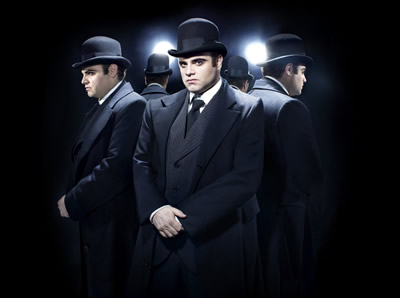
If you had the idea that you would be seeing a traditional production whereby you meet each of Hoffmann's true loves in the real-life form with which he interacted, you were in for a disappointment. In this production, with direction by Tony Award winner Bartlett Sher, sets by Michael Yeargan and costumes by Catherine Zuber, you got the distinct impression that in the telling of the stories, Hoffmann was confessing intoxication-induced dreams. These dreams proved to show the ideals of love that inhabit his mind.

The Prologue began with the poet Hoffmann asleep. His Muse transformed into his sidekick, Nicklausse and the tales began. Singing the role of Nicklausse was Kate Lindsey - a mezzo whose voice fit this trouser role nicely.

The first tale is of Olympia - a mechanical doll created by Spalanzani, an eccentric inventor. We began the Act in Spalanzani's shop circa early 1900s, where life-sized dolls and various doll parts were lying about while a Dr. Evil clone (Spalanzani) flit about. After an argument with Spalanzani over the division of profits from Olympia, the villain in this dream, Coppélius, destroys Olympia in a fit of rage. Hoffmann first love is gone.

The dreamy feeling was set as a theme for this production here in Spalanzani's shop as a giant revolving dragon-like thing descended from the rafters and continued to pivot round and round throughout the act. I was reminded of one of those things that you see in a dream and think, while dreaming, "what the hell is that doing here?"

Korean soprano Kathleen Kim, a spritely and tiny little Olympia, was truly a wonder to hear because hers is not the same carbon copy performance that we have heard time and time again. It is not another Sutherland, Sills or some amalgamation of the two. Kim aptly made this Olympia her own. Unfortunately, she lacked some of the stiff movements of a doll - in fact; she often seemed to come in and out of the characterization.

Following the first intermission, it was announced that tenor Joseph Calleja, whose voice reminds me of a sound from yesteryear that we might hear on an old grammophone recording, had been suffering from a cold and would not proceed as Hoffmann. He wanted to rest and get himself in shape for the opening. To be quite honest, with the exception of a couple of tight notes, I hadn't noticed illness. He was replaced by David Pomeroy who did a fine job as the Hoffmann for Acts 2, 3 and the Epilogue.

As we moved into the second Act, we were treated to another of Hoffmann's dream sequences. In this one, we saw a shockingly stark set with scrims of trees randomly moving in and out at a glacial pace. Antonia sings her love song filled with memories of her dead mother, a famous singer. We find out that Antonia has inherited her mother's weak heart and is forced by her father to stop singing. The villain in this dream, Dr. Miracle, has other plans. Dr. Miracle conjures the ghost of Antonia's mother in order to get Antonia to sing herself to death.

You gotta love operatic plots, right?

Anna Netrebko is an absolutely stellar Antonia. Her "silent movie" treatment of Antonia works very well in contrast to the stark and nebulous setting. As Dr. Miracle conjures the mother, we saw her walking ever so slowly at the top of the stage - she stopped - and we heard the lush, bourbon colored voice of Wendy White as she sang her first "Antonia...". It gets me every time. And this time, it didn't just get me, it slayed me. As we listened to Antonia's mother coaxing her daughter to sing, she calmly walked down stage and continued to remain ghostly while Norma Desmond... I mean... Anna Netrebko continues with Antonia's histrionics, eventually singing herself into expiring.

Another of Hoffmann's loves is gone.

The third Act transports us to Giulietta's Palace circa the 18th century. As the curtain rose today, the audience erupted into applause because this dream sequence is the most opulent of them all. Giulietta is a courtesan and in order to drive that home, we see quite a few women roaming about in nothing more than an almost-thong and a pair of pasties. Giulietta is woo'ed into helping this dream's villain, Dappertutto after he produces a large diamond with which he will bribe Giulietta to steal Hoffmann’s reflection for him. Giulietta has already stolen her current lover Schlémil’s, shadow.

As a side note: the first opera production with which I was ever associated was a production of The Tales of Hoffmann. I was in college and sang chorus with Spokane Opera. In our production, Schlémil was played by a certain Broadway star that is not only currently starring in Finian's Rainbow, but is also currently starring in NBC's 30 Rock. That's right Ladies and Gents, our Schlémil in Spokane was none other than Cheyenne Jackson. It's such a small world.

Mezzo soprano Ekaterina Gubanova sang Giulietta with a rich, chocolatey sound that could seduce anyone. Her voice is extremely even from bottom to top and lent itself amazingly well to Giulietta. I prefer a mezzo Giulietta as opposed to a soprano because a mezzo sound gives the same amorous feeling that we might hear in Carmen or Dalila.

This third Act gave the Met Opera Chorus a vehicle to shine brighter than ever. Their balanced, clean and sturdy sound worked extremely well during the entire show, but during this third act, they had the opportunity to do what they do best: open up and sing.

Meanwhile, back at the ranch, Hoffmann has completed the dreamy accounts of his loves, or ideals of love. At this point, we see the Prima Donna, Stella - Hoffmann's latest love - fresh from her stage triumph. Stella is just as unattainable as Hoffmann's other loves for she belongs to Hoffmann's nemesis Lindorf. The clincher is that each of the stories that we had just been treated to, actually described different attributes of one woman, Stella. She is the ultimate triune as she is part Olympia, part Antonia and part Giulietta.

Hoffmann can't have the loves in his dreams, nor can he have the love of Stella. Nicklausse transforms back into his Muse and Kate Lindsey's voice finally bloomed into a robust femininity that was rightly absent from her boy-ish Nicklausse. The Muse encourages the poet to find consolation in his creative genius just as Hoffmann's loves, sans Stella of course, reappear onstage as if to say, "we live on with you in your dreams and in your poetry."

If you want to see a production that is more about dramatic substance and less about smoke and mirrors, this is a must-see for you. It's visually stunning when there is less dramatic meat in the score and is discernibly sparse when the drama is sizzling away. These tales of Hoffmann are brought together into a single cohesive story - all the while gracefully amplifying the differences between the tales' heroines and thus, between Hoffmann's ideals of love.

Wednesday, November 25, 2009

Wishing you and yours a very Happy Thanksgiving!

Julie Andrews, without the vocal repair, plans a comeback concert

As we reported back in October, Dame Julie Andrews was in talks with a team of doctors about a possible fix for her damaged vocal chords.

The damage occurred after Ms. Andrews had surgery in 1997 to remove nodes from her vocal chords. Unfortunately, the surgery caused a scar tissue build-up which destroyed her famous soprano voice.

Andrews was thought to be one of the first patients to undergo a new surgical treatment developed by Robert Langer of the Massachusettes Institute of Technology and voice specialist Dr. Steven Zeitels. The pair would remove scar tissue from the vocal cords and then would inject them with a gel called polyethylene glycol. Designed by Langer and his team, the gel was specially designed to mimic the natural elasticity of vocal cords.

Here's an update for you:

TimesOnline.co.uk is reporting that Dame Julie has scheduled an upcoming "comeback" concert in London. Twenty years have passed since the 74 year old singer's last stage performance in Britain and generations of fans are eager to hear her.

Although all of our research shows that Dame Julie has not undergone the treatment yet, it has been said that she has started to sing little by little and has begun to regain the confidence in confidence alone.

In recent years, there have been a few concerts “hosted by” Julie Andrews, in which Broadway singers performed songs associated with her or with leading ladies in general. The number of these concerts has increased during the past season and have become more focused on Dame Julie. As a matter of fact, in many of the concerts, she even narrated a musical arrangement of one of her children’s books.

During the last "hosted by" concert of the season, Dame Julie surprised her live audience by mustering all of her determination, confidence and stoic fortitude ... singing four solo songs.

The upcoming "comeback" concert, set to be at the O2 arena in London where Michael Jackson was to have performed, will be an extension of these "hosted by" concerts.

Maurice Whitaker, of IMG Artists, the agent for the show, told the TimesOnline that he promised that Dame Julie “will be performing four or five genuine solo numbers” as well as singing with other vocalists. "Singing is partly a confidence game," Whitaker continued, "and she has regained it."

Songs on the program are said to include the Rodgers and Hammerstein classics Edelweiss, Getting to Know You and Oh, What a Beautiful Mornin’.

Yesterday Dame Julie said: “To perform once again in my homeland on the London stage will be a wonderful moment — it is where it all began for me.”

Go get 'em Jules!


Link: "The hills are alive: Dame Julie Andrews plans singing comeback on London stage next year" at the timesonline.co.uk.

Tuesday, November 24, 2009

So, we begin the end ... of 2009

As the year begins to draw to a close and people start warming up their voices for a little "Auld Lang Syne", we here at A Liberal's Libretto have started to comb our sources for the lists.

What lists, you ask? Well, the "Year in Review", "Entertainer of the Year", "Most [insert appellation here] of the year" lists, of course. It's how we find out who is in and who is on their way out. Although, let's be frank, if your name is on any list at all, you're still in. Am I right?

Enough with the chatter - let the clock start counting down to 2010, Ladies and Gents. We have found our first list.

Mark Blankenship of The Critical Condition writes:
Even when physical magazines go the way of the rotary phone—and that can’t be more than five years away, right?—Roommate Joe and I hope that Entertainment Weekly still produces a newsstand copy of its year-end issue. You know, the one where they anoint the top entertainers of the year with fancy photo spreads and essays, and then present all the critics’ picks for the best and worst of the last twelve months (that’s last year’s cover shown above). That issue, along with the annual Oscar nominees spotlight, arrives in our mailbox like a gift from pop culture heaven.

And because we are geeks passionately invested in the culture, Roommate Joe and I have decided to predict some of the artists whom EW will choose for this year’s issue, which should arrive in the middle of December. That’s right: We’re calling it early. Boom!

We’re also throwing down predictions for the magazine’s annual list of “Great Performances.” It gets its own issue these days, but in our hearts, it will always be part of the year-in-review spectacular.
After giving the list the once-over, I think they've pretty much nailed it. Now, it's your turn. Check it out: The Critical Condition.

[Photo - Baltic Bright TV Clock by Schlabaugh & Sons courtesy of wilddeserthare.com.]

Monday, November 23, 2009

In Memoriam: Elisabeth Söderström 1927-2009

I understand that I am a little late in reporting this, but I couldn't let it go by without so much as a mention.

Soprano Elisabeth Söderström, one of the most versatile and loved operatic singers to come out of Sweden, died on November 20th. Ms. Söderström was 82 years old.

It is said that she was a superb actress, who brought to life a wide range of roles, including the Countess in Tchaikovksy's The Queen of Spades, the Marschallin in Strauss's Der Rosenkavalier and Marguerite in Gounod's Faust, Leonore in Beethoven's Fidelio and another Countess in Strauss's Capriccio.

But, perhaps one of the most valued qualities of Ms. Söderström was not what she did on stage, but what she did off stage. You see, Ms. Söderström was a family gal. The telegraph.co.uk put it this way:
A British television profile, also in 1969, showed her leading a normal family life, preparing a meal in her kitchen. Indeed, family was so important to Elisabeth Söderström that she found it difficult to understand why Rudolf Bing (General Manager at the Met) demanded that, in the seventh month of her third pregnancy, she appear as Musetta (with Renata Tebaldi as Mimi) in La Bohème. "I almost had my baby on stage," she recalled with horror.

In 1964, after six seasons in New York, she took her young family back to Sweden for their schooling, not returning until 1983 when she sang at the Met's centenary gala with Kathleen Battle and Fredrica von Stade under James Levine. Meanwhile Bing, who chastised her by saying that other singers would sell their souls for a contract at the Met, barely mentioned her in his memoirs.
For more on the life of soprano Elisabeth Söderström including her incredible sense of humor and her wide ranging and tireless efforts on the behalf of opera, please be sure to read her obituary at the Telegraph.

[Photo - INTERMEZZO by Richard Strauss, Glyndebourne Festival Opera 1976, Elisabeth Soderstrom as Christine. Photo appears courtesy of: Guy Gravett Collection / ArenaPAL.]

Sunday, November 22, 2009

Closing with Bel Canto...

As National Opera Week draws to a close - it's only fitting that we watch a fantastic discussion on Bel Canto singing.

In my previous post, I discussed "the heritage of magnificence" - these 4 people, mezzo soprano Marilyn Horne, soprano Joan Sutherland, tenor Luciano Pavarotti and conductor Richard Bonynge, inexhaustibly contributed to that heritage. Enjoy!


Thursday, November 19, 2009

Let's take a look: the rich heritage of magnificence...

This week, we've celebrated National Opera Week by discussing some past moments in time, the NEA Opera Honors, a spectacular MET inspired VOGUE photo shoot and even watched some true divas having a little fun.

Now, let's take a look at the future of opera. The melding of the past and present with new innovations and ideas.

This morning, I had a ton of catching up to do. Catching up? Yes, indeed. The last two days have kept the fingers that I try to have on the pulse of all things artistic, busy with other, more mundane (yet financially necessary) activities.

In other words, my day job got in the way.

As I was looking at all of the blogs, websites and news sources that I try to skim daily, I read about Aprile Millo's NY Recital Debut - which, is amusingly written about over at our dearest La Cieca's place, parterre.com. I also looked at some of the video tributes and interviews of those honored at the NEA Opera Honors over the weekend.

Then, it occurred to me that these people in particular -Millo, Horne, Mansouri, Rudel etc.- all represent the generation of greatness that came before us. They represent the people from whom we should gain as much knowledge as possible as they are the operatic elders that come from a time when artistic greatness was paramount. Period. They are our connection to the "old school" traditions.

I am a firm believer that we have to have a clear understanding of where we've come from, before we can get a grasp on where we are going. Opera is a genre that is firmly based on tradition - more so than other genres, I believe. When you ignore that tradition and simply trudge forward without regard for the people and talents that have come before you, it is as though you are ignoring their achievements, talent, hard work, perseverance and dedication to the music and craft that we love so much.

They say the only thing constant is change. And, let's be honest, we would be fooling ourselves to think that opera was immune to change. With the advent of the HD MET Broadcasts - we've already seen the "look" of opera evolve into something a little more "hollywood".

As opera continues to grow and evolve, we will see brand new productions of new operas and will also see some of the old warhorses discarded to make way for new productions of standard repertory.

Some new productions will be successful and will please the public - such as the MET's production of Janacek’s From the House of the Dead. Yet, some of the productions that are being made-over will insight fury and contempt - such as the MET's Luc Bondy version of Tosca.

Here's an interesting thought: audiences will allow their minds to be stretched when it comes to new operas - however, they are not so willing when the traditional warhorses that seem more like a security blanket than an opera production, are made new. Why? Because an audience that allows their mind to expand, also likes to cuddle up with a Tosca security blanket - as it represents tradition. The old warhorses represent what has come before ... the performers that have come before.

When we watch Tosca put the candles next to Scarpia's lifeless body, which is a direction actually noted in the score, we can't help but be reminded of when Callas did it, or when Caballe did it, or when Price did it. Many of us have seen these performers through their legacies now available on DVD, while the numbers of people who actually saw them perform live begin to dwindle. It is up to us, the new generation, to take the traditions onward. It is up to us to carry the greatness that encompassed these productions and performers forward with pride and in allegiance to the genius possessed and hard work with which they molded their craft.

As we witness the perpetual ebb and flow of the "state of opera", we must remember that we are walking a tight robe. We must serve the music, the intentions behind the story and the tradition that has carried both the music and story through hundreds of years, while getting and keeping butts in the seats with new innovations and ideas.

Let's not forget that if we want to challenge our audiences, we must also reward them with the warm and cuddly blanket of traditional productions - productions that not only carry tradition forward, but also make the audience feel like they've been a part of the rich heritage of magnificence that has come before.

[Photos - T.R.: Montserrat Caballe, Luciano Pavarotti in the MET's Tosca. By Beatriz Schiller for LIFE. M.L.: Maria Callas, Tito Gobbi in Tosca. B.R.: Leontyne Price as Tosca.]

Wednesday, November 18, 2009

Another Favorite Clip

As we continue to celebrate National Opera Week - I thought I would give some proof that true divas aren't just about operatic drama. They have a lighter side, too.

Whether it's light music or heavy drama... a true diva knows one thing. She has to sing for her supper.

In this installment of Another Favorite Clip, divas Marilyn Horne, Frederica Von Stade and Renée Fleming have some fun with Sing For Your Supper from the Rodgers and Hart musical The Boys From Syracuse. Enjoy!

Tuesday, November 17, 2009

One moment in time ... Roberta Peters

As we continue to celebrate National Opera Week we bring you another installment of One moment in time ...

On this date in 1950, a 20 year old Roberta Peters made her MET debut in Don Giovanni. Fritz Reiner conducted the cast that included Jerome Hines as the Commendatore and Eleanor Steber as Donna Elvira.

Ms. Peter's debut shot her to operatic stardom, some say, because of the stories surrounding her education, cultivation and experience - not to mention the MET audition to beat all auditions. More on that later.

Roberta Peters was born Roberta Peterman in The Bronx, NY. She started study voice at age 13, encouraged by tenor Jan Peerce, with William Herman, a strict teacher known for giving exhaustive (and exhausting) training. Herman made sure Peters had French, German and Italian lessons and made her sing scales from a clarinet training book.

After six years of training, Herman introduced her to Sol Hurok, an impresario of sorts who arranged for an audition with Rudolf Bing.

If you don't know who Rudolf Bing was... shame on you - look it up. Bing had her sing the Queen of the Night's vengeance aria from The Magic Flute which contains four high Fs ... yes, that's F above high C. Bing didn't hear it once, he had young Roberta sing it seven times - if you do the math, that would be 28 high Fs.

All the while, Bing listened from all parts of the hall to make sure she could fill the hall with sound. He then scheduled her to sing Zerlina in February of 1951.

Things were not to work out that way as fate stepped in. Peters received a phone call from Rudolf Bing on November 17, 1950 asking if she could sing that night. That evening's Zerlina, Nadine Conner, could not perform. Peters obviously knew the role, but had never sung with a full orchestra, never performed in a full opera production, never even performed on stage, professionally or otherwise, except for her audition. She accepted and the rest, they say, is history.

Quaintance Eaton reviewed the performance for Musical America, saying in part:
The surprise debut of twenty-year-old Roberta Peters, who was summoned to sing the role of Zerlina when Nadine Conner fell ill at three o'clock on the afternoon of the performance, gave the first Don Giovanni of the season an air of unusual excitement. The attractive girl won an immediate place for herself in her first appearance on any stage, and her fresh youth, pretty voice and stage wisdom provided the chief interest of the evening. From her first entrance at the head of a line of dancing country girls, Miss Peters never faltered in what seemed an ideal embodiment of the peasant bride and her gaiety and charm pervaded the scenes in which she appeared. Her voice was clear, accurate in pitch and focus and lovely in quality.
Roberta Peters continued to sing at the MET for 35 years until her last performance there as Gilda in Rigoletto on April 12, 1985.


Links:

Information comes courtesy of the MET Opera Database and Wikipedia.

Monday, November 16, 2009

One moment in time...

In celebration of National Opera Week, here are a couple of moments in time for you:

On this day in 1908, Arturo Toscanini made his MET debut conducting Aida. It was opening night of that season with Louise Homer as Amneris and Enrico Caruso as Radamès. Also making her debut that night was Czech soprano Emmy Destinn as Aida. Born Ema Destinnová in Prague, Destinn [R.] went on to sing the US premiere of D'Albert's Tiefland a week after her debut. She would continue to sing at the MET regularly until her final performance with the company on December 27th 1920. The General Manager at that time was Giulio Gatti-Casazza.

Another US premiere happened on this day - this one in 1926. Puccini's last opera Turandot premiered with Maria Jeritza in the title role. The Calàf was Giacomo Lauri-Volpi with Martha Attwood making her debut as Liù.

The New York Times' review said in part:
The production invites more commendation than the music. The music has certain interesting features, but they are not those that inhere in a score of significantly creative or emotional quality. The progress of this-where any progress is shown-is technical or theatrical, but it is not the progress of inspiration or power, The opera, as always has been the case with the composer, owes much to its book. The development of the story is rapid, the episodes are short; the audience is assailed immediately the curtain rises, knocked breathless, as it were, by the scene and by the chorus-one of the best pages of the work-and before there is opportunity for consideration or criticism the scene is changed with another bewildering vista of color and Far East fantasy on the part of (Set Designer Joseph) Urban...

...The audience was exceptionally demonstrative. Applause repeatedly interrupted the progress of the opera. Curtain calls were more than will be numbered here. There was every feature of a triumph. The American premiere of
Turandot was in fact a triumph of the occasion and of the opera company which had so lavishly mounted a work of qualities various. It was a triumph which may repeat itself some five or six more times this season. But a second season, if it should occur with Turandot, would tell another story.
As a matter of fact, Turandot ran for 12 performances that season.


Link: Facts and photos provided by the MET Opera Database.

Friday, November 13, 2009

It's National Opera Week!


National Opera Week begins today! You can count on Vogue to be on trend and ready to celebrate.

A spread in the December issue of Vogue Magazine was inspired by the Metropolitan Opera's production of Hansel and Gretel. Photographed by Annie Leibovitz, these photos are a fantastically fashionable representation of this amazing production.

If that "witch" looks familiar to you - it's because it's none other than Lady Gaga.


Links:

To view the Vogue layout, click here.

To see more information about the MET's Hansel and Gretel, see the MET OPERA website.

Thursday, November 12, 2009

NEA Opera Honors to kick off National Opera Week

Let's hear it for the great state of California! And, not just because it's the birth state of Yours Truly.

The Golden State will be represented to the fullest at this years National Endowment for the Arts Opera Honors - which boasts an operatic a-list of stars.

The honors will be bestowed upon mezzo-soprano Marilyn Horne (pictured right at her birthday party) who not only began her career in L.A., but also currently runs Santa Barbara's Music Academy of the West's vocal program and the Marilyn Horne Foundation, composer John Adams, who is based in the Bay Area and has close ties to the Los Angeles Philharmonic, and Lotfi Mansouri, former general director of the San Francisco Opera, whose wide-ranging career began in L.A. and continues with frequent directing at San Diego Opera.

These Californians will be honored alongside NY City Opera conductor Julius Rudel and director-librettist Frank Corsaro. In addition to the distinct honor of receiving the prize, $25,000 will also be given to each recipients.

The celebration, which is to be held at Harman Center for the Arts in Washington, D.C., will be presented in partnership with Opera America and Washington National Opera. It will feature musical tributes from soprano Angela Brown and baritone Gordon Hawkins, as well as a video tribute to each recipient.

Not only is the honors list amazing, but the presenters list is equally as stellar. On the list: Andre Previn will be the presenter for Mansouri, Broadway and concert singer Barbara Cook will present to Horne, soprano Shirley Verrett is Rudel's presenter, and composer Carlisle Floyd, who collaborated often with Corsaro, will present his award.

Floyd was one of the four inaugural NEA Opera Honors recipients last year, along with soprano Leontyne Price, conductor James Levine and opera administrator and advocate Richard Gaddes.

Why on earth is this not being televised? This is big stuff! Alas, we'll have to settle for the old fashioned method made new.

The WFMT Radio Network, based at Chicago classical station WFMT, hopes to send the live broadcast to more than 150 radio markets. For those who are not part of those markets, wfmt.com will carry the proceedings live starting at 4:30 p.m. PST on November 14. But, you better carve out the time to listen because it has been reported that the program won't be archived for later listening.

The NEA Opera Honors kicks off National Opera Week, which runs from November 13 - November 22. According to Opera America, National Opera Week will celebrate opera in America as a contemporary cultural expression. For more information, see the links below.

Included in the list of National Opera Week events held around the country are the annual Opera News Awards and the annual Richard Tucker Music Foundation Gala; both in New York.

Celebrate National Opera Week!


Links:

For more information on the NEA Opera Honors, you can visit the NEA website.

To find a National Opera Week event in your area, you can visit the Opera America website.

Here's where you can find out more about the Opera News Awards and the Richard Tucker Foundation Gala.

John Adams, Lotfi Mansouri, Marilyn Horne, Julius Rudel, Frank Corsaro, soprano Angela Brown, baritone Gordon Hawkins, Opera America, Washington National Opera, Los Angeles Philharmonic, San Francisco Opera, San Diego Opera, Music Academy of the West, NY City Opera.

Tuesday, November 10, 2009

*Update* The MET receives a windfall from across the pond

The Scottish Sun is reporting that music lover Mona Webster, who died in August at the age of 96, gave £4.5m to the Metropolitan Opera and left millions to the UK's Wildfowl and Wetlands Trust. Ms. Webster's estate is worth an estimated £10m in total.

This is exciting news for the MET... but to me, one of the best parts of this story is the opening sentence of the Scottish Sun article, which reads exactly as:
"A RICH widow has shocked friends and family by leaving £4m in her will - to an American OPERA HOUSE."
SCANDAL!

According to a Sun source: "Everybody knew about Mona's love of opera and birdwatching. But the family are stunned at her level of generosity." While a MET spokesperson says: "Mrs Webster was a long-time friend and a generous donor. She will be greatly missed."

Indeed, I'm sure she'll be missed... but £4.5m to the MET is quite a legacy to leave behind.

From this MET fan: Thank you Mrs. Webster!

- UPDATE -

Just so you all know that Yours Truly has done his homework, I'd like to clarify something.

It seems that there is some confusion on the varying reports as to the worth of Mrs. Webster's estate and how much she bequeathed to the MET. Some reports hold her worth, as reported here, at £10m with £4.5m going to the MET. While other reports, including the NY Times, hold her worth at $16.6m with $7.5m going to the MET.

Please note the symbols £ and $. The difference is in the currency conversion.

Another interesting sticking point though: Ms. Webster left only $167,000 to the Royal Opera Trust, which is a benefactor to Covent Garden in London, much closer to Mrs. Webster's home. According to the NY Times, MET officials said Ms. Webster had complained about the Royal Opera.

Gail Chesler, the Met’s director of planned and special gifts said “She would tell me things that she didn’t like that Covent Garden was doing, and she just loved the Met. It (Covent Garden) was all over the place — casting, productions, management.”

I'm sure many at Covent Garden are stoically turning a blind eye.


Links:

Scottish Sun: Scots widow leaves £4.5m to N.Y. opera.

New York Times: Lover of Birds and Opera Leaves Millions to Both

Monday, November 9, 2009

Spreading holiday cheer

Are you holiday shopping and need some suggestions?

Check out these Gift Ideas from A Liberal's Libretto for the Opera, Broadway & Book lover in your life.

Also, help us build the list. Do you have some suggested items that we've not added? Let us know.

Strapped for cash, Honolulu Symphony bows out

The Honolulu Symphony said it will file for bankruptcy protection and may lay off half of its musicians due to mounting debts, lower revenues and less than stellar fundraising.

The 109-year-old symphony, which bills itself as the oldest American orchestra west of the Rockies, said it will cancel all of its November and December concerts. In addition, the company made no guarantees that the rest of its 2009-10 season would go on.

In speaking to the Honolulu Advertiser, Majken Mechling, the symphony's executive director, said "We cannot spend money we do not have. We cannot continue with business as usual."

Honolulu Symphony is the latest in a string of high-profile bankruptcies to hit the Hawaiian economy.

According to the Honolulu Advertiser- over the past 18 months, the state's largest phone company, Hawaiian Telcom Inc., local retailer Hilo Hattie and Hawaii Medical Center have filed for bankruptcy reorganization.

Mechling said the symphony has accumulated a debt of more than $1 million and has struggled in recent years to meet its $4.1 million-a-year payroll.

The Honolulu Symphony is added to the list of Mainland symphonies — including those in San Antonio, Nashville, Colorado Springs, San Diego and Oakland — that have filed for bankruptcy protection over the past 20 years.

Some, like Oakland and San Diego, filed for bankruptcy liquidation but made successful comebacks years later thanks to economic rebound.

But without an economic rebound in sight, Honolulu Symphony is faced with cutting up to half of the symphony's musicians. In recent days, all but six of the symphony's 22 administrative staff have been let go.

The bankruptcy caps a tumultuous two years for the symphony and its employees.

Steve Dinion, chairman of the musicians orchestra committee, told the Advertiser that the musicians were devastated by Friday's announcement.

Dinion, the symphony's timpanist, said musicians have continued to perform for the symphony during the past two years despite going "months and months without paychecks." This has lead to high turnover in the ranks and understandably low morale.

In addition, Health Care Reform couldn't come soon enough for these musicians. About half of them recently received notification that their health insurance coverage will be terminated.

But Peter Shaindlin, the chairman of Honolulu Symphony's board remains optimistic. He told the Honolulu Advertiser "The Honolulu Symphony Orchestra has achieved a legacy that is priceless and one that can be conceivably rekindled with the combined willingness of community, board and musicians."

Friday, November 6, 2009

Finally! A triumph for City Opera.

Indeed. Last night's NY City Opera Gala, was a triumph. No, not just in the musical sense, although with performers such as: Lauren Flanigan, Joyce DiDonato, Joyce Castle, Samuel Ramey, Measha Brueggergosman and Rufus Wainwright - a musical triumph was all but in the bag.

Last night's major triumph was the gala itself - a record breaker in the fund raising sense. City Opera raised $2 million, marking the most successful gala in City Opera history. Additional funds were raised with a live auction featuring experiences like an African fishing adventure, a five-star trip to Jordan, and a Greek art trip.

The evening honored David Koch, in recognition of his $100 million lead gift to City Opera's joint capital campaign with New York City Ballet to renovate the form State Theater at Lincoln Center.

I've made no bones about the fact that I have not-so-nice feelings toward the David Koch situation. But, money talks. For sure.

That's all I will say about that.

The gala also marked the beginning of City Opera's 2009/2010 season, the first under its new general manager and artistic director, George Steel. I know I don't have to remind you (but, will anyway) that City Opera's survival was in question just a year ago, when the Belgian impresario hired to lead it, Gerard Mortier, left the post before he officially started.

On top of the Mortier fiasco, the company closed down for the year as its theater was renovated, fundraising plummeted with the current financial crisis, and the opera ended up with a $15 million deficit.

Mr. Steel was hired in February to bring the company back to life. Since then, he has raised $14 million and put together a reduced and financially conservative season of just five operas.

Most recently however, Mr. Steel's leadership was questioned and even threatened by an attempted coup by former board members with the former General Director from across the plaza reportedly at the helm.

But last night, most of the drama was left onstage.

Last night was about a successful opening and the kick off of a new era. In addition to the company reaching its subscription goal for the entire season in September, “We set an ambitious goal for the gala, and we are exceeding that goal,” Mr. Steel said. “It's a great testament to the loyalty of our donors and to the excitement about New York City Opera's return to the stage.”

Even though the remodel was majorly funded by a Koch- thankfully the remodel facilitates a return to the stage that is sans the amplification system installed ten years ago!

It certainly seems as though things are looking up at City Opera. Bravi! And, here's to a new beginning!


Links:

For photos of the event, please visit the NY Times Slideshow.

For more on NY City Opera's season, visit the City Opera website.

A full review of the performance and the new acoustics can be found at NYTimes.com.

[Photos - Top: City Opera's opening gala. Middle: David H. Koch, the theater's benefactor, delivered the opening remarks. Bottom: Soprano Measha Brueggergosman sings an intensely expressive account of "My Man's Gone Now" from Gershwin's Porgy and Bess. All by Richard Termine / New York Times]

Thursday, November 5, 2009

Introducing...

Ladies and Gents, please join me in welcoming a new kid on the block... and no, I don't mean a member of the tragically terrible boy band.

Please take a moment- browse around and enjoy COMMANDOpera.

When you see the crack in the door - applaud.

Wednesday evening, President Obama and the First Lady welcomed classical to the White House. The evening featured performances by violinist Joshua Bell, guitarist Sharon Isbin, cellist Alisa Weilerstein and pianist Awadagin Pratt, with some young student musicians sitting in.

As with any event in the White House, there is certain protocol that is painstakingly lead by a team of social secretaries and stewards. It is the job of these individuals to alert the president to all of the do's and don'ts that accompany events in the most famous residence in the world.

However, keeping on top of the do's and don'ts goes beyond the protocol of the White House. Sometimes, it's just sheer audience etiquette.

In comments before the performance, President Obama looked back at the Kennedy White House's "Camelot" legacy of cultural involvement - albeit whimsically.

Here's the insider-anecdote he shared, as relayed in a White House press office transcript of the president's remarks.
"Now, if any of you in the audience are newcomers to classical music, and aren’t sure when to applaud, don’t be nervous. (Laughter.) Apparently, President Kennedy had the same problem. (Laughter.) He and Jackie held several classical music events here, and more than once he started applauding when he wasn’t supposed to. (Laughter.) So the social secretary worked out a system where she’d signal him -- (laughter) -- through a crack in the door to the cross-hall.

"Now, fortunately, I have Michelle to tell me when to applaud. (Laughter.) The rest of you are on your own. (Laughter.)

"This is, of course, a unique concert venue. But tonight, all across America, in community centers and concert halls, in homes and in schools, the sounds of classical music are lifting hearts and spurring imagination, just as they always have. And it’s easy to understand why. There’s precision, of course; but there’s also great feeling and improvisation. There’s structure; but there’s also creativity. It’s music that defies simple definition even as it speaks to a common, universal language.

"So whether you are new to classical music, or have been an aficionado for many, many years, we hope that you enjoy tonight."
I am pleased beyond words at the fact that we now have a president in office who wholly leads our country. And to be clear, I mean that this president has the understanding that leading this country isn't only about creating war and profiteering. Leading this country also includes fostering our cultural and artistic potential and celebrating our cultural and artistic legacy.

[Photos - Right: President Obama addressing the White House audience Wednesday. By Joshua Roberts/Pool/Getty Images. Left: Violinist Joshua Bell performed for the White House audience that included the First Lady, Michelle Obama. By Luke Sharrett/The New York Times.]

Tuesday, November 3, 2009

President’s Committee on the Arts and Humanities

From the NY Times ArtsBeat:
An eclectic roster of artists and entertainment industry figures were named to the President’s Committee on the Arts and Humanities, the White House announced on Monday evening. Among the 25 people who were named by President Obama as members to the committee were the talent agent Bryan Lourd, the managing director and co-chairman of Creative Artists Agency; the actors Sarah Jessica Parker and Edward Norton; the cellist Yo-Yo Ma; and Teresa Heinz Kerry, the philanthropist and wife of Senator John Kerry. Also named were the actors Kerry Washington, Forest Whitaker and Alfre Woodard; the director George C. Wolfe; Anna Wintour, the editor of Vogue magazine; Damian Woetzel, the former New York City Ballet dancer; and the architect Thom Mayne. In September, the committee, which works with federal cultural agencies and in the private and public sectors to further the White House’s cultural objectives, named George Stevens Jr. and Margo Lion its co-chairs and Mary Schmidt Campbell its vice chairwoman.


Links: ArtsBeat

Monday, November 2, 2009

Broadway - the pressure is on

This fall season on Broadway is shaping up to be one of the busiest in recent years. But, is there already a shadow being cast? According to Access Hollywood and the Associated Press - 'tis true:
The abrupt closing Sunday of Neil Simon’s Brighton Beach Memoirs after only nine performances has cast a brief, uneasy shadow over Broadway’s fall season...

... the revival’s collapse has had a ripple effect, forcing the cancellation of a second Simon production,
Broadway Bound, which was to have opened at the same theater (the Nederlander) in December and then run in repertory with Brighton Beach Memoirs.

“A lot of nice people on stage and off will be out of work and a lot of good partners and investors will have lost a great deal of money,” producers Emanuel Azenberg and Ira Pittelman said in a statement. “They all deserve better. It makes us sad.”

Yet its failure — the shortest run ever for a Simon play on Broadway — stands in contrast to the healthy box-office activity of several star-driven productions such as
A Steady Rain, featuring the one-two punch of Hugh Jackman and Daniel Craig; a revival of Hamlet, starring Jude Law as Shakespeare’s melancholy Danish prince, and God of Carnage, last season’s best-play Tony winner, with a cast of James Gandolfini, Marcia Gay Harden, Jeff Daniels and Hope Davis.
It is evident that, generally speaking, stars help. But, there isn't a guarantee of success. Last season, Jane Fonda, Geoffrey Rush, Susan Sarandon and John Leguizamo all appeared in shows. None of which earned back their production costs.

Yet more stars are on tap to appear in Broadway’s almost three dozen theaters despite the difficult economic climate. Some of the names on the marquees are Catherine Zeta-Jones, Angela Lansbury, Abigail Breslin, Sean Hayes, Kristin Chenoweth, Nathan Lane, and Bebe Neuwirth.

In addition to the star laden shows, Broadway is also keeping an eye on how the fall’s two new musicals — Memphis and Fela! — do ... neither of which have any A-listers gracing their Playbills.

Then, there's Finian’s Rainbow, which also doesn't have the coat tails of a celebrity personality to ride on. But, this show has gathered mostly good reviews. Perhaps the producers can lay their magic hands on the upcoming Miracle Worker. Again from the AH / AP article:
David Richenthal, producer of Finian’s Rainbow, and the upcoming Miracle Worker, starring Abigail Breslin as Helen Keller, is optimistic. The new show opens in March at Circle in the Square Theatre, an in-the-round playhouse not used as frequently as more conventional proscenium Broadway theaters.

“It would be disingenuous to pretend ‘Oh, we had a brilliant idea, let’s do it in the round,’” Richenthal said. “But you can make a virtue out of necessity. Theaters are more booked this season than any time in my memory in the 20 years I’ve producing.

“Usually I’ll go to a theater owner and they will tell you, ‘I don’t have a theater right now but wait a couple of months — something will open up,’” the producer said. “Instead, all three of the main theater owners said ‘No. We have backups for our backups for our backups.’”
I think this is good. It's been said that many productions in recent years have been put together in a quick and dirty way just to ensure that there aren't any empty stages. Now, it seems that the pressure is on. Either you're really great, or get the hell out ... NEXT!


Links: Access Hollywood, Associated Press
Related Posts Plugin for WordPress, Blogger...