Showing posts with label NEA. Show all posts

Thursday, August 31, 2017

Help After Harvey

In the wake of Hurricane Harvey ... that ol' so-and-so ... arts organizations are struggling to clean up. And some are still hunkered down and hoping for the best.

One organization that is in clean up mode, is Houston Grand Opera. With their offices closed and their website down, HGO turned to Facebook to release the following statement:


Our great city and region are continuing to suffer from the aftermath of Hurricane Harvey, and we know that we are facing a long recovery together. Following is an update on the Wortham Theater Center, whose two theaters, the Brown and Cullen, are home to Houston Grand Opera.

The Wortham had water penetration into the front of house areas at a low level due to high water; that water has now receded and left residual dirt. In the back of house, water surged over the storm defense and some water went onto the Brown Theater stage. This was at a low level but has resulted in damage to the surface of the stage. The Cullen Theater stage has little water damage and the dressing room corridor had water, but also at a low level. The basement of the building is completely full of flood water. We want to thank Houston First, Theater District Inc. engineers, and Andy Frank Security for their great work in protecting the building from even worse damage. The Theater District garage is completely flooded and will undoubtedly be closed for some time for repairs and cleanup.

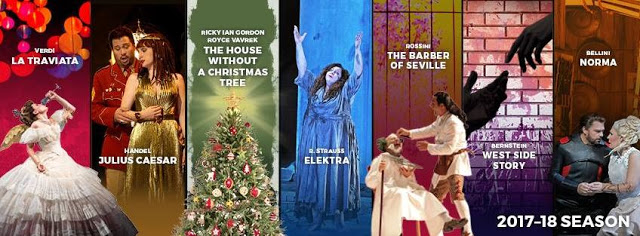
Fortunately, HGO staff members had the foresight to move valuable instruments and many costumes, including those for our opening productions of La traviata and Julius Caesar, to higher floors in advance of the storm.

Houston Grand Opera will be out of our offices until after Labor Day. Our website remains down. We will provide another update on Thursday afternoon, August 31. Meanwhile, we are deeply grateful to the artists and other colleagues from around the country and the world who have sent their support. That means so much to us all.

Houston Grand Opera will recover and deliver a fantastic season to our patrons, giving them the art they need to heal from this calamity. And the only future water we want coming across our stage is that of the Rhine!
As if we needed further proof as to why national arts organizations are so important... the National Endowment for the Arts has committed to helping out organizations such as Houston Grand Opera. Because the show must go on...
The National Endowment for the Arts expresses its deepest concern and most heartfelt sympathies for the millions of people in Texas and Louisiana affected by Hurricane Harvey. Our thoughts and prayers are with all those who are confronted by this disaster. We are working to coordinate support for arts organizations in the regions designated a disaster area by FEMA, and we stand ready to support the recovery of the arts and cultural communities in the devastated areas. In the past, the NEA has responded to national emergencies, including disaster relief in the wake of September 11th, Hurricanes Katrina and Rita, and the devastating tornadoes in Joplin, Missouri, and Tupelo, Mississippi. We are coordinating with the Texas Commission on the Arts and the Division of the Arts in the Louisiana Office of Cultural Development to assess the situation and those arts organizations hardest hit by Hurricane Harvey. As the current situation stabilizes, the National Endowment for the Arts is prepared to direct additional funds to these state arts agencies for re-granting to affected organizations, as we have done in the past. - NEA Chairperson Jane Chu
How can you help? Here are some ideas and thoughts.

Thursday, February 17, 2011

Say goodbye to the NEA Opera Honors

Livid. That's how I would describe my mood right now ... livid - but, ultimately not surprised.

I regret to inform you, my Chiclets, that after only 3 years in existence, the National Endowment for the Arts (NEA) is being forced by budget constraints to give the ol' heave-ho to the NEA Opera Honors. That's right - after the 2011 awards (preparation for which is already underway) we can say goodbye to the NEA publicly honoring the people who make opera great - and ultimately, publicly honoring opera itself.

What's more? After 30 years ... THIRTY YEARS ... there will no longer be the Jazz Masters Awards, either. Nor will there be special recognition through the National Heritage Fellowships.

Gone. Buh-bye. See ya.

The NEA issued this statement through a spokesperson:
The NEA has a proud tradition of honoring master artists in folk and traditional arts, jazz, and more recently, opera. With the Fiscal Year 2012 appropriations request, the agency hopes to be able to extend these honors and the accompanying support to the full range of American artists, including dancers, theater artists, other musicians, film makers, and visual artists.

While the NEA Jazz Masters, National Heritage Fellowships, and Opera Honors will not continue as stand alone programs, the NEA American Artists of the Year proposal will still honor jazz, folk and traditional arts, and opera and will include them as part of a fuller spectrum of American art forms and artists.

The NEA American Artists of the Year designations will include fellowships for the recipients, just as the various honors programs have done in the past. In addition to honoring artists for their lifetime achievements, the NEA American Artists of the Year proposal hopes to also acknowledge the contributions that some artists are making while still in the middle of their careers.

It is important to note that the process is already underway for the 2012 Jazz Masters (which we expect to present at an awards concert and ceremony in January 2012), as well as for the 2011 National Heritage Fellowships and Opera Honors (which will be presented at two ceremonies this coming fall).

Moving forward, it simply seemed correct to extend the NEA's honoring of American artists to as full a spectrum as possible.
Going forward, the NEA American Artists of the Year award will remove specific reference to Jazz, Folk, and Opera - being given only in two separate categories: Performing Arts (Dance/Music/Opera/Musical Theater/Theater) and Visual Arts (Design/Media Arts/Museums/Visual Arts).

Additionally, the awards will no longer only be in recognition for a lifetime of arts greatness:
NEA American Artists of the Year honorific awards would be made not only to individuals who have devoted a lifetime to the advancement of artistic excellence, creativity, and innovation, but to individuals who at mid-career have made an extraordinary contribution to the arts.
You know what I'd like to know? How on Earth does the NEA think they are going to be able to compare artists from the worlds of opera, jazz, folk, musical theater and straight theater with dancers, composers, conductors and the like? How can you compare an opera singer who is "mid-career" with a jazz great who has been at it for 50+ years? How can you compare an unknown, but seasoned and wildly successful ballet dancer with a young, outlandish conductor who is known the world over?

It's craziness, I tell you. And the fact that our only national arts advocacy group is being forced into this is absolutely reprehensible. How are they being forced into this? I'm glad you asked.


The NEA is requesting through appropriations a budget of $146.255 million for Fiscal Year 2012. This is a reduction of $21.245 million or 13% from Fiscal Year 2010 levels. It just so happens that the 2012 level is dialed back to the 2008 level ... 2008 being the year that the NEA Opera Honors was created. Now, just so you're aware, the Appropriations Request break down is as follows:

$66.208 million for Direct Endowment Grants
$44.139 million for State/Regional Partnerships
$5 million for the Our Town initiative
$2.845 million for program support efforts, and
$28.063 million for salaries and expenses.

Now, the NEA does contend on their website that the money listed above "both sustains and develops large scale projects with significant national reach..." giving grants to further performance in our country. I'm not sure I can fully accept that idea. When you read through some the content of their website, you quickly see that the majority of their operatic funding occurred in the past. Furthermore, you see that the NEA Opera Honors was very much their way of saying "see, we still love opera and instead of handing out cash to perpetuate it, we're going to honor greatness."

Fantastic! I fully support honoring operatic greatness. But, now that the NEA Opera Honors are going away ... what's next?

I encourage you to read the NEA's Appropriations Request ... it's very eye-opening. And since we're on the subject, let us discuss for a brief moment the section titled Salaries and Expenses ... more specifically, I'd like to direct your attention to the section on page 54 marked "Rent".
The Agency expects to be charged approximately $2.829 million in rent by the GSA (General Services Administration) for office space in the Old Post Office Building (OPOB) in FY 2012.
So, let me get this straight: our government is appropriating money for office space to be rented ... and the rent is to be paid ... back to our government's GSA? The NEA has to ask the government for money to give back to the government for office space? Why in the hell doesn't the government just give the NEA some office space that it already owns and call it a day?

I can't even begin to get into that travesty.

Here's the bottom line, Ladies and Gents ... in our society, where the arts are looked upon as a luxury item for the "liberal elite" and vast gobs of money continues to buy political power as well as judicial power, we will never see the arts elevated to the stature they deserve. In our society, where we stand by and watch our Speaker of the House advocate for our military to spend $450 million on building jet engines that the Department of Defense neither wants nor needs simply because the engines are built in his district, we will never see the funding that is needed to perpetuate a thriving arts community. An arts community that has the potential to be an spectacular catalyst for expression, national pride, personal growth, joy, peace and yes ... JOBS, too.

$450 million for jet engines the military doesn't want ... or $167.5 million to keep the NEA funded at it's current budget level. Yea, I think it's pretty %*^#!&$ stupid, too.

National Endowment of the Arts: Art Works. Sort of.

Thursday, October 21, 2010

National Opera Week 2010

It's that time again, Chickadees! National Opera Week is coming!

From October 29 through November 7, OPERA America, the National Endowment for the Arts and opera organizations across the United States invite you to participate in a variety of fun, free activities such as backstage tours, flash performances and YouTube contests.

National Opera Week celebrates the vitality of opera in America as a contemporary cultural expression. The strength and diversity of established opera companies, community opera ensembles and opera training programs across the United States will be shared through a variety of free and accessible activities for opera lovers and newcomers to the art form. Coinciding with the presentation of the NEA Opera Honors in Washington, D.C., organizations nationwide offer a range of free programs for the public that demonstrate the allure and accessibility of this most multi-media of the arts. From open houses, lecture/demonstrations and community performances to the presentation of the nation’s highest award in the field, National Opera Week brings the inventiveness and excitement of opera to a broader national audience (see below for examples).

“National Opera Week is an opportunity to highlight the astounding energy and creativity of opera activity across the United States today,” stated Marc A. Scorca, president & CEO of OPERA America. “There is something for everyone during National Opera Week, providing both the seasoned attendee and newcomer a chance to learn about, experience and enjoy the art form in an informal setting.”

In addition to celebrating the exciting ongoing opera activity in the United States, National Opera Week honors the outstanding careers of the 2010 NEA Opera Honors recipients: Soprano Martina Arroyo, General Director David DiChiera, Composer Philip Glass and Music Director Eve Queler. The 2010 NEA Opera Honors will take place tomorrow - October 22nd - at the John F. Kennedy Center for the Performing Arts in Washington, D.C.

For more information about National Opera Week, please visit Opera America's website. To learn more about the NEA Opera Honors, including current and past recipients, please visit www.neaoperahonors.org.

Friday, July 30, 2010

National Opera / Kennedy Center merger?

Is a merger in the works for Washington National Opera and the Kennedy Center? It would appear so.

Erica Orden at the Wall Street Journal reports:
The Washington National Opera, facing financial challenges and questions about its future, is exploring a merger with the John F. Kennedy Center for the Performing Arts, according to a person familiar with the matter.

The arrangement under consideration would mimic the Kennedy Center's relationship with the National Symphony Orchestra, the person said. The center would assume the opera's assets and liabilities, and the opera would cede to the center approval on artistic and budgetary matters. Merger discussions began around March, the person said.
Both the spokesperson for the Kennedy Center and the spokesperson for WNO said that negotiations had begun on a new rental agreement since the current agreement for WNO's rental of the Kennedy Center's space expires in 2013. In addition, their stories matched in that they both also admitted to discussing the "future" and "long term relationship" between the two organizations.

Although the financial challenges could be blamed on the current state of our nation's economy - let's not forget the staggering number of artistic institutions that have shuttered - many continue to blame General Director Placido Domingo for the company's issues. Again, Erica Orden of the Wall Street Journal:
Some have blamed the leadership of Mr. Domingo, who became general director in 2003 after several years as artistic director. Although lauded for his creative vision, he has faced criticism for what has been described as inattentive supervision. "Why can't a general director with the fame, charm and ability of Domingo roll up his sleeves and work to realize his vision, rather than distancing himself from the results?" classical-music critic Anne Midgette wrote earlier this year in the Washington Post. "The answer: because he isn't actually there, running the company."
In FY 2010, Congress appropriated some $40 million to the Kennedy Center for operations, maintenance and other upkeep costs. So, it is safe to say that the Kennedy Center could be a port in the storm for the National Opera.

It does come at a price, however. Domingo could be stripped of his artistic authority and the opera's Board of Directors could be downgraded to figurehead status. That is, of course, if the merger takes on the same shape as the merger between the National Symphony Orchestra and the Kennedy Center, which happened in 1986.

Arts organizations that have a home in our Nation's Capital and are indeed called "National" should have some funding from our National Government. Don't you think? I am in no way saying that they should be solely funded by said government, but if we can subsidize crops, oil etc., I think we could manage to specifically subsidize our "National" arts organizations.

I understand that some will say "That's what the National Endowment for the Arts is for." And that, my Friendlies, is why I said "specifically subsidize". In other words, there should be specific subsidization with funding not funneled through bureaucratic channels that are clogged with bureaucratic plaque.

"A great nation deserves great art!" Wasn't that the motto of the NEA?

If, in our great bureaucratic democracy, the way to national funding of our "National" arts organizations is to merge them with the Kennedy Center, then so be it. Unfortunately, some egos will have to take a back seat - but, that's politics ... and the arts, for that matter.

Friday, June 25, 2010

2010 NEA Opera Honors recipients announced

At yesterday's meeting of the National Council on the Arts, the NEA's advisory body, NEA Chairman Rocco Landesman announced the recipients of the 2010 NEA Opera Honors:
  • Martina Arroyo is admired around the world for her operatic roles, oratorio and recital performances, recordings, and also for her commitment to young artist development through the Martina Arroyo Foundation.

  • David DiChiera's varied career includes important posts in Ohio and California, as well as at the Michigan Opera Theatre, which has played an important role in the cultural and economic vitality of Detroit.

  • Philip Glass has had an unprecedented impact upon the musical and intellectual life of our time, including especially his 20 operas, symphonies, compositions for his own ensemble, and his wide-ranging collaborations.

  • Eve Queler is being recognized for her focus on rarely performed operas and for her dedication to emerging singers, which she has brought to her work as music director of the Opera Orchestra of New York.
Now in its third year, the NEA Opera Honors is the highest award our nation bestows in opera. This year, the awards will be presented at an award ceremony and concert produced by the Washington National Opera on Friday, October 22, 2010 at The John F. Kennedy Center for the Performing Arts in Washington, DC.

Chairman Landesman said,
"On behalf of the NEA, I extend my heartfelt congratulations to this group of stellar artists and thank them for all they have accomplished and shared with us in the course of their careers. Their works of art have delighted and challenged us, illuminated our sense of the world, and refreshed our understanding of what is possible."
NEA Director of Music and Opera Wayne S. Brown said,
"This class of NEA Opera Honorees is four outstanding individuals, who together represent the finest traditions of opera. Without their artistic accomplishments, the world of American opera would be far less extraordinary."
These four honorees will each receive an award of $25,000 in recognition of their significant lifetime contributions to American opera. NEA Opera Honors recipients are nominated by the public and chosen by an NEA-convened panel of opera experts. Past honorees, whose bios can be seen here and here, are John Adams, Frank Corsaro, Carlisle Floyd, Richard Gaddes, Marilyn Horne, James Levine, Lotfi Mansouri, Leontyne Price, and Julius Rudel.

Congratulations to all of the honorees!

Wednesday, June 23, 2010

Happy Birthday to James Levine

On this day in 1943, James Levine was born in Cincinnati, Ohio.

Happy Birthday, Maestro! Hope to see you back on the podium soon.

For a fitting tribute, check out this fantastic video from the National Endowment for the Arts.

Sunday, November 22, 2009

Closing with Bel Canto...

As National Opera Week draws to a close - it's only fitting that we watch a fantastic discussion on Bel Canto singing.

In my previous post, I discussed "the heritage of magnificence" - these 4 people, mezzo soprano Marilyn Horne, soprano Joan Sutherland, tenor Luciano Pavarotti and conductor Richard Bonynge, inexhaustibly contributed to that heritage. Enjoy!


Tuesday, November 17, 2009

One moment in time ... Roberta Peters

As we continue to celebrate National Opera Week we bring you another installment of One moment in time ...

On this date in 1950, a 20 year old Roberta Peters made her MET debut in Don Giovanni. Fritz Reiner conducted the cast that included Jerome Hines as the Commendatore and Eleanor Steber as Donna Elvira.

Ms. Peter's debut shot her to operatic stardom, some say, because of the stories surrounding her education, cultivation and experience - not to mention the MET audition to beat all auditions. More on that later.

Roberta Peters was born Roberta Peterman in The Bronx, NY. She started study voice at age 13, encouraged by tenor Jan Peerce, with William Herman, a strict teacher known for giving exhaustive (and exhausting) training. Herman made sure Peters had French, German and Italian lessons and made her sing scales from a clarinet training book.

After six years of training, Herman introduced her to Sol Hurok, an impresario of sorts who arranged for an audition with Rudolf Bing.

If you don't know who Rudolf Bing was... shame on you - look it up. Bing had her sing the Queen of the Night's vengeance aria from The Magic Flute which contains four high Fs ... yes, that's F above high C. Bing didn't hear it once, he had young Roberta sing it seven times - if you do the math, that would be 28 high Fs.

All the while, Bing listened from all parts of the hall to make sure she could fill the hall with sound. He then scheduled her to sing Zerlina in February of 1951.

Things were not to work out that way as fate stepped in. Peters received a phone call from Rudolf Bing on November 17, 1950 asking if she could sing that night. That evening's Zerlina, Nadine Conner, could not perform. Peters obviously knew the role, but had never sung with a full orchestra, never performed in a full opera production, never even performed on stage, professionally or otherwise, except for her audition. She accepted and the rest, they say, is history.

Quaintance Eaton reviewed the performance for Musical America, saying in part:
The surprise debut of twenty-year-old Roberta Peters, who was summoned to sing the role of Zerlina when Nadine Conner fell ill at three o'clock on the afternoon of the performance, gave the first Don Giovanni of the season an air of unusual excitement. The attractive girl won an immediate place for herself in her first appearance on any stage, and her fresh youth, pretty voice and stage wisdom provided the chief interest of the evening. From her first entrance at the head of a line of dancing country girls, Miss Peters never faltered in what seemed an ideal embodiment of the peasant bride and her gaiety and charm pervaded the scenes in which she appeared. Her voice was clear, accurate in pitch and focus and lovely in quality.
Roberta Peters continued to sing at the MET for 35 years until her last performance there as Gilda in Rigoletto on April 12, 1985.


Links:

Information comes courtesy of the MET Opera Database and Wikipedia.

Monday, November 16, 2009

One moment in time...

In celebration of National Opera Week, here are a couple of moments in time for you:

On this day in 1908, Arturo Toscanini made his MET debut conducting Aida. It was opening night of that season with Louise Homer as Amneris and Enrico Caruso as Radamès. Also making her debut that night was Czech soprano Emmy Destinn as Aida. Born Ema Destinnová in Prague, Destinn [R.] went on to sing the US premiere of D'Albert's Tiefland a week after her debut. She would continue to sing at the MET regularly until her final performance with the company on December 27th 1920. The General Manager at that time was Giulio Gatti-Casazza.

Another US premiere happened on this day - this one in 1926. Puccini's last opera Turandot premiered with Maria Jeritza in the title role. The Calàf was Giacomo Lauri-Volpi with Martha Attwood making her debut as Liù.

The New York Times' review said in part:
The production invites more commendation than the music. The music has certain interesting features, but they are not those that inhere in a score of significantly creative or emotional quality. The progress of this-where any progress is shown-is technical or theatrical, but it is not the progress of inspiration or power, The opera, as always has been the case with the composer, owes much to its book. The development of the story is rapid, the episodes are short; the audience is assailed immediately the curtain rises, knocked breathless, as it were, by the scene and by the chorus-one of the best pages of the work-and before there is opportunity for consideration or criticism the scene is changed with another bewildering vista of color and Far East fantasy on the part of (Set Designer Joseph) Urban...

...The audience was exceptionally demonstrative. Applause repeatedly interrupted the progress of the opera. Curtain calls were more than will be numbered here. There was every feature of a triumph. The American premiere of
Turandot was in fact a triumph of the occasion and of the opera company which had so lavishly mounted a work of qualities various. It was a triumph which may repeat itself some five or six more times this season. But a second season, if it should occur with Turandot, would tell another story.
As a matter of fact, Turandot ran for 12 performances that season.


Link: Facts and photos provided by the MET Opera Database.

Thursday, November 12, 2009

NEA Opera Honors to kick off National Opera Week

Let's hear it for the great state of California! And, not just because it's the birth state of Yours Truly.

The Golden State will be represented to the fullest at this years National Endowment for the Arts Opera Honors - which boasts an operatic a-list of stars.

The honors will be bestowed upon mezzo-soprano Marilyn Horne (pictured right at her birthday party) who not only began her career in L.A., but also currently runs Santa Barbara's Music Academy of the West's vocal program and the Marilyn Horne Foundation, composer John Adams, who is based in the Bay Area and has close ties to the Los Angeles Philharmonic, and Lotfi Mansouri, former general director of the San Francisco Opera, whose wide-ranging career began in L.A. and continues with frequent directing at San Diego Opera.

These Californians will be honored alongside NY City Opera conductor Julius Rudel and director-librettist Frank Corsaro. In addition to the distinct honor of receiving the prize, $25,000 will also be given to each recipients.

The celebration, which is to be held at Harman Center for the Arts in Washington, D.C., will be presented in partnership with Opera America and Washington National Opera. It will feature musical tributes from soprano Angela Brown and baritone Gordon Hawkins, as well as a video tribute to each recipient.

Not only is the honors list amazing, but the presenters list is equally as stellar. On the list: Andre Previn will be the presenter for Mansouri, Broadway and concert singer Barbara Cook will present to Horne, soprano Shirley Verrett is Rudel's presenter, and composer Carlisle Floyd, who collaborated often with Corsaro, will present his award.

Floyd was one of the four inaugural NEA Opera Honors recipients last year, along with soprano Leontyne Price, conductor James Levine and opera administrator and advocate Richard Gaddes.

Why on earth is this not being televised? This is big stuff! Alas, we'll have to settle for the old fashioned method made new.

The WFMT Radio Network, based at Chicago classical station WFMT, hopes to send the live broadcast to more than 150 radio markets. For those who are not part of those markets, wfmt.com will carry the proceedings live starting at 4:30 p.m. PST on November 14. But, you better carve out the time to listen because it has been reported that the program won't be archived for later listening.

The NEA Opera Honors kicks off National Opera Week, which runs from November 13 - November 22. According to Opera America, National Opera Week will celebrate opera in America as a contemporary cultural expression. For more information, see the links below.

Included in the list of National Opera Week events held around the country are the annual Opera News Awards and the annual Richard Tucker Music Foundation Gala; both in New York.

Celebrate National Opera Week!


Links:

For more information on the NEA Opera Honors, you can visit the NEA website.

To find a National Opera Week event in your area, you can visit the Opera America website.

Here's where you can find out more about the Opera News Awards and the Richard Tucker Foundation Gala.

John Adams, Lotfi Mansouri, Marilyn Horne, Julius Rudel, Frank Corsaro, soprano Angela Brown, baritone Gordon Hawkins, Opera America, Washington National Opera, Los Angeles Philharmonic, San Francisco Opera, San Diego Opera, Music Academy of the West, NY City Opera.

Thursday, November 5, 2009

When you see the crack in the door - applaud.

Wednesday evening, President Obama and the First Lady welcomed classical to the White House. The evening featured performances by violinist Joshua Bell, guitarist Sharon Isbin, cellist Alisa Weilerstein and pianist Awadagin Pratt, with some young student musicians sitting in.

As with any event in the White House, there is certain protocol that is painstakingly lead by a team of social secretaries and stewards. It is the job of these individuals to alert the president to all of the do's and don'ts that accompany events in the most famous residence in the world.

However, keeping on top of the do's and don'ts goes beyond the protocol of the White House. Sometimes, it's just sheer audience etiquette.

In comments before the performance, President Obama looked back at the Kennedy White House's "Camelot" legacy of cultural involvement - albeit whimsically.

Here's the insider-anecdote he shared, as relayed in a White House press office transcript of the president's remarks.
"Now, if any of you in the audience are newcomers to classical music, and aren’t sure when to applaud, don’t be nervous. (Laughter.) Apparently, President Kennedy had the same problem. (Laughter.) He and Jackie held several classical music events here, and more than once he started applauding when he wasn’t supposed to. (Laughter.) So the social secretary worked out a system where she’d signal him -- (laughter) -- through a crack in the door to the cross-hall.

"Now, fortunately, I have Michelle to tell me when to applaud. (Laughter.) The rest of you are on your own. (Laughter.)

"This is, of course, a unique concert venue. But tonight, all across America, in community centers and concert halls, in homes and in schools, the sounds of classical music are lifting hearts and spurring imagination, just as they always have. And it’s easy to understand why. There’s precision, of course; but there’s also great feeling and improvisation. There’s structure; but there’s also creativity. It’s music that defies simple definition even as it speaks to a common, universal language.

"So whether you are new to classical music, or have been an aficionado for many, many years, we hope that you enjoy tonight."
I am pleased beyond words at the fact that we now have a president in office who wholly leads our country. And to be clear, I mean that this president has the understanding that leading this country isn't only about creating war and profiteering. Leading this country also includes fostering our cultural and artistic potential and celebrating our cultural and artistic legacy.

[Photos - Right: President Obama addressing the White House audience Wednesday. By Joshua Roberts/Pool/Getty Images. Left: Violinist Joshua Bell performed for the White House audience that included the First Lady, Michelle Obama. By Luke Sharrett/The New York Times.]

Thursday, September 17, 2009

National Opera Week

According to a press release from Patricia Kiernan Johnson at OPERA America:
NATIONAL ENDOWMENT FOR THE ARTS and OPERA AMERICA announce:

NATIONAL OPERA WEEK
November 13 – 22, 2009


Opera has become such a vital part of the American musical fabric, that over 90 companies & organizations from Alaska to Texas, from New York to Los Angeles, and everywhere in between (32 states to be exact/see attachment for full list), will be participating in and celebrating the first ever NATIONAL OPERA WEEK from November 13-22, 2009. NATIONAL OPERA WEEK is organized by OPERA America, the national service organization for opera, with the support of the National Endowment for the Arts.

NATIONAL OPERA WEEK will officially be launched with the presentation of the 2009 NEA Opera Honors to Marilyn Horne, John Adams, Frank Corsaro, Lotfi Mansouri and Julius Rudel on November 14 at the Harman Center for the Performing Arts in Washington, D.C..

The National Opera Week celebration will reach from coast to coast with over 90 opera companies from 32 states (plus the District of Columbia). These opera companies will offer a range of free programs for the public that demonstrate the allure and accessibility of this most multi-media of the arts and will be accessible to both opera lovers and newcomers to the art form. These events, showcasing the strength and diversity of established companies, community opera ensembles and opera training programs, will range from open houses, lectures/demonstrations and community performances to the presentation of the nation’s highest award in the field, the NEA Opera Honors. National Opera Week has been created to bring the inventiveness and excitement of opera to a broader national audience (see attachment for examples).

Other noteworthy events of National Opera Week include in New York City the fifth annual Opera News Awards on November 19; the November 22 annual Richard Tucker Music Foundation Gala, showcasing some of today’s most promising young singers; the New York City Opera dedicating all performances from November 14-22 to National Opera Week, with special tributes to Julius Rudel and Frank Corsaro; and the Metropolitan Opera providing special free access to Met performances available on Met Player, the company’s new online streaming service, during National Opera Week.
Now, THIS is progress! Great work!

Monday, August 10, 2009

The Drama Drop-

As the artistic season starts to ramp up, so does the news. And that means, it's time to bring back The Drama Drop. Forget Healthcare Reform and the screaming Banshees who are hollering against it. Forget Cash for Clunkers. Forget the latest who-wants-what from the Michael Jackson estate... it's time to get down to brass tax.

#1- I ask you: how is it that a no-nonsense, Missouri born man with an affinity for baseball and country music got confirmed as the newest Chaiman of the National Endowment for the Arts? Because Rocco Landesman is not only a business savvy champion for the arts, he is also a Tony winning Broadway producer that grew up around the Crystal Palace - the cabaret theater that his father and uncle ran in St. Louis. In a fantastic article for the NY Times last Friday, Robin Pogrebin writes:
Mr. Landesman, 62, made clear that he has little patience for the disdain with which some politicians still seem to view the endowment, more than a decade after the culture wars that nearly destroyed it.

He was particularly angered, he said, by parts of the debate over whether to include $50 million for the agency in the federal stimulus bill, citing the comment by Mitt Romney, former governor of Massachusetts, on CNBC’s “Squawk Box” in February, that arts money did not belong in the bill. That kind of thinking suggests that “artists don’t have kids to send to college,” Mr. Landesman said, “or food to put on the table, or medical bills to pay.”

In American politics generally, he added: “The arts are a little bit of a target. The subtext is that it is elitist, left wing, maybe even a little gay.”

Mr. Landesman said that as chairman he will focus on the potential of the arts to help in the country’s economic recovery.

“I wouldn’t have come to the N.E.A. if it was just about padding around in the agency,” he said, and worrying about which nonprofits deserve more funds. “We need to have a seat at the big table with the grown-ups. Art should be part of the plans to come out of this recession.”
#2- Our next entry comes via one of my favorite dames: La Cieca of Parterre.com. It would seem that Anna Netrebko will not sing La Traviata in New York during the 2010-2011 season. According to an interview the Frankfurter Allgemeine Sonntagszeitung, Netrebko has cancelled for two reasons: a sense of routine in this production she loves so well, and a concern that she might not be as effective in the staging as she was in a certain well-known DVD release. La Netrebko (who appears to be in competition with a certain Angela Gheorghiu over who is the next Callas) went further and discussed future repertoire in terms of programming for her “new voice”: Anna Bolena, Faust, Trovatore and Lohengrin.

I don't get it. Did she trade the other one in? I would hope not. I saw her spectacular Norma Desmond-like Lucia di Lammermoor via the Met Player and was instantly a fan... of her in THAT role.

#3- Finally, I am a huge-tastic Rachel Maddow fan because she is one of the most witty, well-spoken, smart and down-to-earth personalities on television. On Saturday, she gave me an entirely new reason to love her. At a free, outdoor event hosted by Jacob’s Pillow Dance, the popular political commentator, host of The Rachel Maddow Show on MSNBC, and radio personality discussed the role that the arts play in our lives and society as a whole. Coming via the blog Dancing Perfectly Free, here are some of Dr. Maddow's comments:

“Sometimes we choose to serve our country in uniform, in war. Sometimes in elected office. And those are the ways of serving our country that I think we are trained to easily call heroic. It’s also a service to your country, I think, to teach poetry in the prisons, to be an incredibly dedicated student of dance, to fight for funding music and arts education in the schools. A country without an expectation of minimal artistic literacy, without a basic structure by which the artists among us can be awakened and given the choice of following their talents and a way to get to be great at what they do, is a country that is not actually as great as it could be. And a country without the capacity to nurture artistic greatness is not being a great country. It is a service to our country, and sometimes it is heroic service to our country, to fight for the United States of America to have the capacity to nurture artistic greatness.”

“Not just in wartime but especially in wartime, and not just in hard economic times but especially in hard economic times, the arts get dismissed as ‘sissy’. Dance gets dismissed as craft, creativity gets dismissed as inessential, to the detriment of our country. And so when we fight for dance, when we buy art that’s made by living American artists, when we say that even when you cut education to the bone, you do not cut arts and music education, because arts and music education IS bone, it is structural, it is essential; you are, in [Jacob’s Pillow founder] Ted Shawn’s words, you are preserving the way of life that we are supposedly fighting for and it’s worth being proud of.”
[Photos- Top: Rocco Landesman in his Manhattan office. Damon Winter/The New York Times. Middle: Anna Netrebko. Getty Images. Bottom: Rachel Maddow at Jacob’s Pillow, photo by Christopher Duggan]

Tuesday, May 19, 2009

The Arts “define who we are as a people.”

For the first time as our First Lady, Michelle Obama walked out onto the stage at the Metropolitan Opera House and stepped into, as the New York Times put it, "New York’s glittering world of high culture". Mrs Obama was at the Met to open the American Ballet Theatre's season and earlier in the day, she reopened part of the American Wing of the Metropolitan Museum of Art.

In her remarks, she said “The arts are not just a nice thing to have," adding that the arts "define who we are as a people.” According to the New York Times, Mrs. Obama described the nation’s creative spirit as critical to its ideals and its identity, and said the arts needed to be nurtured even during difficult economic times. Let us not forget that it was her husband that included some $50 million in his economic stimulus package for the National Endowment for the Arts.

What I found most interesting about Mrs. Obama's comments was her emphasis on children - and thankfully so! The first lady seized her moment to call on institutions and philanthropists to make the arts readily accessible to children.

She praised both the Metropolitan Museum and the American Ballet Theatre for involving children of diverse backgrounds in their programs saying: “My husband and I believe strongly that arts education is essential for building innovative thinkers who will be our nation’s leaders of tomorrow." Mrs. Obama then introduced a performance by a multiracial cast of young dancers.

As Mrs Obama spoke to the crowd at the museum, there were dozens of public school children there as well. “The president and I want to ensure that all children have access to great works of art . . . This is your place, too,” she told the children.

[Photo - Michelle Obama, right, was introduced by Caroline Kennedy at the American Ballet Theatre Opening Night Spring Gala on Monday. By Timothy A. Clary/Agence France-Presse — Getty Images]

Monday, April 27, 2009

NEA Opera Honors 2009

The National Endowment for the Arts has announced the second crop of winners of the new NEA Opera Honors, established last year under then-NEA Chairman Dana Gioia. With this second crop of winners, the awards come a step closer to Gioia's goal to create a kind of American opera Hall of Fame. The NY Times ArtsBeat reports that composer John Adams and the mezzo-soprano Marilyn Horne were among the five recipients. The three other recipients are Julius Rudel, the veteran conductor of New York City Opera and the founding artistic director of the John F. Kennedy Center for the Performing Arts; the director and librettist Frank Corsaro; and the general director Lotfi Mansouri, who introduced the use of supertitles in opera.

The awards -- which include $25,000 grants -- will be officially conferred at a ceremony at the Harman Center for the Arts on Nov. 14. For more information on the recipients, check out the NEA website.

Wednesday, April 1, 2009

Musicians Testifying Before Congress


Sarah Gantz reports for the LA Times from Washington -
A woman held a BlackBerry over the crowd surrounding Linda Ronstadt to get a shot of the onetime queen of country rock. Someone else thrust an album insert and pen at Josh Groban. "Just one more photo, please," followed jazz musician Wynton Marsalis out of the room.

The three musicians were among a group who appeared Tuesday on Capitol Hill to speak in favor of increasing funding for the National Endowment for the Arts to $200 million in the 2010 budget. In an effort to demonstrate the importance of the arts to the community -- particularly for young people -- each talked about how music had shaped his or her life.

"I don't remember when there wasn't music going on in some form" at her childhood home in Tucson, Ronstadt told the House Appropriations Subcommittee on Interior, Environment and Related Agencies. She recalled her father whistling while he puttered with things needing repair, her brother stumbling over double bass strings, her mother ripping ragtime tunes on the family piano.

But people don't do that anymore, she said.

"Increasingly, people's experience with music is passive," Ronstadt said. "We need to teach our children to sing their own songs and play their own instruments, not just listen to their iPods."

Concerned about possible cuts in a tough budget year, the stars told their stories in hopes of convincing politicians of the importance of maintaining funding for the arts, which they say is instrumental in helping youths succeed.
There's MORE.

[Photo:Musicians Linda Ronstadt, and Wynton Marsalis, wait to testify for arts funding from Congress, in Washington on Tuesday, March 31. By: Jacquelyn Martin for Associated Press]

Friday, February 6, 2009

ARTS CUT FROM ECONOMIC RECOVERY BILL

This afternoon the U.S. Senate, during their consideration of the economic recovery bill, approved an egregious and despicable amendment offered by Sen. Tom Coburn (R-OK) that stated “None of the amounts appropriated or otherwise made available by this Act may be used for any casino or other gambling establishment, aquarium, zoo, golf course, swimming pool, stadium, community park, museum, theater, art center, and highway beautification project.” According to MSNBC, Sen. Ben Nelson, D-Neb., said the agreement was a bipartisan effort and cited the work of Senators Collins and Specter. "We trimmed the fat, fried the bacon and milked the sacred cows," Nelson said.

That use of language is horrible and Senator Nelson should be ashamed. Zoos, community parks, museums, theaters, arts centers.... they are nothing but fat that can be trimmed and bacon that can be fried? Disgusting!

Unfortunately, the amendment passed by a wide vote margin of 73-24, and surprisingly included support from many high profile Senators including Chuck Schumer of New York, Dianne Feinstein of California, Barbara Mikulski of Maryland, Bob Casey of Pennsylvania, Amy Klobuchar of Minnesota, Russ Feingold of Wisconsin, and several other Democratic and Republican Senators.

If the Coburn amendment language is included in the final conference version of this legislation, many arts groups will be prevented from receiving economic recovery funds from any portion of this specific stimulus bill. It is clear that there is still much work to be done in the Senate and in the media about the role that nonprofit arts organizations and artists play in the nation’s economy and workforce.

Please exercise your right to have an opinion about this Anti-Arts Amendment. Go to Americans for the Arts to find out how!
Related Posts Plugin for WordPress, Blogger...