Which '90s film - actually written in the '70s as a vehicle for Steve McQueen and Miss Diana Ross - is receiving a makeover? Oh yes, Chiclets.... you guessed it. Kevin Costner and Whitney Houston's The Bodyguard is getting a remake.
IndieWIRE reports that writers Jeremiah Friedman and Nick Palmer have been tapped to reboot the love story of the bodyguard and the D-d-d-d-d-DIVA. It will be updated, of course, to reflect the current brand of celebrity fandom, technology and social media. It will also include Iraq combat experience for Mr. Bodyguard.
Hmmm.... wonder who's gonna be tapped to play Miss Rachel Marron since Beyonce is already sucked into A Star is Born? Yours Truly thinks it oughta be J.Hud for sure! It's being said that Rihanna is in the front running for the role but, Deadline.com reports that the goal is to take a young female singer with global appeal and give her the platform that The Bodyguard did Houston. Mmmm, yea ... I'm not thinking that Rihanna and "global appeal" really go together.
I still think it should be J.Hud.
Thursday, February 24, 2011
Happy Birthday to Renata Scotto
![]() |
| Renata Scotto "Blackglama is the world's finest natural dark ranch mink." |
Then, of course, there was the first ever Live from the Met telecast ... La Boheme with "a certain tenor" singing Rodolfo. Why say "a certain tenor", you ask? Well, as Zachary Woolfe reports CapitalNewYork.com:
For one thing, the name “Pavarotti” was rigorously excised from [La Scotto's memoir] More Than a Diva; he is strictly “a certain tenor” in stories of his laziness and selfishness, and he was even scrubbed from the discography in the back.In fact, since her operatic debut in 1952 in which the 18 year old Scotto sang Violetta in Verdi's La Traviata, she has sung more than 45 roles by 18 different composers. As an Emmy Award winning opera director, La Scotto has staged performances at the Met, NY City Opera, Florida Grand Opera, Palm Beach Opera, The Dallas Opera, Michigan Opera Theater, Finnish National Opera, and Lyric Opera of Chicago.
It goes without saying that her career is one that "baby singers" dream about.
Opera Chic had this to say:
Opera has its Queen Bee. The Italian soprano and living legend Renata Scotto (~living legend, you can look, but don't touch~) has done it all. She's been Norma and Violetta and Mimi -- among the best in the modern era. She rediscovered La Voix Humaine back when it wasn't fashionable and also sang Schoenberg's Erwartung. In the span of an enormous career, she’s as intimate with the stage as with the backstage: La Scotto’s made the graceful transition from singer to director to teacher – a versatility that’s made her modern. Her vocal skills spanned from the lightest bel canto to the densest verismo. With ninja-sharp musicianship (and acting skillz) and a deep understanding of each composer, her style was intelligent, authoritative, and passionate.For an in-depth post on La Scotto's life, including an interview with the living legend, hop on over to Opera Chic's Blog. Also, make sure to check out Zachary Woolfe's article at CapitalNewYork.com.
Happy Birthday, La Scotto!
Tuesday, February 22, 2011
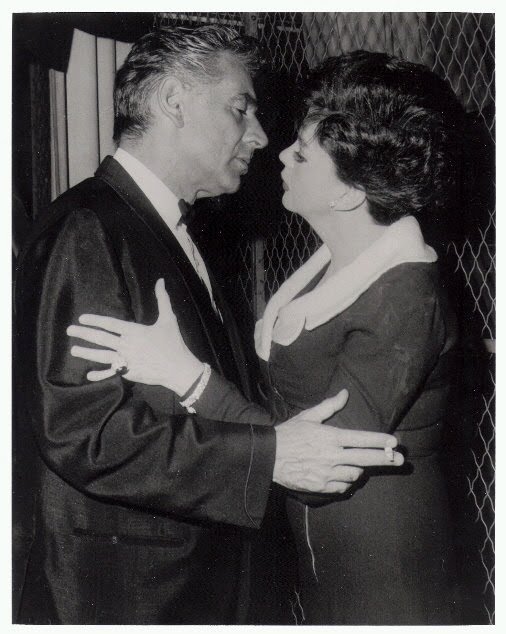
A Moment of Yore: Lenny and Judy
Many of you may have seen on the Huffington Post's Arts section that Steve Sherman has recently published a new book ... A photo essay called Leonard Bernstein at Work - His Final Years, 1984-1990:
Oh, to be a fly on the wall when *this* meeting took place. I love it. Classy. Swanky. Cool.
This remarkable photographic essay of Leonard Bernstein during the last six years of his life gives us rare insight into the disparate, sometimes vastly conflicting elements that shaped his work and deeply influenced everyone who was drawn into his inner world. It contains approximately 200 black-and-white photographs, most previously unpublished, taken on and off stage during 20 different events or concerts, along with personal comments and remembrances from over 50 of his colleagues, friends, and relatives.What an amazing book, right? I literally cannot wait for my copy ... you know ... the copy I'm going to be getting for my birthday ... in April. (Hint. Hint.) Anyhoo, as a little celebration of this new book, I thought I would bring you A Moment of Yore.
The foreword is by Hollywood superstar Lauren Bacall, the preface by Jamie Bernstein (Leonard Bernstein's eldest daughter), and the introduction by James M. Keller, Leonard Bernstein scholar-in-residence at the New York Philharmonic.
These vivid images reveal Leonard Bernstein at work in his final years, as mortality encroached upon his unrelenting energy and indefatigable creative genius.
Oh, to be a fly on the wall when *this* meeting took place. I love it. Classy. Swanky. Cool.
| Leonard Bernstein and Judy Garland embrace. |
Thursday, February 17, 2011
Say goodbye to the NEA Opera Honors
Livid. That's how I would describe my mood right now ... livid - but, ultimately not surprised.
I regret to inform you, my Chiclets, that after only 3 years in existence, the National Endowment for the Arts (NEA) is being forced by budget constraints to give the ol' heave-ho to the NEA Opera Honors. That's right - after the 2011 awards (preparation for which is already underway) we can say goodbye to the NEA publicly honoring the people who make opera great - and ultimately, publicly honoring opera itself.
What's more? After 30 years ... THIRTY YEARS ... there will no longer be the Jazz Masters Awards, either. Nor will there be special recognition through the National Heritage Fellowships.
Gone. Buh-bye. See ya.
The NEA issued this statement through a spokesperson:
Additionally, the awards will no longer only be in recognition for a lifetime of arts greatness:
It's craziness, I tell you. And the fact that our only national arts advocacy group is being forced into this is absolutely reprehensible. How are they being forced into this? I'm glad you asked.
The NEA is requesting through appropriations a budget of $146.255 million for Fiscal Year 2012. This is a reduction of $21.245 million or 13% from Fiscal Year 2010 levels. It just so happens that the 2012 level is dialed back to the 2008 level ... 2008 being the year that the NEA Opera Honors was created. Now, just so you're aware, the Appropriations Request break down is as follows:
$66.208 million for Direct Endowment Grants
$44.139 million for State/Regional Partnerships
$5 million for the Our Town initiative
$2.845 million for program support efforts, and
$28.063 million for salaries and expenses.
Now, the NEA does contend on their website that the money listed above "both sustains and develops large scale projects with significant national reach..." giving grants to further performance in our country. I'm not sure I can fully accept that idea. When you read through some the content of their website, you quickly see that the majority of their operatic funding occurred in the past. Furthermore, you see that the NEA Opera Honors was very much their way of saying "see, we still love opera and instead of handing out cash to perpetuate it, we're going to honor greatness."
Fantastic! I fully support honoring operatic greatness. But, now that the NEA Opera Honors are going away ... what's next?
I encourage you to read the NEA's Appropriations Request ... it's very eye-opening. And since we're on the subject, let us discuss for a brief moment the section titled Salaries and Expenses ... more specifically, I'd like to direct your attention to the section on page 54 marked "Rent".
I can't even begin to get into that travesty.
Here's the bottom line, Ladies and Gents ... in our society, where the arts are looked upon as a luxury item for the "liberal elite" and vast gobs of money continues to buy political power as well as judicial power, we will never see the arts elevated to the stature they deserve. In our society, where we stand by and watch our Speaker of the House advocate for our military to spend $450 million on building jet engines that the Department of Defense neither wants nor needs simply because the engines are built in his district, we will never see the funding that is needed to perpetuate a thriving arts community. An arts community that has the potential to be an spectacular catalyst for expression, national pride, personal growth, joy, peace and yes ... JOBS, too.
$450 million for jet engines the military doesn't want ... or $167.5 million to keep the NEA funded at it's current budget level. Yea, I think it's pretty %*^#!&$ stupid, too.
National Endowment of the Arts: Art Works. Sort of.
I regret to inform you, my Chiclets, that after only 3 years in existence, the National Endowment for the Arts (NEA) is being forced by budget constraints to give the ol' heave-ho to the NEA Opera Honors. That's right - after the 2011 awards (preparation for which is already underway) we can say goodbye to the NEA publicly honoring the people who make opera great - and ultimately, publicly honoring opera itself.
What's more? After 30 years ... THIRTY YEARS ... there will no longer be the Jazz Masters Awards, either. Nor will there be special recognition through the National Heritage Fellowships.
Gone. Buh-bye. See ya.
The NEA issued this statement through a spokesperson:
The NEA has a proud tradition of honoring master artists in folk and traditional arts, jazz, and more recently, opera. With the Fiscal Year 2012 appropriations request, the agency hopes to be able to extend these honors and the accompanying support to the full range of American artists, including dancers, theater artists, other musicians, film makers, and visual artists.Going forward, the NEA American Artists of the Year award will remove specific reference to Jazz, Folk, and Opera - being given only in two separate categories: Performing Arts (Dance/Music/Opera/Musical Theater/Theater) and Visual Arts (Design/Media Arts/Museums/Visual Arts).
While the NEA Jazz Masters, National Heritage Fellowships, and Opera Honors will not continue as stand alone programs, the NEA American Artists of the Year proposal will still honor jazz, folk and traditional arts, and opera and will include them as part of a fuller spectrum of American art forms and artists.
The NEA American Artists of the Year designations will include fellowships for the recipients, just as the various honors programs have done in the past. In addition to honoring artists for their lifetime achievements, the NEA American Artists of the Year proposal hopes to also acknowledge the contributions that some artists are making while still in the middle of their careers.
It is important to note that the process is already underway for the 2012 Jazz Masters (which we expect to present at an awards concert and ceremony in January 2012), as well as for the 2011 National Heritage Fellowships and Opera Honors (which will be presented at two ceremonies this coming fall).
Moving forward, it simply seemed correct to extend the NEA's honoring of American artists to as full a spectrum as possible.
Additionally, the awards will no longer only be in recognition for a lifetime of arts greatness:
NEA American Artists of the Year honorific awards would be made not only to individuals who have devoted a lifetime to the advancement of artistic excellence, creativity, and innovation, but to individuals who at mid-career have made an extraordinary contribution to the arts.You know what I'd like to know? How on Earth does the NEA think they are going to be able to compare artists from the worlds of opera, jazz, folk, musical theater and straight theater with dancers, composers, conductors and the like? How can you compare an opera singer who is "mid-career" with a jazz great who has been at it for 50+ years? How can you compare an unknown, but seasoned and wildly successful ballet dancer with a young, outlandish conductor who is known the world over?
It's craziness, I tell you. And the fact that our only national arts advocacy group is being forced into this is absolutely reprehensible. How are they being forced into this? I'm glad you asked.
The NEA is requesting through appropriations a budget of $146.255 million for Fiscal Year 2012. This is a reduction of $21.245 million or 13% from Fiscal Year 2010 levels. It just so happens that the 2012 level is dialed back to the 2008 level ... 2008 being the year that the NEA Opera Honors was created. Now, just so you're aware, the Appropriations Request break down is as follows:
$66.208 million for Direct Endowment Grants
$44.139 million for State/Regional Partnerships
$5 million for the Our Town initiative
$2.845 million for program support efforts, and
$28.063 million for salaries and expenses.
Now, the NEA does contend on their website that the money listed above "both sustains and develops large scale projects with significant national reach..." giving grants to further performance in our country. I'm not sure I can fully accept that idea. When you read through some the content of their website, you quickly see that the majority of their operatic funding occurred in the past. Furthermore, you see that the NEA Opera Honors was very much their way of saying "see, we still love opera and instead of handing out cash to perpetuate it, we're going to honor greatness."
Fantastic! I fully support honoring operatic greatness. But, now that the NEA Opera Honors are going away ... what's next?
I encourage you to read the NEA's Appropriations Request ... it's very eye-opening. And since we're on the subject, let us discuss for a brief moment the section titled Salaries and Expenses ... more specifically, I'd like to direct your attention to the section on page 54 marked "Rent".
The Agency expects to be charged approximately $2.829 million in rent by the GSA (General Services Administration) for office space in the Old Post Office Building (OPOB) in FY 2012.So, let me get this straight: our government is appropriating money for office space to be rented ... and the rent is to be paid ... back to our government's GSA? The NEA has to ask the government for money to give back to the government for office space? Why in the hell doesn't the government just give the NEA some office space that it already owns and call it a day?
I can't even begin to get into that travesty.
Here's the bottom line, Ladies and Gents ... in our society, where the arts are looked upon as a luxury item for the "liberal elite" and vast gobs of money continues to buy political power as well as judicial power, we will never see the arts elevated to the stature they deserve. In our society, where we stand by and watch our Speaker of the House advocate for our military to spend $450 million on building jet engines that the Department of Defense neither wants nor needs simply because the engines are built in his district, we will never see the funding that is needed to perpetuate a thriving arts community. An arts community that has the potential to be an spectacular catalyst for expression, national pride, personal growth, joy, peace and yes ... JOBS, too.
$450 million for jet engines the military doesn't want ... or $167.5 million to keep the NEA funded at it's current budget level. Yea, I think it's pretty %*^#!&$ stupid, too.
National Endowment of the Arts: Art Works. Sort of.
Wednesday, February 16, 2011
"Juan": A modern, darkly bold film based on an old story.
Out of all of the operas rotating through the various opera houses around the world, there are really only a handful that can successfully make the transition from stage to screen. Not because of the music, but because many operatic libretti (you musical theater types call it the "book") are so far fetched that the transition just doesn't work out.
On January 9th of this year Juan debuted at the Palm Springs International Film Festival. As you can probably imagine, Juan is an adaptation of Mozart's Don Giovanni. Debuting filmmaker Kasper Holten, who is also the Artistic Director of the Danish Royal Opera, updates both the locale - a large city in the internet age - and the English libretto. Yes, it's sung in English and honestly, Ladies and Gents ... I think it's going to work, chiefly because the film abandons the usual lip syncing to the previously recorded track. That's right ... during the filming, all of the singing was done live on camera, which will give it a true realness.
The Cineuropa website lists the synopsis of this movie version thusly:
Well, here you go - the write up from the Palm Springs International Film Festival website gives us a little more:
While there are numerous rumors as to when the film will release to a wider audience, I have a feeling that those of us in the States may have to wait to see it given it's ... uhm, dark seductiveness. But, just so you're not disappointed, here is the movie's trailer, which gives you a pretty good idea of the overall timbre of the film. Let me just say at the outset that this trailer might be a little too graphic for some of you - especially the opening.
Those of you who might be of puritanical sensibilities - don't say I didn't warn you. OH, and PS ... keep your eyes open for a cameo by Placido Domingo.
Finally, here is what the entertainmentbible news-mag Variety had to say about the film:
On January 9th of this year Juan debuted at the Palm Springs International Film Festival. As you can probably imagine, Juan is an adaptation of Mozart's Don Giovanni. Debuting filmmaker Kasper Holten, who is also the Artistic Director of the Danish Royal Opera, updates both the locale - a large city in the internet age - and the English libretto. Yes, it's sung in English and honestly, Ladies and Gents ... I think it's going to work, chiefly because the film abandons the usual lip syncing to the previously recorded track. That's right ... during the filming, all of the singing was done live on camera, which will give it a true realness.
The Cineuropa website lists the synopsis of this movie version thusly:
A story about a man who loved and loathed women, a heartless seducer who took great delight in enticing and abandoning his prey. In this film adaptation of W. A. Mozart's opera Don Giovanni, the sensual Juan is a self-confident, modern man, who has a perpetual need to feel and sense life to the full.You're already intrigued, right? You're already wanting to know more.
Well, here you go - the write up from the Palm Springs International Film Festival website gives us a little more:
Retribution closes in on the serial seducer who has bedded and abandoned thousands of women in this sumptuous, thrillingly cinematic version of W.A. Mozart’s opera Don Giovanni. One of the composer’s most darkly seductive scores is performed here by Concerto Copenhagen, under the baton of maestro Lars Ulrik Mortensen. The truly sexy international cast knows how to act as well as sing, and includes Christopher Maltman as Juan, Mikhail Petrenko as Leporello, Elizabeth Futral as Elvira, Maria Bengtsson as Anna, Eric Halfvarson as The Commander, Peter Lodahl as Ottavio, Katija Dragojevic as Zerlina, and Ludvig Bengtson Lindström as Masetto.
![]() |
| Elizabeth Futral and Christopher Maltman in Juan |
Those of you who might be of puritanical sensibilities - don't say I didn't warn you. OH, and PS ... keep your eyes open for a cameo by Placido Domingo.
Finally, here is what the entertainment
Juan may upset opera purists who prefer their favorites staged with no jarring alterations to the basic material. But this raunchy, modernized Don Giovanni -- music intact, but libretto and action profanely updated -- will strike the more open-minded as a bold but satisfying interpretation channeling what Mozart and Da Ponte might have created today, with free access to explicit sexuality and language. Theatrical placements are likely to be spotty but above average within the range of opera's tepid screen track record, with European sales leading in all media.According to Variety (and the trailer), official release of the film will be April 7th in Denmark, with further release to follow.
Monday, February 14, 2011
A Replay: Chicago Symphony Orchestra's Verdi Requiem
As you know by now, the Chicago Symphony Orchestra picked up two Grammy Awards yesterday for Best Classical Album and Best Choral Performance of Verdi's Requiem. In honor of their win, I'd like to do A Replay of my review of the recording from October - included is my seemingly famous "Mayor of Crazytown" comment.
From October 17, 2010:
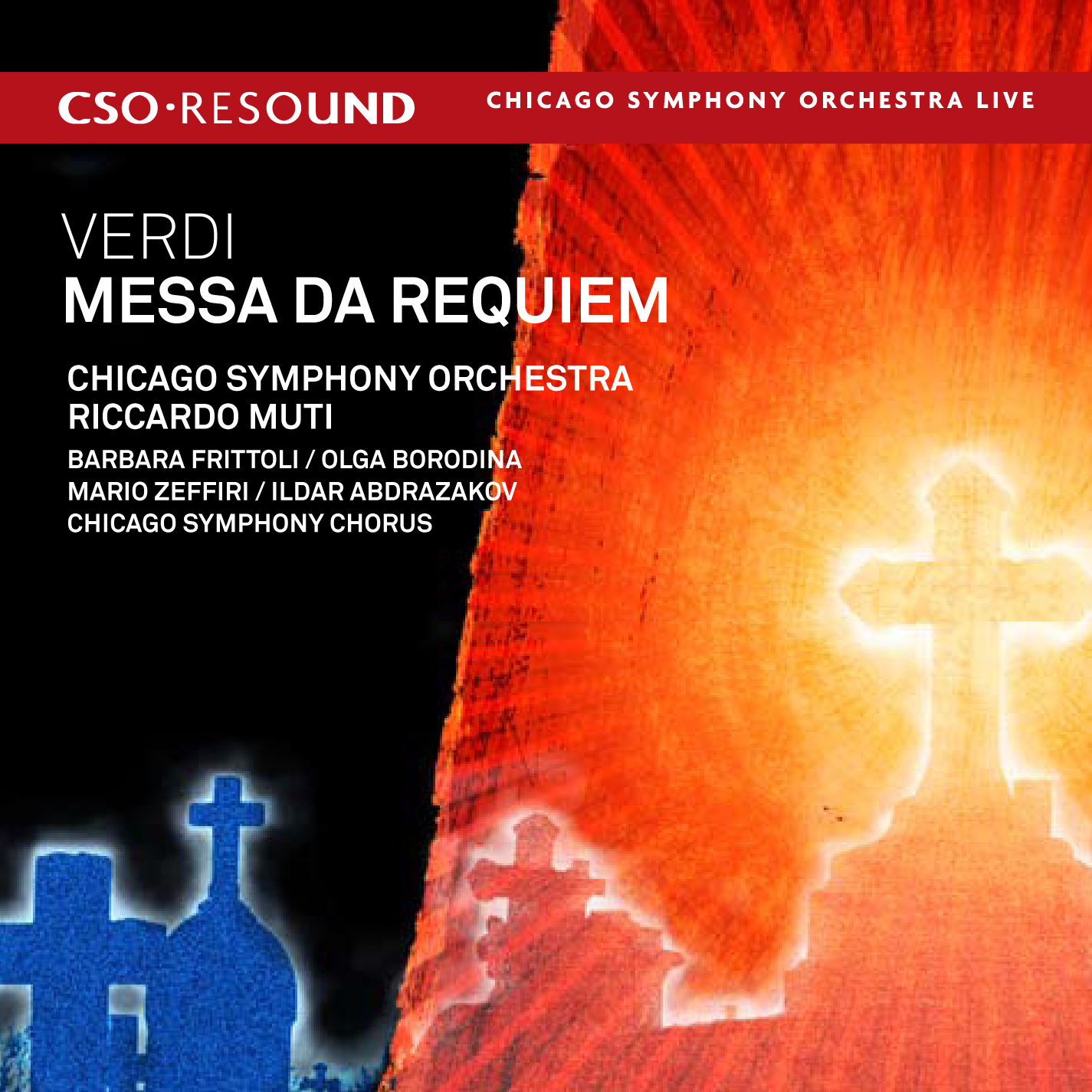
In January of last year, the Chicago Symphony Orchestra and Chorus recorded 3 live performances of Verdi’s Messa da Requiem
under the baton of Riccardo Muti. These performances were then brought together in CD form and recently released on the CSO RESOUND label. Having sung the work a few times and fallen in love with it, I thought it was time to break out the critic hat and get to listening.
Finally! A review.
My very first, knee jerk reaction: the Chicago Symphony Chorus is remarkable. From the first permeating Requiem, they communicate each word with a truly velvety sound through which not only definition, but pathos rings forth. Rich in color, the sopranos don’t sacrifice that color as they climb the scale as many soprano sections tend to do… another recording that I have of an English Choir has the sopranos often with a strident straight toned sound that would most likely peel the paint from the walls.
The bass section of this CSO recording truly anchors the overall sound with a darkness and weight that doesn’t drag the group down. The overall singing from all sections is healthy, vibrant and the voices are balanced. By balanced, I don’t mean between sections… that would be what some consider "blending"… which, to me, is something you do with a cocktail - not a group of voices. What I mean is the singer’s voices are balanced individually and within each section giving the sections a commonality of tone.
Their precise use of consonants is extremely effective and not only gives life to the text, but also adds many effects that are present in the music. For example, in the Sanctus portion of the mass, the sibilance is so crisp that it creates almost a percussiveness that brings to mind a distant high-hat.
And then, there’s the Dies Irae. For me, Verdi’s Dies Irae is the portion of the piece that separates the professionals from the amateurs.
The Chicago Symphony Orchestra plays spectacularly under the baton of Riccardo Muti [R.] and, again, the detail is to the letter. There is nothing left out. You know, occasionally on these types of recordings (yes, even those from well-known orchestras) you can get a sense of which portions of the piece went under-rehearsed. In this instance, there isn’t that sense – at. all.
Now, before I get to the soloists - I feel the sudden need to share a story.
Back when yours truly was a rookie singer – I think I was in my second year of lessons or something like that – I committed what seemed to be a cardinal sin. I had listened to a recording of a Beethoven’s 9th Symphony and felt that a vocal pedagogy class with my former voice teacher would be a safe place to discuss what I heard.
I know. Why not? Right?
In discussing my observations, I made some rather pointed but relatively harmless comments about a certain "Soprano X". Well, my former voice teacher flipped her lid and wanted me to know that it was NOT ok to talk about any other singers in public. Who did I think I was? "You need to watch every word you say! You never know - ‘Soprano X’ might have a second cousin sitting outside. What if she goes and tells ‘Soprano X’ what you said … the next thing you know, you’re blacklisted from companies. You’ll never be a singer THAT way."
No ... honestly, Friends. I'm not exaggerating.
Even though we all thought this former voice teacher was on the verge of being elected Mayor of Crazytown – I understood her point. A young singer can't really afford to offend anyone by shooting off his mouth about other singers.
Now here I am, years later, and I still find it difficult to speak critically about singers in public. But, for your sake, Chickpeas … I will put aside my fear and carry on.
First off, there is Olga Borodina. These mezzo soprano solos are some of the best singing I’ve heard from her. She gives a very stirring, almost haunting performance and adds just the right amount of thunder to the middle of this quartet. If I were to have one small issue with her performance on this recording, it would be her overly used straight tone. It reminds me of a certain soprano that is known for using straight tone to scoop from note to note. Truly though, Ms. Borodina’s voice is so creamy and lovely, you can easily forgive the issue.
Mario Zeffiri provides a capable tenor. His voice is pleasant enough to the ear, but his upper register lacks the power that you might assume would be necessary when he’s smack dab in the middle of the other voices. His bio boasts that he is an "esteemed interpreter of bel canto repertory" like Don Pasquale, and La fille du régiment - I would much rather listen to him in these works, or perhaps Mozart. But, Verdi … it’s not a good fit for him.
Now, Chiclets – anyone who knows me, knows that I’m big fan of vast, broad and voluminous vibrato. Vast is luscious. Broad is luxurious. Voluminous is savory. But, there is taking the vastness TOO FAR – as in having vibrato that is so boundless, wide and cavernous that you could drive a truck through the oscillations. Soprano Barbara Frittoli allows hers to get to this point in many instances – especially in soft pianissimo singing when her vocal oscillations border on wobble-issimo.
There are many voices out in the world that simply don’t record well. Generally, they are the voices with, shall we say, luxurious vibrati – like Ghena Dimitrova, for example. Her voice was gigantic and had a massive vibrato that sped to the speed of a Porsche at the top of her range. Bless her heart, I actually think that someone replaced Dimitrova’s voice with an air-raid siren without telling her. That being said, it is a well known fact that Dimitrova's voice just didn’t record well. But it sure was a head-splitting thrill in-person. Perhaps Frittoli’s voice is like this. In this case though, I think the unrestrained and burly undulations suck the life out of the music at times.
As for bass Ildar Abdrazakov … I can’t deal, Friendlies. I. Just. Can't. In fact, I’m damn-near speechless where this particular performance is concerned. Mr. Abdrazakov (who happens to be Ms. Borodina's husband) brings to this recording a full-bodied, dark, commanding sound that is present in a very noble and splendid manner. His voice has enough growl to give it depth, but also has the capability to be very shiny and shimmery as well. From a musicality standpoint, his performance has a wonderfully committed, yet subtle quality to it that we don’t see from many of the barking basses currently gracing the operatic and concert stages.
Let it be said: these sort of true Verdian, full-throated, heart-stirring, meticulously precise recordings don’t come along very often. I highly recommend it - even with the minimal imperfections from certain soloists. So, don’t let it pass by without snagging a Messa da Requiem
for your own collection. You wont be sorry.
From October 17, 2010:
In January of last year, the Chicago Symphony Orchestra and Chorus recorded 3 live performances of Verdi’s Messa da RequiemFinally! A review.
My very first, knee jerk reaction: the Chicago Symphony Chorus is remarkable. From the first permeating Requiem, they communicate each word with a truly velvety sound through which not only definition, but pathos rings forth. Rich in color, the sopranos don’t sacrifice that color as they climb the scale as many soprano sections tend to do… another recording that I have of an English Choir has the sopranos often with a strident straight toned sound that would most likely peel the paint from the walls.
The bass section of this CSO recording truly anchors the overall sound with a darkness and weight that doesn’t drag the group down. The overall singing from all sections is healthy, vibrant and the voices are balanced. By balanced, I don’t mean between sections… that would be what some consider "blending"… which, to me, is something you do with a cocktail - not a group of voices. What I mean is the singer’s voices are balanced individually and within each section giving the sections a commonality of tone.
Their precise use of consonants is extremely effective and not only gives life to the text, but also adds many effects that are present in the music. For example, in the Sanctus portion of the mass, the sibilance is so crisp that it creates almost a percussiveness that brings to mind a distant high-hat.
And then, there’s the Dies Irae. For me, Verdi’s Dies Irae is the portion of the piece that separates the professionals from the amateurs.
Quantus tremor est futures, quando judex est venturus, cuncta stricte discussurus!They sing this phrase with such a hushed, yet marked intensity that it is - simply put - heart-stirring. Every sound from this chorus is there - spot on and together with ultimate precision.
What horror must invade the mind when the approaching judge shall find and sift the deeds of all mankind!
The Chicago Symphony Orchestra plays spectacularly under the baton of Riccardo Muti [R.] and, again, the detail is to the letter. There is nothing left out. You know, occasionally on these types of recordings (yes, even those from well-known orchestras) you can get a sense of which portions of the piece went under-rehearsed. In this instance, there isn’t that sense – at. all.Now, before I get to the soloists - I feel the sudden need to share a story.
Back when yours truly was a rookie singer – I think I was in my second year of lessons or something like that – I committed what seemed to be a cardinal sin. I had listened to a recording of a Beethoven’s 9th Symphony and felt that a vocal pedagogy class with my former voice teacher would be a safe place to discuss what I heard.
I know. Why not? Right?
In discussing my observations, I made some rather pointed but relatively harmless comments about a certain "Soprano X". Well, my former voice teacher flipped her lid and wanted me to know that it was NOT ok to talk about any other singers in public. Who did I think I was? "You need to watch every word you say! You never know - ‘Soprano X’ might have a second cousin sitting outside. What if she goes and tells ‘Soprano X’ what you said … the next thing you know, you’re blacklisted from companies. You’ll never be a singer THAT way."
No ... honestly, Friends. I'm not exaggerating.
Even though we all thought this former voice teacher was on the verge of being elected Mayor of Crazytown – I understood her point. A young singer can't really afford to offend anyone by shooting off his mouth about other singers.
Now here I am, years later, and I still find it difficult to speak critically about singers in public. But, for your sake, Chickpeas … I will put aside my fear and carry on.
First off, there is Olga Borodina. These mezzo soprano solos are some of the best singing I’ve heard from her. She gives a very stirring, almost haunting performance and adds just the right amount of thunder to the middle of this quartet. If I were to have one small issue with her performance on this recording, it would be her overly used straight tone. It reminds me of a certain soprano that is known for using straight tone to scoop from note to note. Truly though, Ms. Borodina’s voice is so creamy and lovely, you can easily forgive the issue.
Mario Zeffiri provides a capable tenor. His voice is pleasant enough to the ear, but his upper register lacks the power that you might assume would be necessary when he’s smack dab in the middle of the other voices. His bio boasts that he is an "esteemed interpreter of bel canto repertory" like Don Pasquale, and La fille du régiment - I would much rather listen to him in these works, or perhaps Mozart. But, Verdi … it’s not a good fit for him.
Now, Chiclets – anyone who knows me, knows that I’m big fan of vast, broad and voluminous vibrato. Vast is luscious. Broad is luxurious. Voluminous is savory. But, there is taking the vastness TOO FAR – as in having vibrato that is so boundless, wide and cavernous that you could drive a truck through the oscillations. Soprano Barbara Frittoli allows hers to get to this point in many instances – especially in soft pianissimo singing when her vocal oscillations border on wobble-issimo.
There are many voices out in the world that simply don’t record well. Generally, they are the voices with, shall we say, luxurious vibrati – like Ghena Dimitrova, for example. Her voice was gigantic and had a massive vibrato that sped to the speed of a Porsche at the top of her range. Bless her heart, I actually think that someone replaced Dimitrova’s voice with an air-raid siren without telling her. That being said, it is a well known fact that Dimitrova's voice just didn’t record well. But it sure was a head-splitting thrill in-person. Perhaps Frittoli’s voice is like this. In this case though, I think the unrestrained and burly undulations suck the life out of the music at times.
As for bass Ildar Abdrazakov … I can’t deal, Friendlies. I. Just. Can't. In fact, I’m damn-near speechless where this particular performance is concerned. Mr. Abdrazakov (who happens to be Ms. Borodina's husband) brings to this recording a full-bodied, dark, commanding sound that is present in a very noble and splendid manner. His voice has enough growl to give it depth, but also has the capability to be very shiny and shimmery as well. From a musicality standpoint, his performance has a wonderfully committed, yet subtle quality to it that we don’t see from many of the barking basses currently gracing the operatic and concert stages.
Let it be said: these sort of true Verdian, full-throated, heart-stirring, meticulously precise recordings don’t come along very often. I highly recommend it - even with the minimal imperfections from certain soloists. So, don’t let it pass by without snagging a Messa da Requiem
Friday, February 11, 2011
A Friday Finale - Opera de Monte Carlo
Another week has gone by Ladies and Gents. To kick off the weekend, here is some visual loveliness - the Opera de Monte Carlo in Monaco. All of this golden splendor was photographed by David Leventi. Enjoy - and have a great weekend!
Friday, February 4, 2011
The Diva's Future.
Zachary Woolfe has written an eye-opening article for the New York Observer on mezzo soprano Susan Graham. It begins:
Woolfe continues to dive deeper:
I am saying that as opera continues to become more visual with focus placed on how someone looks rather than the sound of their voice ... never mind ... I'll leave the rest up to you to figure out.
As for Ms. Graham's future?
Susan Graham doesn't want to be your friend.Ah, yes. The obsessive adoption of social media. You're either on board the Social Media Express -- or: I'm sorry, what was your name again?
"Everyone asks me, 'Are you on Facebook? Do you have a thousand friends?'" the eminent mezzo-soprano said recently in her apartment near Lincoln Center. "I do not. I'm not interested in being friends with people I don't know in real life. I've gotten criticism for it. I got a comment on my Web site, someone saying, 'You're so ungrateful.' But I'm not your friend; I'm an artist. I'm grateful for your support, but just because you came to see me sing does not give you a window into my private life." ...
... She is precisely the kind of warm, engaging, mom-next-door presence that opera loves these days, but she doesn't always follow the script. Ms. Graham doesn't write a blog, and while her publicists set her up on Twitter, she often forgets she has it. This is, needless to say, far from the party line circa 2011 in the opera world, which tends to pin its hopes for continued relevance on the obsessive adoption of social media.
Woolfe continues to dive deeper:
She rose in a generation filled with mezzos-from Anne Sofie von Otter to Cecilia Bartoli to the late, great Lorraine Hunt Lieberson-but there seemed to be room for everyone.As you already know, Chickpeas - I tend to agree. How long will it be before there's a conversation in some office at the Met like the one that follows (if it hasn't happened already)?
It was in certain ways, despite the competition, an easier time. Appearance is far more important now, as Ms. Graham, who has starred in and regularly hosts the Met's HD broadcasts, knows as well as anyone.
"This generation of singers coming up is being groomed for the television cameras," she said. "We weren't. We are now. Look at Renée [Fleming]. She's undergone a physical transformation over the past 10 years. I lost 30 pounds last year. But still, you're not 25, and the camera's in your face and it's in HD. It's turning our audiences into people who become more obsessed with the literal. They're less likely to suspend their disbelief, to accept someone who doesn't look like the part. I mean, witness the whole Debbie Voigt thing a couple of years ago. When Ariadne has to fit the dress, what is that?"
L.B. Mayer: Joan, my Joan, you're in a position to do me a favor that will be as big a favor for you as it is for me.Now, before you all flip your lids about this - I'm not comparing Susan Graham to Joan Crawford. I mean - come on...
Joan Crawford: You don't have to ask! You only have to tell me.
L.B. Mayer: Good. I want you to leave Metro.
Joan Crawford: Leave Metro? Leave Metro?
L.B. Mayer: Your pictures one after another are losing money. Theater owners voted you "box office poison". Still for years I've paid no attention. You know me, Joan. I don't give up so easily. We'll pay you off on your contract. But you can't afford to make three or four more losers for us.
Joan Crawford: It's the scripts, L.B. Bad pictures, bad directors...
L.B. Mayer: Bad with you, good with others.
Joan Crawford: No, listen to me L.B., I have been BEGGING YOU... begging you for a good script. Now you've always given me my share of bad movies because you knew I'd make them work. Well I can't keep doing it, L.B.!
L.B. Mayer: Listen with your ears and not with your pride. With me, feeling is more important than money. You're a great star! You're Hollywood royalty! But styles change. You'll leave. We have 'creative differences'. Other studios will think they're smarter than L.B., they'll try to finesse me. You'll be offered two, three, four films. You may even get a hit!
Joan Crawford: Will you be sorry then?
L.B. Mayer: I'm sorry now. But here there's no feeling, no hope. New faces, new voices, breath of fresh air, who knows. Don't do this to yourself.
Joan Crawford: I'll have my maid and studio people clear out my bungalow. I've got a lot of years to collect.
L.B. Mayer: It's done, Joan. They've packed your things, they're loading your car.
Joan Crawford: You mean everybody already knows?
L.B. Mayer: That we parted friends because we didn't agree.
Joan Crawford: Will you walk me to my car? [L.B. doesn't answer]
Joan Crawford: "Hollywood royalty". [walks out alone]
I am saying that as opera continues to become more visual with focus placed on how someone looks rather than the sound of their voice ... never mind ... I'll leave the rest up to you to figure out.
As for Ms. Graham's future?
"I'm terrified," she said, tearing up as she spoke about her future, a vintage Chérubin poster hanging above the dining table. "I'm scared to death about what's going to happen when I don't have singing anymore. I'm not scared about how I'll survive; I'm just scared of where my head will be because I love what I do so much."There's more Susan Graham where this came from - hop on over to the New York Observer and check it out.
Wednesday, February 2, 2011
Happy Birthday to: Renata Tebaldi
I missed one yesterday. And if I let it go by, I will have hell to pay from many of you.
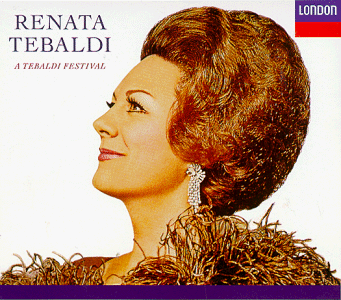
Born on February 1st in 1922 ... the Patron Saint of Cotton Candy Hair, Renata Tebaldi. You laugh, I know. But check out that head of puffiness!
Tebaldi primarily focused on the verismo roles of the lyric and dramatic repertoires. Many acclaim her to be the most beloved opera singers of all time - and they, of course, are not Maria Callas fans.
After debuting at the Met as Desdemona in 1955, Tebaldi continued to sing there quite often ... making it her operatic home. According to many fans, she developed a special relationship with the Met audiences and quickly became known as "Miss Sold Out". She sang there some 270 times making her final appearance there, again as Desdemona, on January 8, 1973.
Happy Birthday, La Tebaldi!
Subscribe to:
Posts (Atom)